
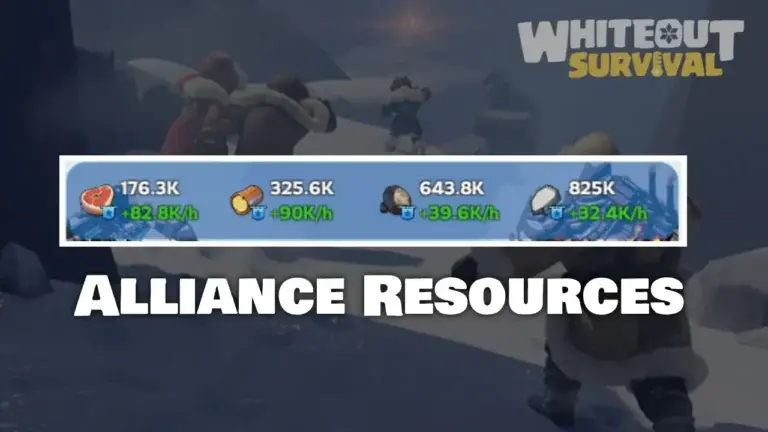
Learning how to get alliance resources in Whiteout Survival is essential for any alliance that wants to expand its territory, construct banners, develop Alliance Tech, and reach valuable locations on the world map.
Unlike the resources stored in an individual city, alliance resources belong to the alliance as a whole. Your alliance primarily earns them by extending connected territory over special Alliance Farms.
This guide explains how Alliance Farms work, how to secure meat, wood, coal, and iron, and how alliance leaders can plan an efficient banner network without wasting valuable territory resources.
What Are Whiteout Survival Alliance Resources?
Alliance resources are materials held and used at the alliance level. They are separate from the meat, wood, coal, and iron stored in each member’s city.
An alliance needs these resources for several important activities, including:
- Constructing additional Alliance Banners.
- Building or developing alliance structures.
- Completing resource-dependent Alliance Tech.
- Expanding toward facilities, strongholds, and strategic areas.
- Maintaining a sustainable territory network.
| Alliance Resource | Territory Source | Why It Matters |
|---|---|---|
| Meat | Alliance Animal Farm | Supports early expansion, technology, and building costs. |
| Wood | Alliance Woodmill | Frequently needed for banners and early alliance development. |
| Coal | Alliance Coal Mine | Becomes increasingly important as alliance technology advances. |
| Iron | Alliance Iron Mine | Required for later expansion and more advanced development. |
How to Get Alliance Resources in Whiteout Survival
Alliance resources are mainly obtained by placing connected Alliance Banners so that your territory covers Alliance Farms on the world map. Once a farm is properly controlled, it contributes its corresponding resource to the alliance.
- Open the world map.Switch from your city to the World view and zoom out until territory, facilities, and resource markers become easier to see.
- Use the map’s resource view.Activate the relevant resource or territory display when available. Interface labels can differ slightly by language and game version.
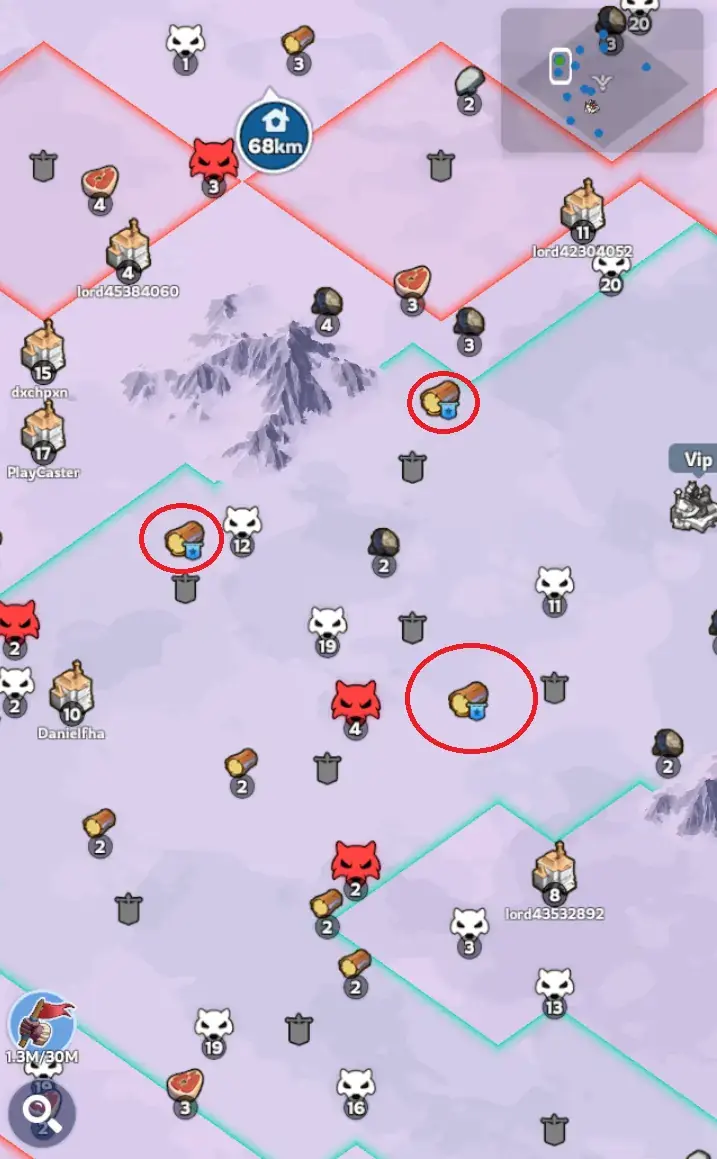
- Identify an Alliance Farm.Look for the special alliance resource icons, which are commonly shown with a blue banner-style marker. Do not confuse them with ordinary gathering nodes.
- Plan a connected territory route.The new banner should extend from territory connected to an Alliance Headquarters or an existing active banner chain.
- Have an R4 or R5 place the banner.Members with the appropriate alliance rank select the exact banner location.
- Send members to construct it.Alliance members can help complete the banner after it has been placed. Faster construction reduces the time during which the expansion route remains vulnerable.
- Confirm that the farm is covered.The resulting territory must cover enough of the Alliance Farm for it to become active.
- Check the alliance resource income.After construction, confirm that the farm is controlled and that the expected resource income appears in the Alliance Territory interface.
How Alliance Farm Coverage Works
An Alliance Farm occupies a two-by-two area, giving it four map tiles. Your alliance territory generally needs to cover at least three of those four tiles, or 75% of the farm, for it to produce resources.
The banner itself does not need to sit directly in the center of the farm. What matters is the territory created by the banner and how much of the farm falls inside that territory.
Alliance Farms Do Not Work Like Normal Resource Nodes
Ordinary gathering nodes have levels that determine how many personal resources they contain. Alliance Farms are territory objectives rather than normal gathering locations, so you do not send a gathering march to collect from them.
Once an Alliance Farm is controlled, its production contributes to the alliance’s resource system while that control remains active.
Connected Territory Is Essential
A banner network should remain connected to the active Alliance Headquarters. If an HQ is relocated or an important connecting banner is removed, part of the territory chain can become disconnected.
Disconnected banners may eventually expire. Removing or losing banners can also return only a small portion of the resources spent on construction. Therefore, leaders should review the entire route before relocating an HQ or dismantling a central banner.
How to Get Alliance Wood in Whiteout Survival
To get alliance wood, your territory must control an Alliance Woodmill. Find one on the world map and extend a connected banner route until at least three of its four tiles are inside your territory.
Wood is commonly needed during early alliance expansion. An alliance that expands too quickly without securing enough Woodmills may struggle to afford additional banners and technology.
For a new alliance, prioritize Woodmills that can be reached with a short, efficient banner route. A nearby farm that requires one or two banners is usually more sustainable than a distant farm that requires a long chain.
How to Get Alliance Meat in Whiteout Survival
Alliance meat comes from an Alliance Animal Farm. The claiming process is the same: connect your territory to the farm and cover enough of its two-by-two area.
Meat and wood often support the earliest stages of alliance development. However, the ideal balance depends on your current technology, banner costs, existing resource income, and planned expansion route.
Instead of claiming every nearby Animal Farm, compare your hourly production with upcoming alliance expenses. This prevents your alliance from creating a large surplus of one resource while lacking another.
How to Get Alliance Coal in Whiteout Survival
Alliance coal is produced by an Alliance Coal Mine controlled by your territory. Coal demand usually becomes more noticeable as your alliance progresses into technologies and construction projects with broader resource requirements.
If coal production is falling behind, leaders should check whether an existing banner route can cover a nearby Coal Mine without creating a major detour. It may be more efficient to widen current territory than to build a separate chain.
How to Get Alliance Iron in Whiteout Survival
To get alliance iron, your territory must claim an Alliance Iron Mine. Iron can be more difficult for an early alliance to obtain because suitable mines may be located farther from its starting territory.
Alliance Iron Mines are commonly encountered as alliances expand toward more advanced map areas, including the Tundra. The exact locations and the timing of access can vary by state progression and territory layout.
If your alliance cannot currently reach an Iron Mine, consider these options:
- Prepare a gradual banner route toward a reachable Iron Mine.
- Coordinate future Tundra Headquarters placement around iron access.
- Reserve resources before starting a long expansion chain.
- Use the Alliance Resource Exchange after it becomes available.
- Negotiate territory boundaries with nearby alliances when appropriate.
How the Alliance Resource Exchange Works
The Alliance Resource Exchange allows an alliance to convert one alliance resource into another. It becomes available later in a state’s development and can help when the alliance has a large surplus of one material but lacks another.
For example, an alliance that has abundant meat and wood but no access to an Iron Mine may be able to exchange part of its surplus for iron.
However, exchanges are not always equal. Conversion rates may make some trades expensive, and the feature may apply daily limits. Ratios, limits, and unlock timing can also change between game versions.
Best Alliance Resource Strategy for New Alliances
A new alliance should focus on creating a compact and sustainable territory before attempting a long expansion across the state.
- Secure nearby meat and wood income. These resources help support early banner construction and technology.
- Avoid unnecessary branches. Every side route increases costs and creates another connection that may need protection.
- Mark future farms in advance. R4 and R5 members can use map markers to communicate the planned route.
- Build one route at a time. Completing a useful chain is better than leaving several unfinished paths.
- Monitor resource income. Compare current production with banner and technology costs before approving the next expansion.
- Develop Tactical Expansion. This Alliance Tech increases the alliance’s ability to build additional banners.
Advanced Alliance Territory Planning
Established alliances should evaluate farms as part of a wider territory plan. A resource node may be valuable, but its route should also support access to future facilities, Tundra positions, or contested objectives.
Prioritize Efficient Banner Routes
Use the fewest reasonable banners to reach each objective. Diagonal or poorly aligned placement can create gaps, waste territory coverage, and increase the cost of later expansion.
Protect Important Connection Points
A single central banner may connect an entire branch of farms and facilities. If that banner is removed, the rest of the route can become disconnected.
Place critical connections where they are easier to reinforce, and avoid building fragile one-tile corridors near hostile territory unless the strategic reward justifies the risk.
Plan Headquarters Placement Carefully
An Alliance Headquarters should support both current income and future expansion. Before relocating it, identify which banners will remain connected and which territory branches may be lost.
Leaders should also review nearby resource farms and future strategic objectives before committing alliance resources to the move.
Balance Production Instead of Chasing Every Farm
The best resource mix is not identical for every alliance. Review current stockpiles, hourly production, technology requirements, and upcoming banner costs.
If one resource is accumulating much faster than it is being spent, the alliance may benefit more from securing a different farm type or using the Resource Exchange.
| Common Problem | Likely Cause | Recommended Fix |
|---|---|---|
| Alliance cannot afford new banners | Expansion is faster than resource income | Pause expansion and secure nearby farms. |
| Farm is inside the banner area but inactive | Less than 75% of the farm is covered | Recheck the four farm tiles and adjust placement. |
| Alliance has no iron income | No controlled Iron Mine is connected | Plan a Tundra route or use the Resource Exchange. |
| Territory branch becomes inactive | A connecting banner or HQ link was removed | Restore the connection before banners expire. |
| One resource has a large surplus | Farm distribution does not match current spending | Claim a different farm type or evaluate an exchange. |
How Alliance Members Can Help
R4 and R5 members usually handle banner placement, but every active member can help the alliance maintain a healthy resource network.
- Contribute to Alliance Tech: Use the Alliance Tech contribution screen regularly to support alliance development.
- Help build banners: Send a march when leaders announce a new construction project.
- Follow territory markers: Avoid requesting random branches that conflict with the planned route.
- Scout nearby farms: Report useful Woodmills, Animal Farms, Coal Mines, and Iron Mines to alliance leadership.
- Watch vulnerable routes: Inform leaders when rival territory approaches an important connection.
- Support diplomacy: Respect agreed territory boundaries and state rules.
Common Alliance Resource Mistakes
Confusing Personal Resources with Alliance Resources
Gathering from an ordinary Sawmill, Hunting Ground, Coal Mine, or Abandoned Smelter increases your personal inventory. It does not claim an Alliance Farm or directly supply the alliance territory balance.
Covering Too Little of the Farm
A banner may touch an Alliance Farm without claiming it. Confirm that at least three of the four farm tiles are inside your alliance territory.
Building a Long Route Without a Resource Budget
Leaders should estimate the full route rather than looking only at the next banner. Otherwise, the alliance may run out of resources before reaching the intended farm.
Removing a Central Banner Too Early
Demolishing a connecting banner can disconnect every banner beyond it. Review the territory chain and the demolition preview before removing anything.
Relocating the Headquarters Without Reviewing Connections
An HQ move can change which banners remain active. Mark essential farms and facilities before confirming the relocation.
Assuming Exchange Rates Never Change
Resource Exchange ratios, limits, and unlock conditions may be adjusted. Always use the values shown in the current in-game panel.
FAQs
How do you get alliance resources in Whiteout Survival?
Your alliance gets resources by extending connected banner territory over Alliance Farms. The territory generally needs to cover at least three of the farm’s four tiles before it begins contributing resources.
How do you get alliance wood in Whiteout Survival?
Find an Alliance Woodmill and place a connected banner so that your territory covers at least 75% of it. Once controlled, the Woodmill contributes wood to the alliance.
How do you get alliance iron in Whiteout Survival?
Claim an Alliance Iron Mine with connected territory. If no mine is currently reachable, prepare a route toward the Tundra or use the Alliance Resource Exchange after the feature becomes available.
Can members donate personal resources directly to the alliance?
Members cannot make an unrestricted transfer from their city inventory into the alliance territory balance. They can support the alliance by contributing through Alliance Tech and helping construct territory buildings.
Why is an Alliance Farm not producing resources?
The farm may not have enough tiles inside your territory, the banner route may be disconnected, or another alliance may control the location. Check the territory display and confirm that at least three of the four tiles are covered.
Who can place Alliance Banners?
Alliance members with R4 or R5 authority can normally place banners. Other members can then send marches to help complete construction.
Develop the relevant Tactical Expansion technologies in the Territory section of Alliance Tech. The exact banner capacity depends on the alliance’s current technology progress.
A disconnected banner may remain temporarily but can expire if its connection is not restored. Because only part of the construction cost may be recovered, leaders should reconnect the route quickly or review the in-game removal preview.
Conclusion
Understanding how to get alliance resources in Whiteout Survival begins with one core mechanic: your alliance must use connected banner territory to control Alliance Farms.
Cover at least three of each farm’s four tiles, maintain the connection to your Headquarters, and balance meat, wood, coal, and iron production around your alliance’s actual expansion and technology needs.
The strongest strategy is to build compact routes, secure sustainable income before expanding farther, and avoid spending resources on isolated farms that do not support a wider territory plan.
For more territory advice, alliance management strategies, and progression tips, explore our collection of Whiteout Survival guides.