
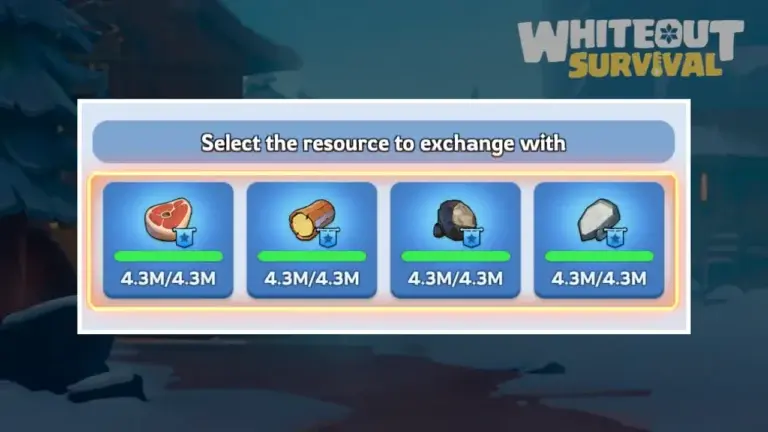
The Whiteout Survival Resource Exchange allows an alliance to convert one type of alliance resource into another. It is especially useful when your alliance has accumulated too much Meat or Wood but urgently needs Coal or Iron for territory development.
However, the exchange should not be treated as your alliance’s main source of resources. Its daily limit and conversion ratios make it better suited to correcting temporary shortages than replacing well-planned territory expansion.
This guide explains when the Alliance Resource Exchange unlocks, where to find it, how its rates work, and how alliance leaders can use it without wasting valuable reserves.
What Is the Whiteout Survival Resource Exchange?
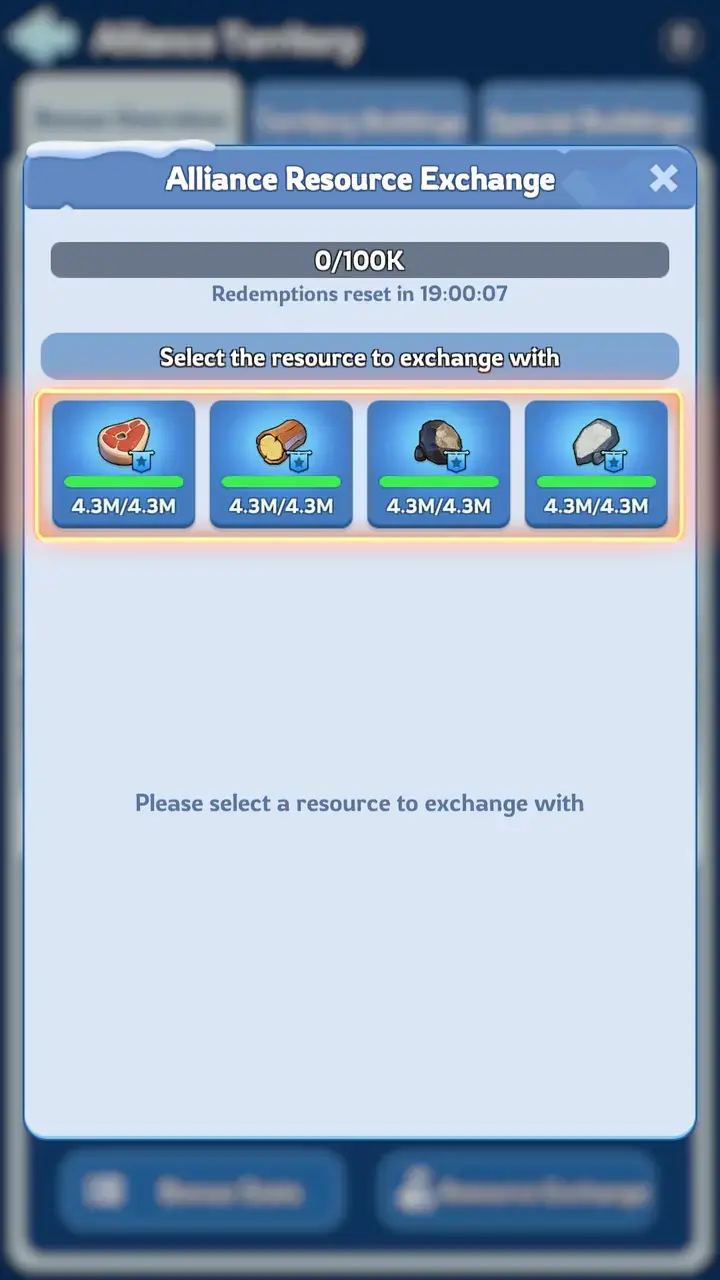
The Resource Exchange is an alliance feature that converts resources held in the alliance’s shared storage. It supports the four main alliance resources:
- Meat
- Wood
- Coal
- Iron
These are different from the resources stored in your individual city. Your personal Meat, Wood, Coal, and Iron cannot be placed directly into the exchange.
Alliance resources are primarily generated by controlling Alliance Farms within your territory. Once a farm is successfully covered by alliance territory, it contributes resources automatically over time.
When Does the Alliance Resource Exchange Unlock?
The Alliance Resource Exchange normally becomes available when a state reaches approximately 45 days of age.
This requirement is based on the age of the state rather than your Furnace level, personal account age, or alliance level. Therefore, a developed alliance in a newer state may still need to wait for the feature to appear.
If your state has recently passed the expected milestone and the exchange is still missing, check the following:
- Confirm that you are checking the age of the state rather than the age of your account.
- Restart the game to refresh newly unlocked features.
- Install any available game update.
- Ask an R4 or R5 member to check the Alliance Territory interface.
- Check the live interface because unlock timing can vary following game updates or state rollout changes.
How to Access the Alliance Resource Exchange
After the feature has unlocked in your state, follow these steps:
- Tap Alliance near the bottom-right corner of the game screen.
- Select Territory from the Alliance menu.
- Find the Resource Exchange option near the bottom of the Territory screen.
- Select the resource your alliance wants to spend.
- Select the resource your alliance needs to receive.
- Review the conversion amount and remaining daily allowance before confirming.
Whiteout Survival Resource Exchange Rates
The exchange uses different ratios depending on which resource is being spent and which resource is being received. In the table below, the ratio is shown as resources spent to resources received.
| Resource Spent | Resource Received | Exchange Ratio | Example |
|---|---|---|---|
| Meat | Wood | 2:1 | 10,000 Meat becomes 5,000 Wood |
| Meat | Coal | 4:1 | 10,000 Meat becomes 2,500 Coal |
| Meat | Iron | 8:1 | 8,000 Meat becomes 1,000 Iron |
| Wood | Meat | 2:1 | 10,000 Wood becomes 5,000 Meat |
| Wood | Coal | 4:1 | 10,000 Wood becomes 2,500 Coal |
| Wood | Iron | 8:1 | 8,000 Wood becomes 1,000 Iron |
| Coal | Meat | 1:1 | 10,000 Coal becomes 10,000 Meat |
| Coal | Wood | 1:1 | 10,000 Coal becomes 10,000 Wood |
| Coal | Iron | 4:1 | 4,000 Coal becomes 1,000 Iron |
| Iron | Meat | 1:2 | 5,000 Iron becomes 10,000 Meat |
| Iron | Wood | 1:2 | 5,000 Iron becomes 10,000 Wood |
| Iron | Coal | 1:1 | 5,000 Iron becomes 5,000 Coal |
The documented ratios are set according to the relative value of each resource. Wood and Meat require the largest quantities, while Iron generally appears in smaller amounts.
Do not assume that the rates regularly fluctuate or become better during events. Check the live exchange screen before confirming, but plan around the standard ratios unless the game explicitly displays a temporary change.
What Is the Daily Resource Exchange Limit?
Current game documentation lists a daily exchange allowance of 100,000 resources. The Resource Exchange screen should display how much of the allowance remains before the daily reset.
This limit prevents an alliance from instantly converting a large stockpile into whichever resource it needs. As a result, alliances should address shortages early instead of waiting until a construction or research deadline.
When Should Your Alliance Use the Resource Exchange?
The best time to use the exchange is when a small shortage is blocking a valuable alliance action. Common examples include:
- Completing an important Alliance Technology requirement.
- Building banners toward a facility or resource farm.
- Preparing resources for an alliance building.
- Correcting an imbalance caused by poor farm distribution.
- Obtaining a limited amount of Iron before the alliance has reliable access to Iron Farms.
For example, suppose your alliance has enough Meat, Wood, and Coal for its next objective but lacks 5,000 Iron. Converting the exact amount required may be worthwhile because it allows the project to begin immediately.
By contrast, converting resources simply because one stockpile looks large can create a new shortage later.
Best Whiteout Survival Resource Exchange Strategy
1. Identify the exact resource requirement
Check the cost of the planned technology, banner, building, or territory action. Avoid exchanging based on estimates when the exact requirement is visible in the game.
2. Review current stock and hourly production
Compare the alliance’s stored resources with its passive hourly income. A shortage that will disappear naturally within a few hours may not justify using the daily exchange allowance.
3. Protect resources needed for territory expansion
Alliance resources support more than research. Banners and territory projects also require reserves. Spending heavily on one objective can prevent the alliance from reacting to a new facility opportunity or territory dispute.
4. Preserve Iron unless it is genuinely surplus
Iron is often difficult for developing alliances to produce consistently, particularly before they secure suitable territory. Converting Iron into Meat or Wood may solve a short-term problem, but it can delay more valuable projects later.
5. Exchange only enough to clear the bottleneck
Partial conversions are usually safer than using the entire allowance at once. Calculate the missing amount and stop when the planned requirement is covered.
6. Correct the territory problem afterward
If your alliance repeatedly converts the same resource, the real problem is probably its territory layout. Expand toward the appropriate Alliance Farms instead of relying permanently on the exchange.
How to Improve Alliance Resource Production
The Resource Exchange manages shortages, but territory planning prevents them. Alliances obtain passive resources by covering Alliance Farms with their territory.
An Alliance Farm occupies a four-tile area. In general, at least three of those four tiles must be covered by alliance territory for the farm to be claimed.
Alliance leaders should regularly review:
- The number and type of farms currently controlled.
- Hourly production of Meat, Wood, Coal, and Iron.
- Upcoming banner and building costs.
- Alliance Technology priorities.
- Whether inactive or poorly positioned banners should be replaced.
Meat and Wood are normally required in larger quantities, while Coal and Iron are needed in smaller but strategically important amounts. The ideal balance depends on your alliance’s current territory, technology progress, and next objectives.
Planning Progression in an Established State
Players joining friends in an older state should compare state age, account progression, and transfer restrictions before making a decision. When evaluating a wos account for sale, review the state number, Furnace level, heroes, Chief Gear, account binding, transfer eligibility, and account security rather than considering power alone.
Common Resource Exchange Mistakes
Confusing alliance resources with personal resources
The Resource Exchange cannot convert resources stored in an individual city. It only works with the alliance’s shared resource stock.
Using the exchange without consulting leadership
An exchange may affect banner construction, technology research, or another planned project. Resource decisions should therefore follow the alliance’s agreed priorities.
Expecting better rates later in the day
The standard exchange table uses established ratios. Waiting for random fluctuations is not a reliable strategy unless the game itself announces and displays a temporary change.
Converting scarce Iron into common resources
Although Iron can be converted into Meat, Wood, or Coal, developing alliances may struggle to replace it. Check future technology and building costs before spending an Iron reserve.
Ignoring the daily allowance
A large conversion early in the day can leave no room to fix a more important shortage later. Use the allowance according to planned alliance objectives.
Relying on the exchange instead of claiming farms
The exchange cannot support unlimited growth. A strong alliance needs territory that produces a balanced supply of all four resources.
FAQs
When does the Whiteout Survival Resource Exchange unlock?
The feature generally unlocks when the state reaches approximately 45 days old. The requirement is linked to state age rather than an individual player’s account age.
Where is the Alliance Resource Exchange located?
Open Alliance, select Territory, and then tap Resource Exchange. The option may not appear in states that have not reached the required age.
Can I exchange my personal city resources?
No. The feature only converts resources held in the alliance’s shared storage. Personal Meat, Wood, Coal, and Iron are separate.
Which resources can an alliance exchange?
The exchange supports Alliance Meat, Alliance Wood, Alliance Coal, and Alliance Iron. Each conversion direction has its own ratio.
What is the Alliance Resource Exchange daily limit?
Current documentation lists a daily exchange allowance of 100,000 resources. Check the in-game panel for the remaining allowance and any future adjustments.
Do Whiteout Survival Resource Exchange rates change?
The documented exchange table uses set ratios. There is no reliable basis for assuming that rates regularly fluctuate or automatically improve during events. Always review the live confirmation screen before exchanging.
Your state may not yet be 45 days old. If it has passed that point, restart the game, check for updates, and ask an alliance leader to verify the Territory menu.
Should an alliance exchange Meat or Wood for Iron?
It can be worthwhile when a small Iron shortage is blocking an important project. However, the 8:1 rate means alliances should first check whether passive Iron production will cover the shortage soon.
Conclusion
The Whiteout Survival Resource Exchange is most effective as a tool for correcting temporary alliance resource shortages. It can keep important research, banner construction, or territory projects moving when one missing resource creates a bottleneck.
Before making an exchange, check the exact project cost, current stockpile, hourly production, and remaining daily allowance. Convert only what the alliance needs instead of spending the entire limit without a clear objective.
For long-term growth, prioritize a balanced territory layout and reliable control of Alliance Farms. Strong passive production will always be more sustainable than repeatedly converting resources.
For more territory planning, alliance management, and progression advice, explore our collection of Whiteout Survival guides.