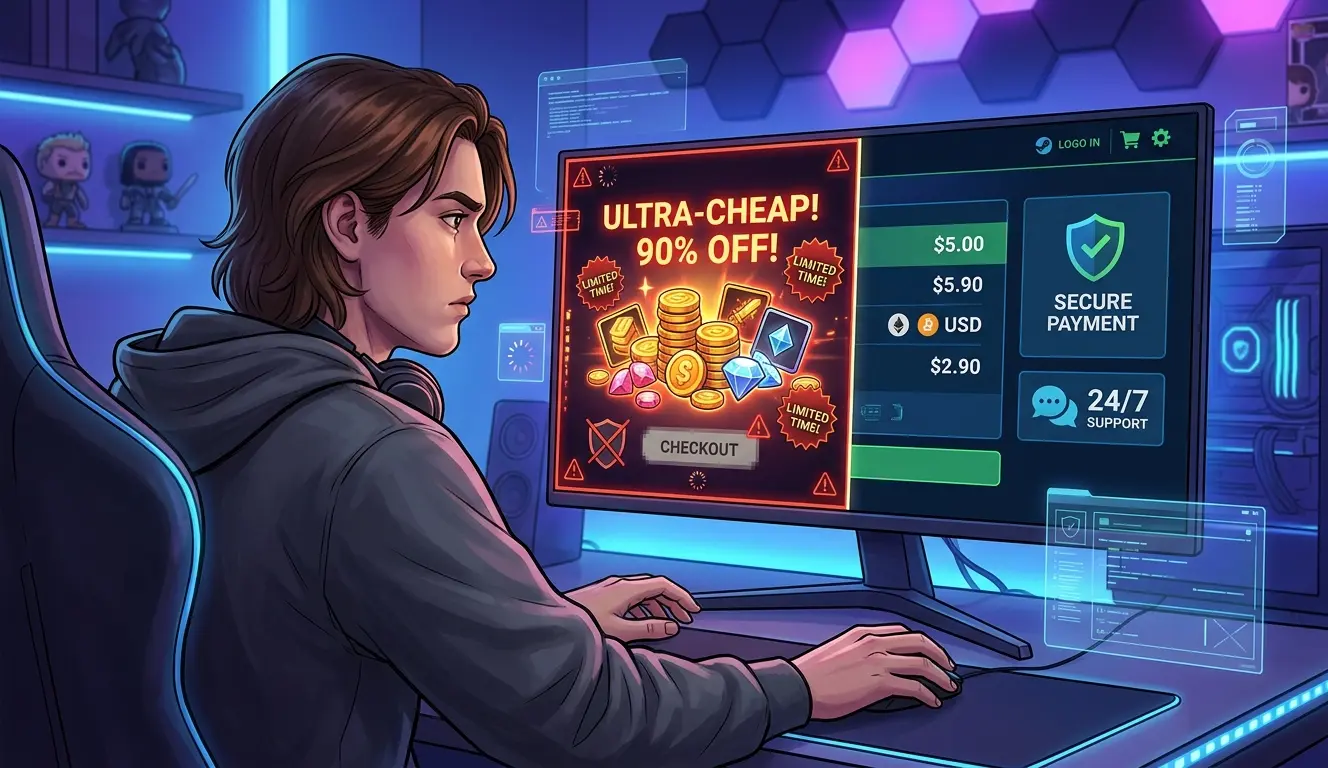
Cheap game currency can be appealing, especially when two websites appear to offer the same currency, bundle, pack, or top-up for very different prices. Saving money is not a problem by itself. The problem starts when the discount becomes the only reason you trust the seller.
An unusually low price does not automatically mean a top-up is fake or unsafe. Legitimate sellers can run promotions, reduce margins, or offer different pricing structures. However, a deal that looks dramatically cheaper than comparable options deserves more verification, not less.
Before buying, look beyond the advertised price. The seller’s reputation, payment process, account-access requirements, delivery information, refund terms, and support options can matter far more than a small difference in cost.
Why Cheap Game Currency Deserves Extra Scrutiny
Low prices naturally attract attention. Players may be comparing premium currency, event packs, skins, passes, bundles, or other digital purchases, so choosing the lower price can feel like an obvious way to get better value.
However, extremely attractive pricing can also make buyers overlook warning signs. Instead of asking whether the seller is trustworthy, they start asking only how much they can save.
That is the wrong order.
Evaluate the seller first and the discount second. If an offer is legitimate, it should still make sense after you examine how the transaction works, what information is required, how payment is handled, and what happens if something goes wrong.
Cheap Does Not Automatically Mean Fake
There are legitimate reasons why one game currency seller may charge less than another. A service might be running a temporary promotion, accepting a lower margin, offering different packages, or using a different pricing structure.
Therefore, the goal is not to avoid every discounted top-up. Instead, determine whether the lower price is supported by a credible buying experience.
Be more cautious when a low price appears alongside several warning signs, such as:
- vague product or package descriptions;
- unclear ordering instructions;
- no visible support process;
- unexpected payment requests;
- unclear delivery expectations;
- missing refund or problem-resolution information;
- unexplained requests for sensitive information;
- pressure to complete the purchase immediately.
One warning sign may have an innocent explanation. Several appearing together deserve much closer scrutiny.
The Biggest Risks Behind Very Cheap Game Currency
The price itself is rarely the only issue. Most of the meaningful risk appears in the transaction surrounding the purchase.
1. An Unverified or Poorly Explained Seller
Start by determining who is actually selling the currency or top-up. A polished website alone does not prove legitimacy.
Look for consistent company information, clear support channels, understandable policies, and a history that can be checked outside the seller’s own promotional material. When reviewing customer feedback, look across multiple independent sources rather than relying entirely on testimonials displayed by the seller.
Be particularly cautious when a website has almost no history, no meaningful support information, copied-looking content, or a domain that appears designed to imitate another business.
2. Weak or Unclear Payment Protection
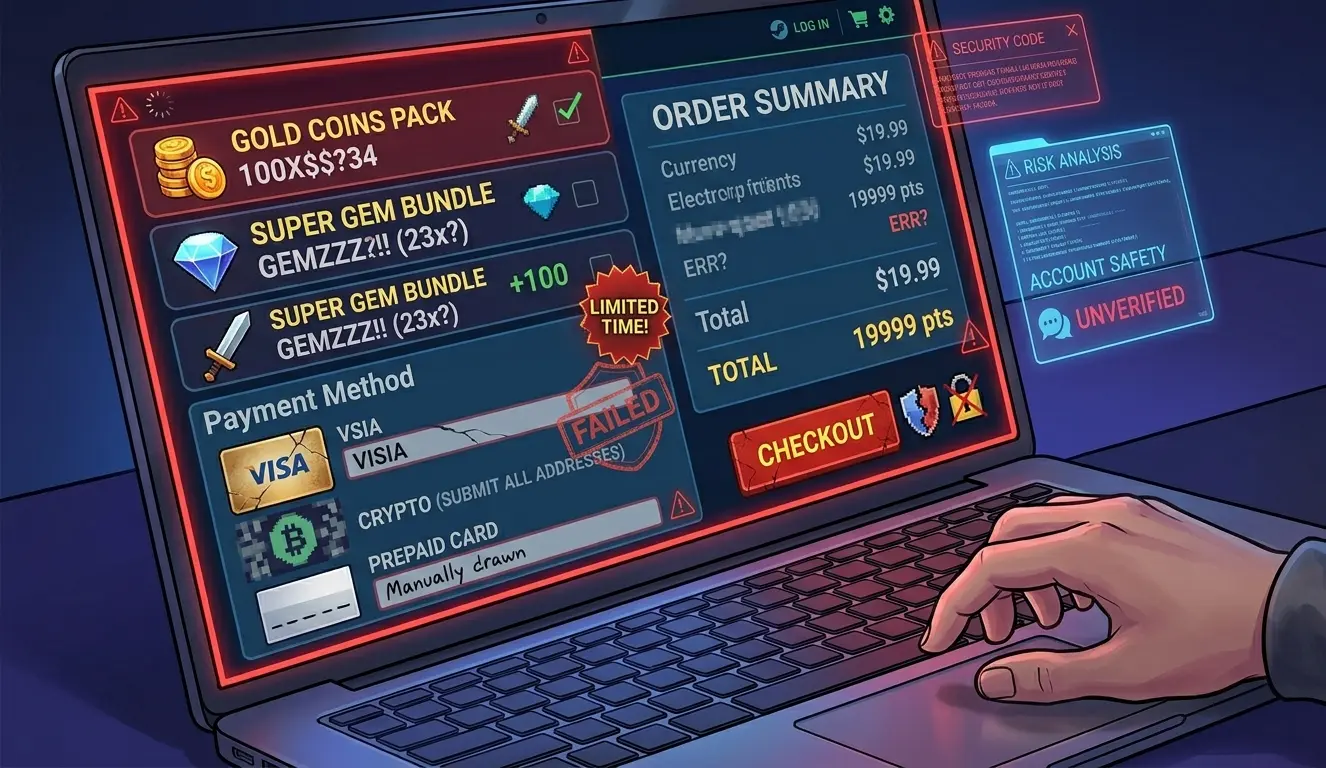 A discount becomes much less attractive if the payment method leaves you uncertain about what happens after you send the money.
Before paying, confirm:
- the final amount you are expected to send;
- the correct recipient or checkout destination;
- whether the payment method offers a dispute mechanism;
- whether the transaction is treated as a personal or commercial payment;
- what records or confirmation you will receive;
- what the seller will do if the order cannot be completed.
Different payment methods provide different levels of recourse. Do not assume that seeing a familiar payment brand automatically gives every transaction the same protection.
This is why understanding why secure payment matters when buying game currency online is more important than choosing a seller based on price alone.
3. Unclear Delivery or Processing Expectations
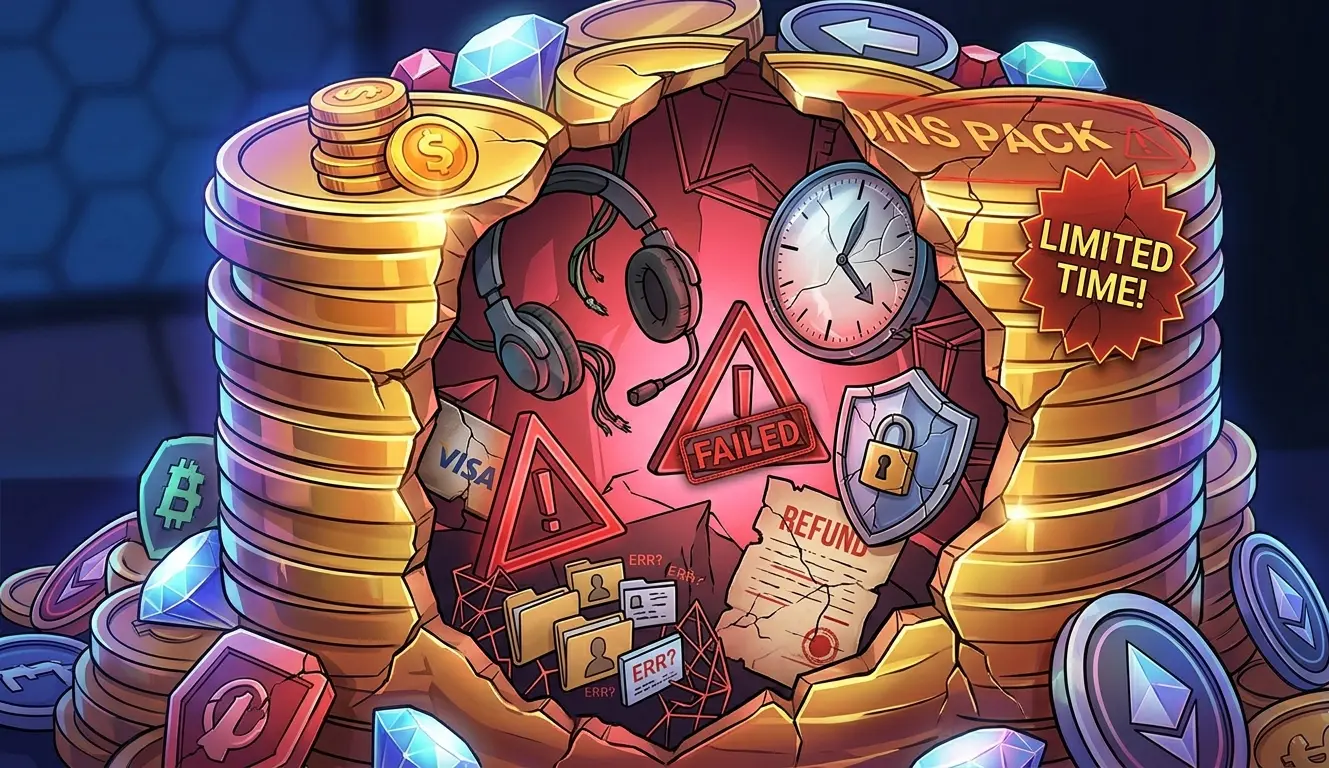 A cheap top-up is not particularly useful if you have no idea when it will arrive or what to do if it does not appear.
Look for a seller that explains whether its processing time is an estimate or a guarantee. Be skeptical of vague claims such as “instant” when the service provides no explanation of what instant means or what can cause delays.
If you are buying currency for a limited-time event, do not leave the purchase until the final minutes simply because a seller advertises fast fulfillment. Payment verification, account checks, service demand, or game-side issues can all affect timing depending on the service.
4. Weak Refund or Problem-Resolution Policies
Before you buy, check what happens if the seller cannot complete the order, sends the wrong item, experiences a delay, or needs additional information from you.
A trustworthy transaction should not require you to discover the refund rules only after something has gone wrong.
Look for clear answers to questions such as:
- What happens if the top-up cannot be completed?
- How do I report an incorrect or incomplete order?
- Which support channel should I use?
- Are refunds subject to specific eligibility conditions?
- What proof of payment or order information should I keep?
Keep your own transaction records as well. Save the order details, payment confirmation, relevant messages, and the seller’s stated terms at the time of purchase.
5. Excessive or Unexplained Account-Access Requests
Account access requires more nuance than simply assuming that every login request is fraudulent.
Some top-up methods can work with a player ID or another account identifier. Other assisted top-up services may require temporary game-account access so the requested purchase can be completed directly on the player’s account.
The important question is whether the access requirement is clearly disclosed, appropriate for the service, and handled through a verified private process.
A seller should not use a cheap price as an excuse to obtain unrelated sensitive information. Be especially cautious about requests for:
- your email account password;
- banking or payment-account passwords;
- cryptocurrency wallet seed or recovery phrases;
- private keys;
- unrelated identity documents;
- recovery codes without a clearly verified need;
- credentials submitted through public comments, public Discord channels, or social media posts.
For more practical precautions, see our guide on how to protect your account when buying game currency.
6. Phishing and Fake Checkout Pages
Very large discounts are often used to create urgency. A player sees an unusually cheap bundle, follows a link quickly, and enters information before checking where the link actually leads.
Before logging in or paying, verify the website address independently. Be suspicious of misspelled domains, shortened links from unknown senders, copied branding, unexpected login pages, and messages that pressure you to act immediately.
If you reached an offer through an advertisement, private message, email, or social post, navigating to the seller’s known website independently is safer than assuming the supplied link is genuine.
7. Fake Scarcity and Pressure-Based Selling
A legitimate promotion can have a real deadline. However, repeated countdowns, dramatic “last chance” warnings, or claims that a digital product is almost gone can also be used to stop buyers from checking the seller properly.
Do not allow a timer to make the security decision for you.
If you need another few minutes to verify the domain, payment instructions, seller reputation, or service policies, take those minutes.
8. Game or Publisher Rules You Have Not Checked
Top-up and account-access policies can differ between games, regions, platforms, and publishers. A purchasing method accepted in one game should not automatically be assumed to be acceptable in another.
Before using an independent seller, check the game’s current official terms and purchasing rules when possible. This is especially important if the transaction involves account sharing, temporary login access, regional pricing, or an unconventional method of delivering currency.
Do not use services that encourage exploits, stolen payment methods, modified applications, currency generators, or attempts to bypass game restrictions.
Temporary Login Is Not the Same as Giving Away Your Account
A temporary login request should always receive careful scrutiny, but the request itself is not enough to prove that a service is fraudulent.
With an assisted-login top-up, the service temporarily accesses the game account to complete the requested purchase. That is different from transferring ownership of the account.
Before providing temporary access, confirm:
- that you are communicating with the correct service;
- that the login requirement was disclosed before the transaction;
- that credentials are being provided through the official private ordering channel;
- what access is actually required;
- that unrelated email, banking, or payment credentials are not being requested;
- whether the game’s own terms permit the method being used.
How to Compare Cheap Game Currency Offers Properly
Instead of comparing only the headline price, compare the entire transaction.
| What to Check | Better Sign | Reason for Caution |
|---|---|---|
| Price | Competitive price with a reasonable explanation or promotion | Price dramatically below comparable offers with no explanation |
| Product details | Currency, package, account requirements, and conditions are clear | Vague promises or unclear bundle contents |
| Payment | Payment method and recipient are explained before sending funds | Last-minute changes or pressure to use an unfamiliar method |
| Account access | Requirements are explained and handled privately | Unexpected requests for unrelated passwords or recovery information |
| Delivery | Processing expectations and possible delays are explained | Unqualified “instant” promises with no support process |
| Problems | Refund, failed-order, and support procedures are visible | No explanation of what happens after a failed order |
If you are comparing independent top-up options, Heaven Guardian’s current game top up service page is one place to review its supported games and current service terms. As with any provider, check the live requirements and decide whether the available payment, access, and fulfillment process fits your needs before ordering.
Heaven Guardian’s current Top Up FAQ also states that delayed or uncompleted top-ups are covered by its published refund guarantee. That is Heaven Guardian’s own service policy rather than a protection supplied by a game publisher or by PayPal, so check the current policy and order terms before payment.
What a Legitimate Cheap Top-Up Can Look Like
A genuinely competitive price does not need to be accompanied by suspicious behavior.
A lower-priced seller can still provide:
- clear information about what you are purchasing;
- reasonable explanations of account requirements;
- transparent payment instructions;
- realistic processing expectations;
- accessible customer support;
- clearly stated refund or failed-order procedures;
- a consistent website and ordering process.
That combination is much more meaningful than the discount itself.
In other words, cheap game currency becomes concerning when the seller asks you to trade transparency, control, or account safety for the lower price.
A Quick Checklist Before Buying Cheap Game Currency
Before completing a purchase, run through these checks:
- Compare the price. Is it simply competitive, or dramatically below everything else?
- Verify the seller. Look beyond reviews displayed on the seller’s own website.
- Read the product details. Know exactly what currency, pack, or bundle you are purchasing.
- Check the final cost. Look for additional charges or conditions before payment.
- Understand the payment method. Know what dispute or recovery options actually apply.
- Review delivery expectations. Treat processing estimates as estimates.
- Read the refund policy. Know what happens if the order cannot be completed.
- Question account-access requests. Temporary game access may be legitimate for an assisted service, but unrelated credentials are not necessary for a normal top-up.
- Use official private channels. Never post login information publicly.
- Check the game’s rules. Policies regarding third-party purchases and account access vary between games.
If several of these checks fail, a lower price should not persuade you to continue.
FAQ
Is cheap game currency always a scam?
No. A lower price alone does not prove that a seller is fraudulent. Legitimate sellers can offer promotions or competitive pricing. However, an unusually low price should encourage you to investigate the seller, payment process, support, delivery terms, and account requirements more carefully.
Why can very cheap game currency be risky?
The risk often comes from the transaction rather than the currency itself. A suspicious seller may have unclear fulfillment, weak support, poor refund information, questionable payment instructions, phishing pages, or excessive account-information requests.
Is the cheapest game top up always the best value?
No. Price is only one part of value. A slightly more expensive transaction may be preferable if the seller provides clearer terms, dependable support, understandable account requirements, and a more suitable payment process.
What payment method is safest for buying game currency?
There is no single payment method that is best in every situation. Compare the protections and dispute options attached to the exact transaction you are making. Where credit-card payment is legitimately available, card issuers may provide dispute rights, but the protections attached to digital wallets, cryptocurrency, personal payments, and other methods differ.
Never assume that a payment method offers purchase protection simply because you recognize its brand.
Is a temporary login request always a scam?
No. Some assisted top-up services require temporary access to the game account to complete the requested purchase. The requirement should be disclosed clearly, access should be provided only through a verified private channel, and you should not provide unrelated email, banking, wallet, or recovery credentials.
Can buying cheap game currency get my account banned?
It depends on the game and the method used. Publishers can have different rules regarding third-party purchases, account sharing, regional transactions, and unauthorized currency sources. Check the specific game’s current official terms rather than assuming the same rules apply everywhere.
What are the biggest warning signs of a cheap game currency website?
Common warning signs include a price dramatically below comparable offers, unclear seller identity, fake-looking reviews, unexpected payment instructions, aggressive countdowns, vague refund policies, suspicious login pages, and requests for information unrelated to completing the top-up.
Conclusion
Cheap game currency is not automatically unsafe, and paying more does not automatically make a seller trustworthy. The important question is whether the lower price is supported by a transparent and credible transaction.
Before paying, check the seller independently, understand the payment method, review delivery and refund terms, and make sure any account-access requirement makes sense for the service being provided. A large discount should make you more careful, not more willing to ignore warning signs.
The best value usually comes from balancing price with transparency, account security, reasonable terms, and confidence in how problems will be handled.
For more practical advice about buying currency, comparing services, and avoiding common purchasing mistakes, explore our latest game top-up guides.