
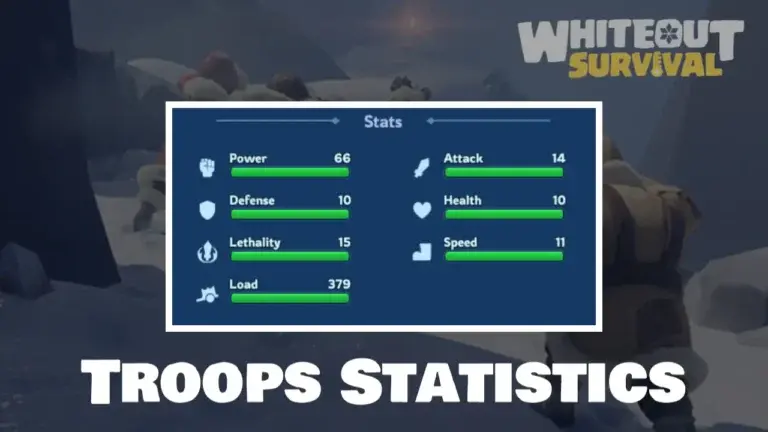
Whiteout Survival troop stats are built around five important values: Attack, Defense, Health, Lethality, and Load. The first four affect combat, while Load determines how many resources your troops can carry when gathering or plundering.
The most common question is Attack vs Lethality: which is better? Both contribute to damage, but they do different jobs. Whiteout Survival’s official Wiki explains that Lethality primarily affects damage to enemy Health, while Attack is more focused on overcoming enemy Defense. There is no reliable reason to treat Lethality as automatically better than Attack in every battle.
★Quick Take: Attack and Lethality are your main offensive stats. Defense and Health are the defensive counterparts. For damage-focused PvE such as Bear Hunt, offensive stats usually deserve more attention. In PvP and garrison battles, blindly maximizing Lethality while neglecting Health and Defense can leave your formation too fragile.
Whiteout Survival Troop Stats Explained
| Stat | Main Function | Most Relevant For |
|---|---|---|
| Attack | Contributes to damage and works against the opponent’s Defense | Offensive PvP, rallies, PvE damage |
| Defense | Helps reduce the pressure caused by enemy attacks | Infantry, garrisons, defensive PvP |
| Lethality | Primarily affects damage dealt to enemy Health | Damage-focused marches and rallies |
| Health | Determines how much punishment troops can survive | Frontline durability and long fights |
| Load | Determines resource carrying capacity | Gathering and city plunder |
These stats should not be evaluated in isolation. Troop tier, troop count, hero skills, Hero Gear, Chief Gear, Chief Charms, research, special bonuses, troop composition, and the Infantry-Lancer-Marksman counter system can all change the result of a battle.
Whiteout Survival Lethality vs Attack
Lethality and Attack are both offensive stats, but they are not interchangeable.
According to the official Whiteout Survival Wiki, both appear in the game’s damage calculation. Attack is more closely associated with overcoming the target’s Defense, while Lethality primarily affects the damage applied to the target’s Health.
| Comparison | Attack | Lethality |
|---|---|---|
| Primary role | Offensive stat interacting with enemy Defense | Offensive stat affecting HP damage |
| Counterpart | Defense | Health |
| Useful for PvE damage | Yes | Yes |
| Useful for PvP damage | Yes | Yes |
| Should you ignore the other? | No | No |
Is Lethality Better Than Attack?
Not universally. Older troop-stat advice often reduces progression to a simple order such as “Lethality first, Attack second.” That can be useful as a rough damage-focused rule, but it is too simplistic for Whiteout Survival’s current combat systems.
The official Wiki does not publish a complete combat formula that lets players say that one percentage point of Lethality is always worth more than one percentage point of Attack. Your heroes, exclusive-gear bonuses, troop composition, target stats, and battle type all matter.
Bear Hunt guidance, for example, has historically favored combinations that include multiple Lethality-focused exclusive-gear bonuses because the objective is maximizing damage. That does not mean the same setup is automatically optimal for defending Sunfire Castle or fighting another player with very different stats.
!Important: Do not compare Attack and Lethality percentages as if they were the same stat. Both improve offensive performance through different parts of the combat calculation. The most useful comparison is usually your actual battle report before and after an upgrade.
Attack and Defense Explained
What Does Attack Do?
Attack is one of the fundamental offensive troop stats. Higher Attack improves your damage potential and is particularly relevant when fighting opponents with substantial defensive stats.
Attack bonuses can come from many progression systems, including:
- Battle Research
- Chief Gear
- Hero Expedition skills
- Hero and exclusive-gear effects
- Alliance and State bonuses
- Temporary combat buffs
- Later War Academy research
Higher-tier troops also start with stronger base combat values. Percentage bonuses are therefore more valuable when applied to an already strong troop tier.
What Does Defense Do?
Defense is one of the main defensive stats. It works against enemy offensive pressure and helps your troops remain alive longer.
Defense is especially important for the part of your formation expected to absorb the most attacks. In normal troop combat, Infantry occupy the frontline role, so weak Infantry defensive stats can cause the rest of the formation to collapse earlier.
That does not mean Marksman or Lancer Defense is useless. Enemy composition, troop counters, and special skills can expose different parts of a march to damage.
Lethality and Health Explained
What Is Lethality in Whiteout Survival?
Lethality is an offensive troop statistic primarily associated with the amount of damage inflicted on enemy Health. Alongside Attack, it is part of your formation’s damage potential.
Lethality is commonly increased through systems such as Hero Gear, Chief Charms, Battle Research, hero skills, exclusive equipment, special bonuses, and later War Academy technologies.
For damage-only situations, improving Lethality can be extremely valuable. It becomes less useful, however, if you sacrifice so much survivability that your troops cannot remain effective for the full battle.
What Does Health Do?
Health determines how much damage troops can withstand before they are defeated or wounded. It is the defensive counterpart most closely associated with Lethality.
Health becomes especially important in longer PvP battles because surviving troops continue contributing damage. A formation with excellent offensive percentages can still lose if its frontline disappears too quickly.
This is why competitive troop development normally requires a balance rather than four offensive stats and no defensive foundation.
Defense vs Health: Which Is More Important?
Like Attack versus Lethality, there is no universal winner between Defense and Health.
| Stat | What It Helps With | When It Becomes Valuable |
|---|---|---|
| Defense | Reduces the effect of incoming offensive pressure | Against opponents with strong Attack |
| Health | Gives troops more durability before being defeated | Long battles and strong enemy Lethality |
Strong defensive accounts generally develop both. Infantry in particular benefit from durability because they are expected to protect the Lancer and Marksman portions of the formation.
Load: The Resource Stat
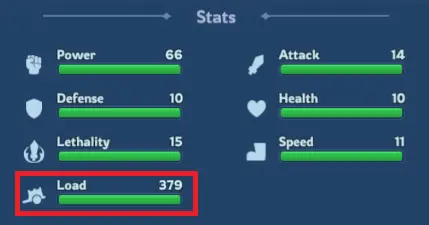
Load is not a combat-damage stat. It determines how many resources a troop can carry while gathering or bringing resources home after a successful city attack.
Each troop type and tier has its own Load value, and higher-tier troops generally have greater carrying capacity. You can view this stat from the relevant military camp.
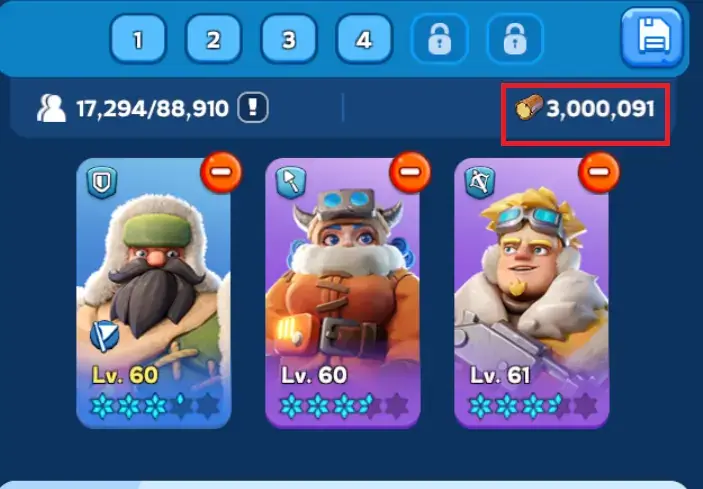
When preparing a gathering march, the deployment screen displays the total resource capacity of the troops you selected. If that total is smaller than the resources remaining on the tile, your troops cannot clear the entire tile in one trip.
Load also matters when plundering another city. The resources that surviving troops can bring back are constrained by their available carrying capacity. Losing a large portion of the march reduces the amount the survivors can transport.
Load vs Gathering Speed
Do not confuse Load with Gathering Speed.
- Load = how much the march can carry.
- Gathering Speed = how quickly it collects resources from the tile.
Gathering heroes such as Cloris, Eugene, Smith, and Charlie are valuable because their Expedition skills improve gathering efficiency for particular resources. Their utility should not be confused with the troop’s base Load stat.
Troop Type Matters as Much as Raw Stats
A bigger stat number does not guarantee victory because Whiteout Survival also uses a troop counter triangle:
- Infantry counters Lancer.
- Lancer counters Marksman.
- Marksman counters Infantry.
Infantry generally function as the frontline, Lancers provide a more offensive middle layer, and Marksmen are a major source of ranged damage. Your preferred stat investments should therefore reflect what each class is doing in your formation.
For example, increasing Infantry Health may produce more practical value in a PvP formation than adding the same amount of personal hero Attack if your main problem is the frontline dying first.
Where Do Troop Stats Come From?
Your battle report percentages are built from multiple progression systems. Improving only one of them leaves a large amount of potential unused.
1. Troop Tier
Higher troop tiers have stronger base values and higher Load. The official Wiki recommends progressing toward the highest practical troop tier because these stronger base values are then amplified by percentage bonuses.
After unlocking troop promotion, upgrading lower-tier troops is also important so that weak troops do not continue filling your formations and Infirmary.
2. Battle Research
The Research Center‘s Battle tree permanently improves the four major combat-stat families:
- Attack
- Defense
- Health
- Lethality
The tree includes class-specific technologies for Infantry, Lancer, and Marksman as well as broader troop bonuses.
Later-state War Academy progression continues expanding these same combat-stat categories, so troop-stat development does not stop after the normal Research Center tree is completed.
3. Chief Gear
Chief Gear unlocks at Furnace Level 22 and primarily increases troop Attack and Defense.
| Chief Gear Pieces | Troop Class Improved |
|---|---|
| Coat and Pants | Infantry Attack and Defense |
| Cap and Watch | Lancer Attack and Defense |
| Ring and Weapon | Marksman Attack and Defense |
Chief Gear also provides set-quality bonuses. Equipping three pieces of the same quality increases the Defense of all three troop classes, while a complete six-piece set increases their Attack.
4. Chief Charms
Chief Charms unlock at Furnace Level 25 and are an important progression system for Lethality and Health.
This creates a useful distinction:
- Chief Gear: primarily Attack and Defense progression.
- Chief Charms: primarily Lethality and Health progression.
Because both systems use limited upgrade materials, maintaining reasonable balance can be better than pushing one class far ahead while leaving another important troop class underdeveloped.
5. Hero Gear
Hero Gear contributes both hero stats and Command bonuses. For troop combat, its Lethality and Health bonuses are especially important.
Common Hero Gear progression follows this pattern:
- Goggles and Boots: associated with troop Lethality.
- Gauntlets and Belts: associated with troop Health.
The troop class receiving the bonus depends on the class of the hero wearing that equipment.
6. Hero Skills
Combat heroes can add Attack, Defense, Health, Lethality, Damage Dealt, Damage Taken reduction, enemy debuffs, and other effects.
These bonuses are one reason comparing two players only by the four visible troop percentages can be misleading. A lower raw stat can sometimes be paired with stronger Expedition skills or exclusive-gear effects.
7. Exclusive Hero Gear and Special Bonuses
Legendary heroes can have exclusive equipment that adds Lethality and Health while also unlocking special effects such as Rally Troop Attack, Defender Troop Defense, or other conditional bonuses.
These special bonuses can materially affect battle results and should be checked in battle reports rather than ignored during hero comparisons.
Which Whiteout Survival Troop Stats Should You Prioritize?
There is no single stat order that is correct for every mode. A better approach is to prioritize according to what the formation is trying to accomplish.
| Activity | Higher-Priority Stats | Why |
|---|---|---|
| Bear Hunt / damage-focused PvE | Lethality and Attack | Primary objective is maximizing damage output |
| Polar Terror rallies | Attack and Lethality | Offensive performance determines faster, stronger clears |
| Offensive PvP | Attack and Lethality, without neglecting Health | You need damage but must survive long enough to apply it |
| Garrison / city defense | Health and Defense, supported by offensive stats | Survivability and maintaining troop numbers are critical |
| Infantry frontline development | Health and Defense are especially valuable | Infantry absorb a large share of frontline pressure |
| Damage-oriented Marksman development | Attack and Lethality | Marksmen are an important source of sustained damage |
| Gathering | Load plus Gathering Speed bonuses | Combat stats do not increase carrying capacity |
Should You Always Upgrade Lethality First?
No. Lethality is extremely valuable, especially for damage-focused rallies, but an account that upgrades only Lethality can become unbalanced.
If you are losing because your Infantry dies immediately, another offensive upgrade may produce less practical benefit than additional Health or Defense. Likewise, if you consistently survive but fail to deal enough damage, more defensive investment may not solve the actual problem.
Use battle reports to identify the bottleneck instead of following one stat order forever.
F2P Troop Stat Upgrade Strategy
F2P players should focus on upgrades that deliver permanent value without spreading limited materials across too many projects.
Recommended F2P Priorities
- Keep Battle Research progressing consistently.
- Train and promote toward your highest available troop tier.
- Build Chief Gear evenly enough to preserve useful set bonuses.
- Do not neglect Chief Charms simply because Chief Gear gives more visible Power.
- Concentrate Hero Gear on the heroes and troop classes used in your main formation.
- Save scarce Essence Stones and other premium materials for equipment that will remain useful.
- Use battle reports to decide whether offense or survivability is currently limiting you.
A balanced F2P account usually gains more from completing efficient upgrades across several permanent systems than from heavily over-investing in one percentage while other stats fall far behind.
Spender and Rally-Leader Stat Strategy
Spenders can push several stat systems simultaneously, but the same principle applies: build for your actual role.
Rally leaders should pay close attention not only to Attack and Lethality but also to:
- Hero Expedition skills
- Rally-specific exclusive-gear bonuses
- Troop composition
- Current-generation hero stats
- Temporary combat buffs
- Chief Gear and Charms
- Research and War Academy progression
A rally with slightly lower displayed Attack can still perform differently because the leader has stronger Damage Dealt bonuses, enemy debuffs, or exclusive-gear effects.
Players who prefer beginning with an established roster and developed troop-stat systems can also compare a wos account for sale as an optional progression path. Check Chief Gear, Charms, research, Hero Gear, hero generations, and troop tiers rather than judging an account only by total Power.
How to Read Troop Stats More Accurately
Do not judge combat strength from one screen alone.
Military Camps
Your Infantry, Lancer, and Marksman camps show information about individual troop tiers, including their base statistics and Load.
Battle Reports
Battle reports are more useful when comparing real combat performance because they show the bonuses that actually applied to the fight.
When reviewing a loss, compare:
- Attack
- Defense
- Health
- Lethality
- Troop tiers
- Troop counts and composition
- Hero Expedition skills
- Special and conditional bonuses
If only one value is higher, that does not explain the full result.
Common Troop Stat Mistakes
Treating Lethality as the Only Important Stat
Lethality is a major damage stat, but Attack is also part of the damage calculation. PvP formations additionally need enough Health and Defense to remain alive.
Thinking Attack Directly Equals Damage
Attack does not operate alone. Enemy Defense, your Lethality, troop tier, skills, special bonuses, troop composition, and other mechanics influence the final result.
Ignoring Troop Counters
A statistical advantage can be reduced by an unfavorable Infantry-Lancer-Marksman matchup. Formation composition matters alongside raw percentages.
Upgrading Only the Stat With the Highest Percentage
A large number is not automatically the upgrade you need most. Identify whether you are losing because of low damage or poor survivability.
Ignoring Base Troop Tier
Percentage bonuses multiply the strength of the troops you actually send. Higher-tier troops provide a better foundation for those bonuses.
Confusing Load With Gathering Speed
Load determines capacity, not collection speed. A march can have a large Load and still gather slowly if it lacks gathering bonuses.
Ignoring Hero and Exclusive-Gear Effects
Two players with similar troop stats can have very different results because one has stronger Damage Dealt, Damage Taken reduction, rally, garrison, or class-specific hero effects.
FAQs
What is Lethality in Whiteout Survival?
Lethality is one of Whiteout Survival’s major offensive troop stats. The official Wiki describes it as primarily affecting damage to enemy Health. It works alongside Attack as part of the game’s damage calculation.
What is the difference between Attack and Lethality in Whiteout Survival?
Attack is more focused on overcoming enemy Defense, while Lethality primarily affects HP damage. Both contribute to offensive performance, so neither should be treated as a complete replacement for the other.
Is Lethality better than Attack in Whiteout Survival?
Not in every situation. Lethality is highly valuable for damage-focused content such as Bear Hunt, but Attack is also part of the damage calculation. PvP performance additionally depends on Defense, Health, troop composition, heroes, and special bonuses.
Which troop stat should I upgrade first?
For pure PvE damage, prioritize offensive development such as Lethality and Attack. For PvP or garrison defense, maintain stronger Health and Defense as well. The best upgrade is the stat that addresses the weakness shown in your battle reports.
How do I increase Lethality in Whiteout Survival?
Lethality can be increased through systems including Battle Research, Chief Charms, Hero Gear, hero skills, exclusive hero equipment, buffs, and later War Academy research. Available sources expand as your State progresses.
What does troop Load do?
Load determines how many resources troops can carry while gathering or plundering. Higher-tier troops generally have greater Load, and only surviving troops contribute to the carrying capacity after a city battle.
Conclusion
Whiteout Survival troop stats work together rather than following one permanent priority list. Attack helps your troops overcome enemy Defense, Lethality primarily affects HP damage, Defense reduces offensive pressure, Health keeps troops fighting longer, and Load controls resource capacity.
For damage-focused content, Attack and Lethality deserve greater attention; for PvP and defense, Health and Defense can be equally decisive. Use troop tier, hero skills, formation composition, and battle reports alongside the raw percentages when planning upgrades. For more combat breakdowns, hero guides, and progression strategies, explore our Whiteout Survival guides.