
Alliance Pact in Last War Season 6 is a formal partnership between two alliances belonging to the same faction. A Pact lets the two alliances use each other’s territory for adjacency, reinforce important structures, share battlefield information, and coordinate through a dedicated chat.
The most important requirement is the Handshake: both alliances must own territory that directly touches. Each alliance can maintain only one Pact at a time, and choosing the right partner matters because forming a Pact starts a three-day cooldown during which another Pact cannot be formed. A strong partner in the wrong location can therefore be less useful than a well-positioned alliance that opens the territory route your faction actually needs.
Choose your Pact partner for map position, coordination, and defensive value rather than Power alone. Protect the Handshake territory at all costs: if your alliances stop sharing an adjacent border, the Pact becomes invalid and allied reinforcements are recalled.
What Is an Alliance Pact in Season 6?
Season 6: Shadow Rainforest changes Last War from a collection of largely independent Warzones into a wider faction conflict. The season group is divided between the opposing Deepwood and Wetland factions, with alliances on the same side expected to cooperate across the seasonal map.
Alliance Pact is the system that makes that cooperation functional.
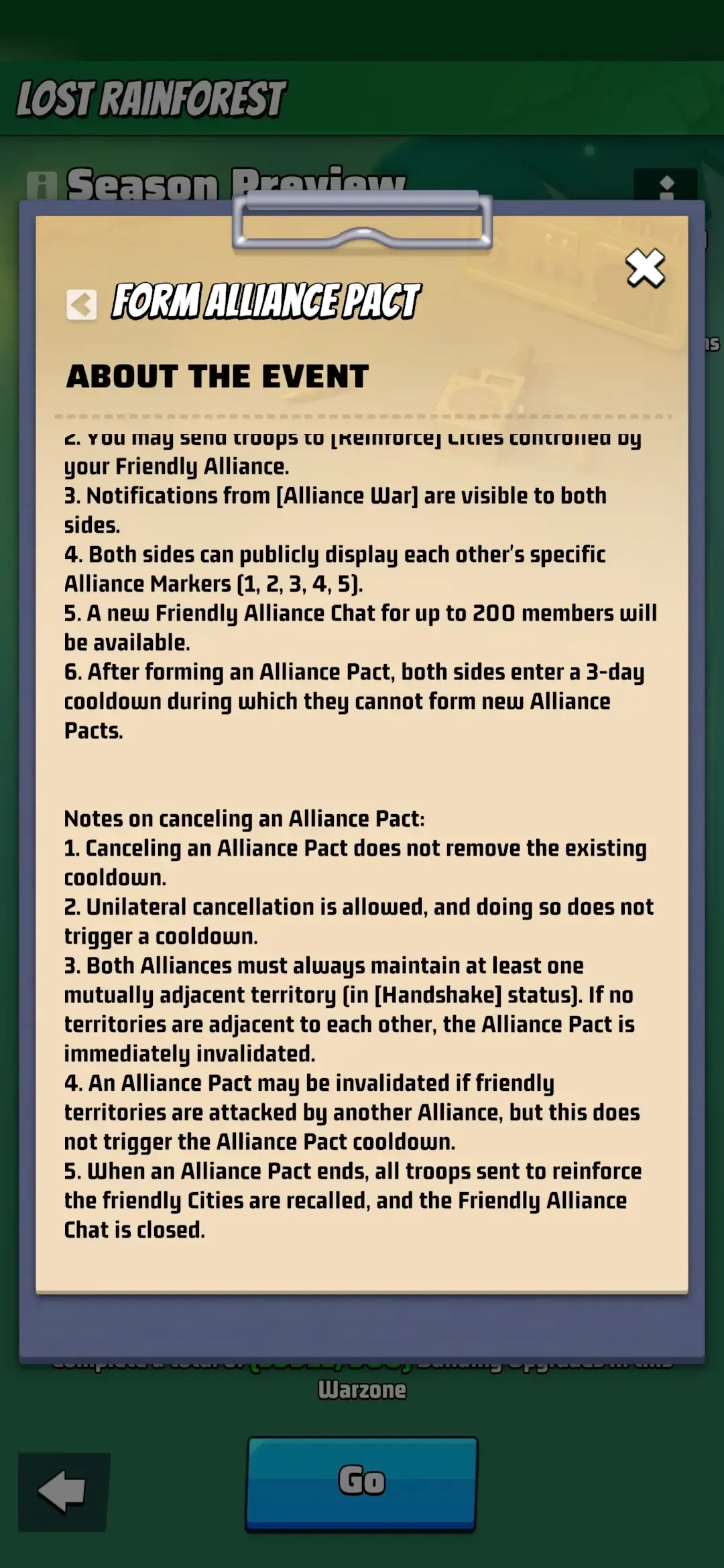
Once two same-faction alliances establish a Pact, they gain several important benefits:
- Each alliance can use the other’s territory for adjacency.
- Members can reinforce eligible cities and other seasonal objectives controlled by the partner alliance.
- Alliance War information can be shared between the two sides.
- Special alliance map markers become visible to the partner.
- A dedicated Friendly Alliance Chat supports up to 200 members across both alliances.
- Reinforcement marches toward Pact objectives receive movement support under the current system.
The system is introduced through the Season 6 preview and becomes an important strategic mechanic once seasonal territorial warfare begins.
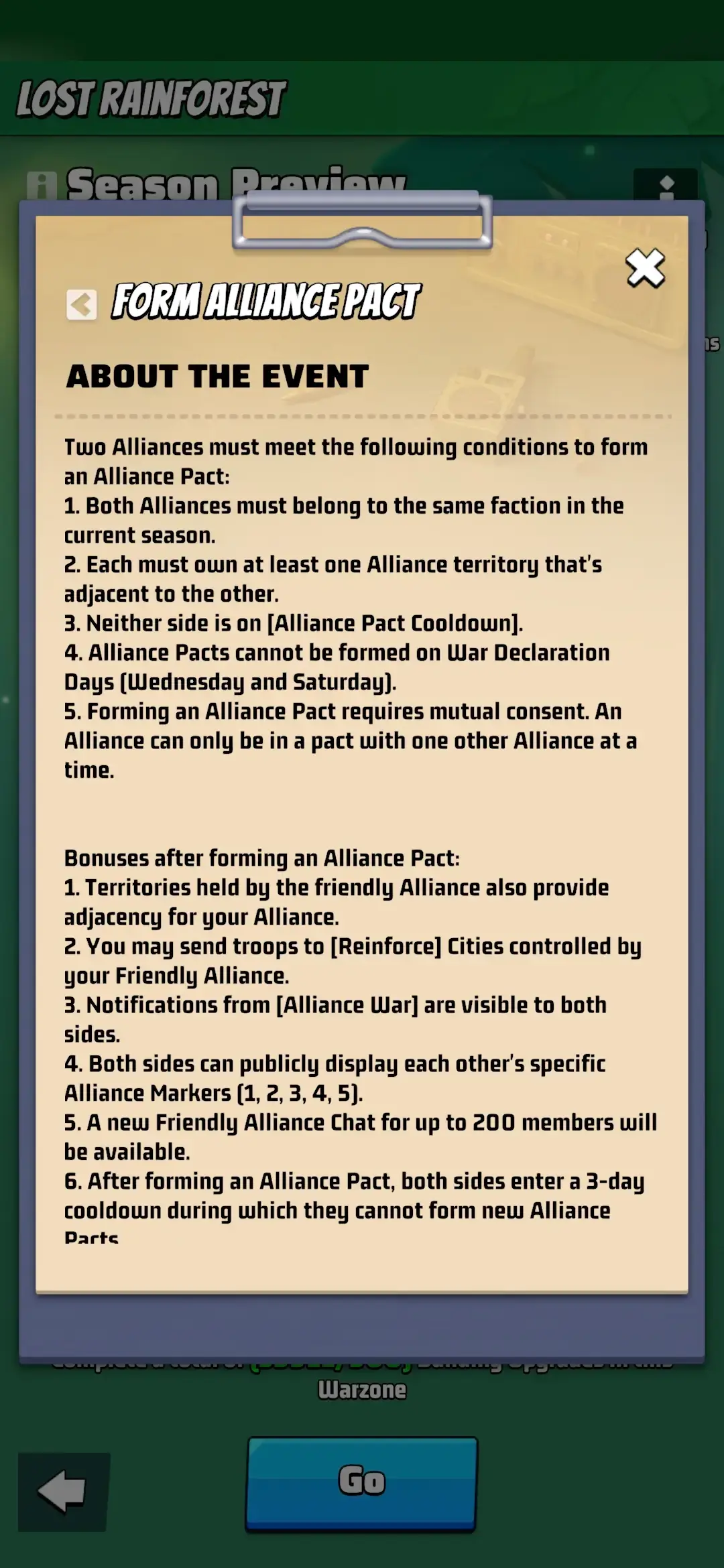
Alliance Pact Requirements
Two alliances cannot simply select each other from a list. Several conditions must be satisfied first.
| Requirement | Rule |
|---|---|
| Faction | Both alliances must belong to the same Season 6 faction |
| Season Group | Both must be part of the same seasonal grouping |
| Territory | At least one territory from each alliance must be directly adjacent |
| Handshake | The shared border must remain valid for the Pact to continue |
| Cooldown | Neither alliance can be blocked by an active Alliance Pact cooldown |
| War Days | A new Pact cannot be formed on Wednesday or Saturday |
| Approval | Both alliances must agree to the Pact |
| Maximum Pacts | One active Pact per alliance |
Only the appropriate alliance leadership, including the Alliance Leader or Recruiter role under the current system, can initiate the request.
What Is Handshake Territory?
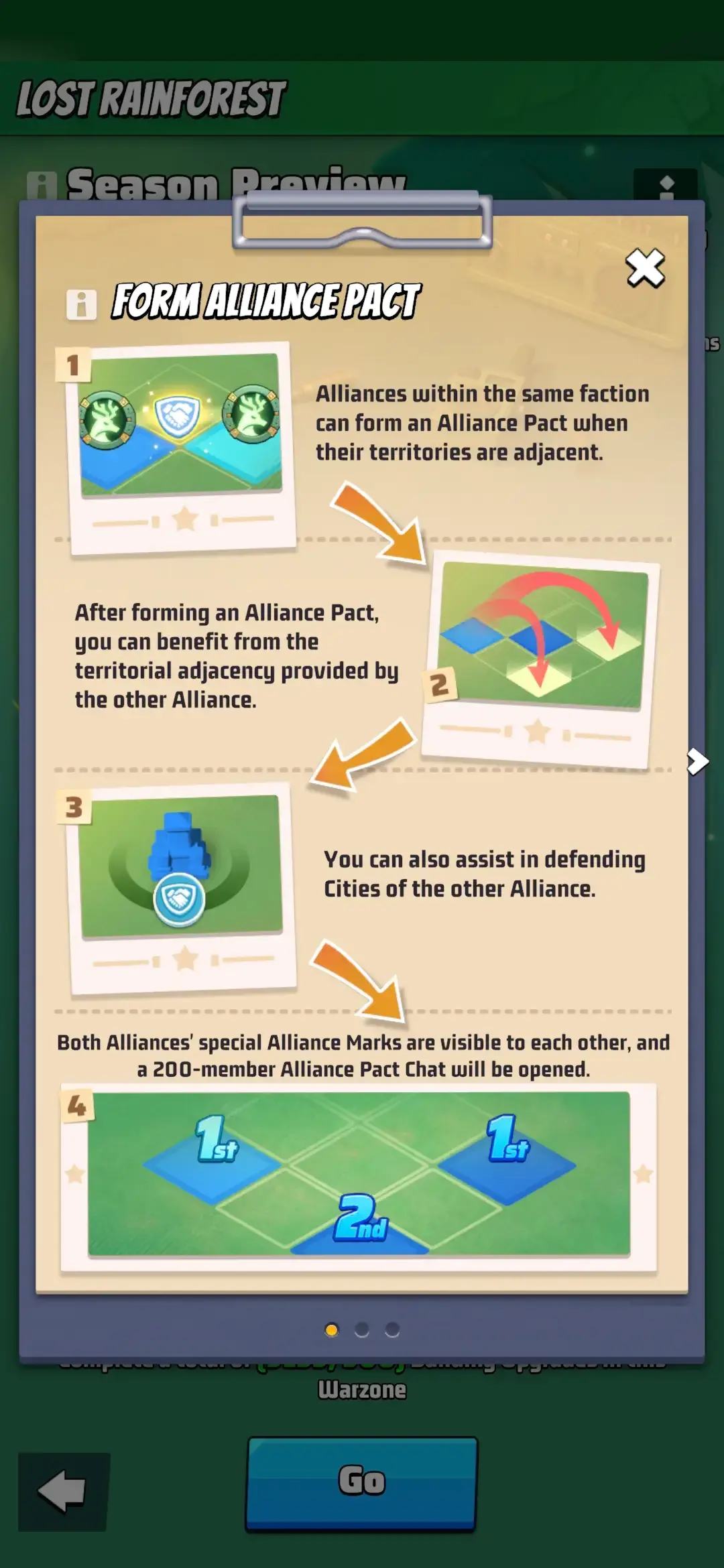
Handshake is the term used when the territory of two same-faction alliances touches directly.
This shared border is the foundation of an Alliance Pact. Without it, the Pact cannot be formed.
After the agreement becomes active, your partner’s territory starts providing adjacency to your alliance. That allows your alliance to continue seasonal territorial progression from positions that would otherwise belong only to the Pact partner.
For example, if Alliance A has territory leading toward an important battlefield objective and Alliance B establishes a Handshake with Alliance A, Alliance B can use its partner’s territorial connection when planning its own eligible expansion.
This creates much more flexible faction-wide routes than every alliance attempting to build an independent territory chain from its original position.
Why Losing the Handshake Is Dangerous
The Pact remains dependent on the two alliances maintaining at least one valid adjacent territory connection.
If the last Handshake point disappears, the Alliance Pact is immediately invalidated.
That can happen when territorial changes remove the shared border. When the Pact ends:
- Partner territory stops providing adjacency.
- Reinforcement troops sent to the partner are recalled.
- The shared Friendly Alliance Chat closes.
- The two alliances lose the Pact’s cooperation features until another valid Pact can be established.
Losing the Handshake or manually canceling does not start an additional three-day cooldown. However, it also does not erase any cooldown that is already running from when the Pact was formed.
Do not treat your connecting border as disposable territory. Losing the final Handshake point can break the Pact during an important battle and automatically recall troops that were reinforcing your partner’s objectives.
How to Form an Alliance Pact
A practical Pact setup follows this sequence:
- Choose a same-faction alliance. Enemy-faction alliances cannot become Pact partners.
- Create territorial contact. Expand until the two alliances own directly adjacent territory.
- Check the calendar. Do not plan the formation for Wednesday or Saturday, when new Pacts cannot be established.
- Check both cooldowns. Neither alliance can be restricted by an active Pact cooldown.
- Send the request. Eligible alliance leadership initiates the Pact.
- Have the partner confirm. Formation requires mutual agreement.
- Protect the shared border. Maintain at least one Handshake territory afterward.
Because each side receives only one active Pact slot, alliance leadership should agree on the strategic objective before confirming.
How the Three-Day Pact Cooldown Works
After a successful Pact is formed, both alliances enter a three-day Alliance Pact cooldown. During this period, they cannot form another Pact.
This matters even if the agreement is canceled early.
For example, forming a Pact and immediately discovering that the partner blocks your intended route does not let you simply cancel and create another Pact five minutes later. Canceling does not add a second cooldown, but the original formation cooldown remains relevant until it expires.
The same planning issue applies when the Handshake is lost. Breaking the territory connection does not create an additional penalty, but it is not a reliable shortcut around a cooldown already in progress.
Why You Cannot Form Pacts on Wednesday or Saturday
Wednesday and Saturday are Season 6 War Declaration Days, and new Alliance Pacts cannot be established on those days.
Alliance leadership should therefore review upcoming battles in advance. If you need a specific partner for a Wednesday or Saturday operation, waiting until the battle day itself is too late.
A good leadership habit is to review:
- Current Pact expiration or cancellation plans.
- Handshake security.
- Next territorial target.
- Likely enemy attack routes.
- Wednesday and Saturday battle requirements.
Make any required Pact changes before the relevant war day whenever the cooldown permits.
Shared adjacency is one of the strongest Pact benefits.
Normally, an alliance’s territorial advancement depends on its own connected land. With an active Pact, territory belonging to your friendly alliance can also satisfy adjacency requirements for eligible actions.
This allows faction alliances to create a connected network instead of duplicating every route.
Use Pacts to Build Strategic Routes
When comparing possible partners, inspect where their land actually leads.
A useful partner can provide:
- A route toward an important city.
- Access toward the central seasonal area.
- A connection to another Warzone.
- A defensive route behind a pressured frontline.
- A way around terrain or territorial bottlenecks.
- A staging position for later Faction Clash objectives.
This is why total alliance Power should not be the only factor when choosing a Pact.
Alliance Pact Reinforcement Explained
Alliance Pact allows two alliances to provide direct Defense Support to eligible objectives.
Depending on the active Season 6 battlefield rules, this can include cities and seasonal objectives such as Outposts or Fishing Grounds. Pact mechanics also become relevant in larger objectives where faction-wide defense is needed.
Reinforcement differs from normal same-alliance garrisoning.
Reinforce vs Garrison
Pact reinforcements remain manageable by both alliances’ leadership. Eligible R4/R5 officers from the sending side can recall their forces, while leadership on the receiving side can also remove supporting troops when necessary.
Reinforcement requires:
- An active Pact.
- An eligible partner-controlled target.
- Available reinforcement capacity.
- A target that is still valid for reinforcement.
- Compliance with current cross-Warzone battlefield rules.
Targets already in an invalid or destroyed state cannot simply be rescued by sending additional Pact troops.
Why Reinforcement Speed Matters
Pact Defense Support receives faster marching behavior toward eligible friendly objectives under the current Season 6 system.
Use that advantage proactively.
If an enemy is clearly preparing to attack a partner city, waiting until the final moments wastes the benefit. Leadership should identify likely targets and start reinforcement movements before the defense becomes desperate.
This is especially important when multiple enemy alliances can pressure different parts of the faction at the same time.
Alliance Pact also improves battlefield awareness.
Both partners can see relevant Alliance War information, partner alliance markers, and useful details around allied defensive positions. The shared Friendly Alliance Chat provides a direct communication channel for up to 200 players.
The practical value is speed. Instead of relaying every instruction through separate leadership chats, Discord messages, or screenshots, both alliances can communicate around the same objective inside the game.
During active warfare, useful messages include:
- Which city needs reinforcement.
- How many squads are still required.
- Which territory is maintaining the Handshake.
- Which target should be captured next.
- Whether reinforcements should be recalled.
- Where enemy pressure is developing.
Clear communication becomes increasingly important when two full alliances are operating through the same channel.
Joint City and Stronghold Captures
Pact partners can cooperate on eligible captures rather than treating each alliance’s progress as completely separate.
The capture progress contributes toward the same target total, while the game also tracks how much each alliance individually contributes.
When the objective reaches completion, ownership is determined by the alliance with the greater qualifying individual contribution, provided it meets the requirements to hold the target.
This means Pact alliances should decide ownership before beginning an important capture.
If Alliance A needs a location for its future route, Alliance B can help accelerate the objective without accidentally planning around ownership that will ultimately go to the wrong side.
Best Alliance Pact Partner
The strongest alliance is not automatically the best partner. Evaluate at least four factors.
1. Territory Position
Look at what their territory unlocks for your own path. A strategically placed middle-power alliance can be more useful than a very powerful partner whose land leads nowhere your alliance needs to go.
2. Activity and Attendance
Defense Support only matters when players are available to send troops. An active alliance with organized battle participation is usually a more reliable partner than an alliance with higher displayed Power but poor attendance.
3. Leadership Communication
R4/R5 teams should be able to coordinate objectives, reinforcement timing, ownership, territory, and Pact changes without confusion.
4. Long-Term Faction Strategy
Do not evaluate the Pact as a one-battle agreement. Consider how the relationship helps later city routes, Faction Clash, Outpost battles, central objectives, and faction-wide Influence competition.
Choose the alliance that improves your faction’s map network. Territory position, reliable attendance, and leadership coordination can provide more Season 6 value than simply selecting whichever alliance has the highest Power.
Cross-Warzone Movement and Alliance Pacts
Season 6 eventually allows Commanders to move between Warzones in their seasonal grouping, but the rules are time-gated.
During Week 1, teleporting is generally restricted to your own Warzone. From Week 2 onward, Advanced Teleporters support wider cross-Warzone movement, while Alliance Teleporters become relevant after the appropriate Assembly Point is established.
Do not confuse territory adjacency with free player teleportation. A Pact can create the territorial route needed for seasonal objectives, but individual Commanders still need to follow the current cross-Warzone movement rules.
Alliance Pact and War Merit
Pacts do not simply help territory expansion. Reinforcing seasonal cities is also connected with the wider Season 6 War Merit system.
This gives individual players another reason to participate when a Pact partner requests defensive support. Successful faction coordination can therefore advance both strategic map objectives and personal seasonal progression.
Do not send random troops solely to chase participation, however. Reinforcement capacity is limited, so important objectives should prioritize formations that meaningfully strengthen the defense.
Best Alliance Pact Strategy for R4 and R5
- Map the faction before choosing a partner. Identify the city and Outpost routes each alliance needs.
- Create a safe Handshake point. Avoid relying on one exposed tile when a more secure border can be maintained.
- Confirm the battle calendar. New Pacts cannot be created on Wednesday or Saturday.
- Understand the three-day cooldown. Do not experiment casually with your single Pact slot.
- Agree on objective ownership. Set expectations before joint captures begin.
- Use shared markers. Mark priority attack, defense, and Handshake locations.
- Coordinate reinforcement limits. Do not fill an important objective with weak or unnecessary squads.
- Protect the territorial connection. Losing it can terminate the Pact immediately.
- Review the Pact before major season phases. The best Week 1 partner may not be the best partner later.
Common Alliance Pact Mistakes
- Choosing by Power alone: Territory position can be more strategically valuable.
- Ignoring the Handshake: Without adjacent territory, the Pact cannot exist.
- Relying on one vulnerable connection: Losing the final Handshake immediately invalidates the Pact.
- Trying to form a Pact on Wednesday or Saturday: New agreements cannot be created on War Declaration Days.
- Forgetting the cooldown: A newly formed Pact blocks another formation for three days.
- Assuming cancellation resets everything: Canceling adds no new cooldown but does not erase one already running.
- Failing to agree on capture ownership: Joint capture progress and ownership are not the same thing.
- Reinforcing too late: Pact Defense Support is more effective when organized before the target is almost lost.
- Confusing Pact adjacency with free teleporting: Cross-Warzone player movement follows separate Season 6 rules.
- Ignoring faction-level planning: Two alliances optimizing only for themselves can still hurt the wider faction.
Optional Faster Starting Point
Season 6 territory warfare benefits from developed formations, strong seasonal progression, and an active alliance environment. Players who prefer starting from a more established position can browse Last War accounts for sale on Heaven Guardian. When comparing Season 6 accounts, check the server grouping, faction, alliance situation, hero formations, troop progression, and seasonal development rather than relying only on total Power.
FAQs
What is an Alliance Pact in Last War?
An Alliance Pact is a Season 6 agreement between two alliances in the same faction. It provides shared territory adjacency, reinforcement support, battlefield information, markers, and a combined Friendly Alliance Chat.
How many Alliance Pacts can an alliance have?
Each alliance can maintain one active Alliance Pact at a time.
What is required to form a Pact?
The alliances must belong to the same faction and season group, own adjacent territory, have no blocking Pact cooldown, mutually agree to the partnership, and form it outside Wednesday and Saturday War Declaration Days.
What is Handshake status?
Handshake means territory owned by the two alliances is directly adjacent. At least one such connection must exist for the Pact to remain valid.
What happens if Handshake territory is lost?
If no mutually adjacent territory remains, the Pact is invalidated. Reinforcing troops are recalled and the Friendly Alliance Chat closes.
How long is the Alliance Pact cooldown?
Successfully forming a Pact starts a three-day cooldown during which another Alliance Pact cannot be created.
Does canceling a Pact create another cooldown?
No additional cooldown is created by unilateral cancellation. However, canceling does not remove an existing cooldown that began when the Pact was formed.
Can Pact alliances reinforce each other’s cities?
Yes. One of the main Pact benefits is Defense Support for eligible partner-controlled cities and other seasonal objectives, subject to reinforcement limits and current battlefield rules.
Can two Pact alliances capture the same objective together?
Yes. Their capture progress can contribute toward the same total, while each alliance’s contribution is also tracked individually for determining ownership.
Can I form an Alliance Pact with an enemy faction?
No. Alliance Pacts are limited to alliances belonging to the same Season 6 faction.
Conclusion
The Last War Alliance Pact system turns Season 6 territory into a faction-wide coordination problem rather than a collection of independent alliance routes. Establish a secure Handshake, choose a partner whose territory actually supports your strategy, and use shared adjacency to create efficient paths toward future cities and seasonal objectives.
Once the Pact is active, treat defense as a joint responsibility. Reinforce important partner objectives early, keep leadership communication clear, and protect the shared border so the Pact is not invalidated during a critical battle. With only one active Pact slot and a three-day formation cooldown, careful partner selection is far more valuable than repeatedly changing agreements.
For more Season 6 walkthroughs, alliance strategies, and progression advice, explore our additional Last War Survival guides.