
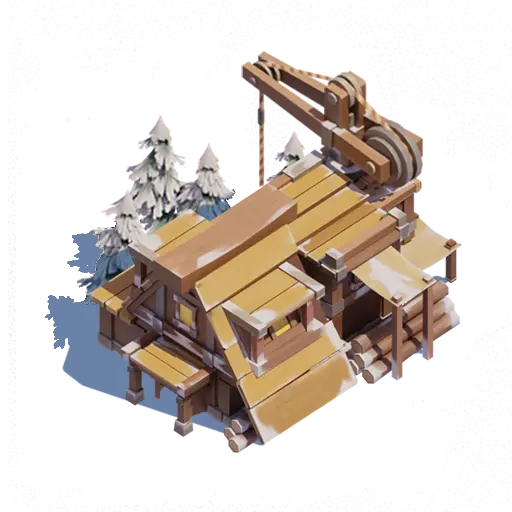
The Whiteout Survival Sawmill is the first production building available in your city. It produces Wood, one of the four basic resources used for construction, research, troop training, and general city progression.
Although Wood is easy to obtain during the opening stages, its importance increases as building costs grow. A poorly developed Sawmill will not completely stop your progress, since Wood can also come from gathering, events, resource items, and rewards. However, keeping the building upgraded provides a steady supply without using marches or opening protected resource packs.
This guide covers every Sawmill level from 1 to 30, including requirements, resource costs, construction times, furniture, Wood Output research, upgrade priorities, production tips, and common mistakes.
The Sawmill unlocks at Furnace Level 1 and has a maximum standard level of 30. Reaching Level 30 requires approximately 117.62 million Meat, 117.85 million Wood, 23.37 million Coal, 5.90 million Iron, and 8 days 14 hours 27 minutes of combined base construction time.
What Does the Sawmill Do in Whiteout Survival?
The Sawmill produces Wood continuously while Survivors are assigned to its available workstations. Upgrading the building increases its building power and supports higher Wood production through improved levels and interior development.
| Sawmill feature | Details |
|---|---|
| Building type | Resource production building |
| Resource produced | Wood |
| Unlock requirement | Furnace Level 1 |
| Maximum standard level | Level 30 |
| Main limitation | Cannot exceed the current Furnace level |
| Main benefits | Passive Wood production and additional building power |
The Sawmill is useful because its production does not occupy a world-map march. Consequently, it continues supplying your city while your marches gather other resources, join rallies, complete Intel missions, or participate in events.
When Do You Unlock the Sawmill?
The Sawmill unlocks at Furnace Level 1, making it the first production building opened in a new city.
Its first levels are extremely inexpensive and take only a few seconds or minutes. Therefore, there is little reason to leave the building behind during the earliest Furnace stages.
Beginner tip: Upgrade the Sawmill whenever the cost does not delay an important Furnace requirement. The earliest levels are fast, inexpensive, and provide useful building power in addition to Wood production.
How Sawmill Requirements Work
The Furnace determines the maximum level of most city buildings. As a result, Sawmill Level 10 requires Furnace Level 10, Sawmill Level 20 requires Furnace Level 20, and Sawmill Level 30 requires Furnace Level 30.
No separate military, Embassy, or Research Center prerequisite is shown for the Sawmill. Its main building requirement is the matching Furnace level.
Early Sawmill upgrades primarily consume Wood. Coal appears at Level 4, Iron is added at Level 6, and Meat becomes part of the cost beginning at Level 11.
| Level range | Resources commonly required | Progression stage |
|---|---|---|
| Levels 1-3 | Wood | Opening city development |
| Levels 4-5 | Wood and Coal | Early production expansion |
| Levels 6-10 | Wood, Coal, and Iron | Developing city |
| Levels 11-30 | Meat, Wood, Coal, and Iron | Mid-to-late standard progression |
Whiteout Survival Sawmill Level 1-30 Upgrade Costs
The following table lists the current base requirements for every standard Sawmill level.
Construction timers do not include reductions from research, State buffs, Chief bonuses, Zinman’s skill, pets, Alliance Help, or similar effects. Therefore, the actual timer displayed in your city may be lower.
| Level | Furnace requirement | Meat | Wood | Coal | Iron | Base time | Building power |
|---|---|---|---|---|---|---|---|
| 1 | Furnace 1 | – | 30 | – | – | 2s | 40 |
| 2 | Furnace 2 | – | 45 | – | – | 3s | 76 |
| 3 | Furnace 3 | – | 200 | – | – | 10s | 130 |
| 4 | Furnace 4 | – | 450 | 90 | – | 35s | 202 |
| 5 | Furnace 5 | – | 1.9K | 380 | – | 1m 10s | 310 |
| 6 | Furnace 6 | – | 4.8K | 960 | 240 | 2m 20s | 472 |
| 7 | Furnace 7 | – | 17K | 3.4K | 865 | 4m 45s | 706 |
| 8 | Furnace 8 | – | 31K | 6.3K | 1.5K | 7m 10s | 940 |
| 9 | Furnace 9 | – | 65K | 13K | 3.2K | 10m 30s | 1,174 |
| 10 | Furnace 10 | – | 110K | 23K | 5.7K | 14m | 1,514 |
| 11 | Furnace 11 | 110K | 110K | 23K | 5.9K | 18m | 1,854 |
| 12 | Furnace 12 | 150K | 150K | 30K | 7.5K | 21m 30s | 2,194 |
| 13 | Furnace 13 | 210K | 210K | 42K | 10K | 26m | 2,768 |
| 14 | Furnace 14 | 280K | 280K | 56K | 14K | 33m 30s | 3,342 |
| 15 | Furnace 15 | 410K | 410K | 83K | 20K | 43m | 3,916 |
| 16 | Furnace 16 | 530K | 530K | 100K | 26K | 1h 13m | 4,724 |
| 17 | Furnace 17 | 830K | 830K | 160K | 41K | 1h 27m 30s | 5,532 |
| 18 | Furnace 18 | 1.1M | 1.1M | 220K | 56K | 1h 45m | 6,340 |
| 19 | Furnace 19 | 1.4M | 1.4M | 280K | 70K | 2h 38m | 7,488 |
| 20 | Furnace 20 | 1.9M | 1.9M | 300K | 96K | 3h 17m 30s | 8,636 |
| 21 | Furnace 21 | 2.4M | 2.4M | 490K | 120K | 4h 16m 30s | 9,784 |
| 22 | Furnace 22 | 3.2M | 3.2M | 640K | 160K | 6h 25m | 11,506 |
| 23 | Furnace 23 | 4M | 4M | 800K | 200K | 8h 59m | 13,228 |
| 24 | Furnace 24 | 5.4M | 5.4M | 1M | 270K | 12h 34m 30s | 14,950 |
| 25 | Furnace 25 | 7.3M | 7.3M | 1.4M | 360K | 17h 36m 30s | 16,672 |
| 26 | Furnace 26 | 9.4M | 9.4M | 1.8M | 470K | 20h 15m | 19,202 |
| 27 | Furnace 27 | 13M | 13M | 2.6M | 670K | 1d 18m | 21,732 |
| 28 | Furnace 28 | 17M | 17M | 3.5M | 890K | 1d 3h 57m | 24,262 |
| 29 | Furnace 29 | 22M | 22M | 4.4M | 1.1M | 1d 8h 8m | 26,792 |
| 30 | Furnace 30 | 27M | 27M | 5.4M | 1.3M | 1d 14h 34m | 30,470 |
Total Sawmill Cost From Level 1 to 30
Adding the displayed upgrade values produces the following approximate totals:
| Requirement | Approximate total |
|---|---|
| Meat | 117.62 million |
| Wood | 117.85 million |
| Coal | 23.37 million |
| Iron | 5.90 million |
| Base construction time | 8 days, 14 hours, 27 minutes, and 15 seconds |
| Level 30 building power | 30,470 |
The totals are approximate because several official upgrade values are displayed in shortened form, such as 1.1M or 27M, rather than as exact individual units.
New players must develop the Sawmill and other production buildings gradually as their Furnace advances. Players comparing that early progression with an established city may review a wos account for sale, while checking the account’s state, Furnace level, transfer eligibility, resource buildings, heroes, and remaining supplies.
Sawmill Furniture Explained
The Sawmill contains several interior furniture pieces:
- Workbench
- Design Bench
- Steam Engine
- Changing Room
- Two Bellows
These items belong to the Survivor-side production system. Workbenches provide places for Survivors to work, while other interior upgrades can contribute to the building’s production setup and progression.
Furniture levels are separate from the main exterior building level. Therefore, a Level 20 Sawmill does not automatically mean every interior item is also at its maximum available level.
Furniture tip: Check the production bonus and upgrade requirement displayed in your city before spending resources. Prioritize workstations and any furniture that provides an immediate production improvement or blocks useful progress.
How to Increase Wood Production
Upgrading the Sawmill is only one part of a strong Wood-production plan. Several other systems can improve your supply.
Keep the Sawmill Staffed
Production buildings rely on Survivors assigned to their available workstations. Empty worker positions reduce the value of the building and its furniture.
If you do not have enough healthy Survivors, inspect your Shelters, city warmth, sickness, food supply, and Survivor mood.
Research Wood Output Technologies
The Economy research tree contains multiple Wood Output technologies. These research upgrades permanently improve Sawmill production.
Wood Output research is different from Wood Gathering research:
- Wood Output increases production inside the city Sawmill.
- Wood Gathering increases the speed of marches gathering Wood on the world map.
Players who confuse these two technologies may research a gathering bonus while expecting their city production number to increase.
Use Eugene’s Growth Skill
Eugene has a Growth skill connected to Sawmill production. Improving the skill increases the value provided by your city’s Wood-production buildings.
Because Eugene is available early, his production skill can provide steady value throughout standard city development.
Use Chief’s House Edicts
The Chief’s House contains Edicts that interact with Survivor work and city production.
Urgent Mobilization forces Survivors to work for an extended period at the cost of Survivor mood. Meanwhile, Rush Job immediately provides several days of production resources.
Use these Edicts carefully because they consume Contentment and may affect Survivor condition.
Gather Wood on the World Map
World gathering does not increase Sawmill output, but it remains one of the best ways to solve a temporary Wood shortage.
Gathering is especially useful when:
- A major Furnace upgrade is approaching.
- Your city production cannot cover several building queues.
- You need Wood without opening protected resource items.
- An active event rewards resource gathering.
Keep Resource Items Protected
Wood items stored in the backpack remain protected until opened. Avoid converting every Wood item into exposed city resources before you know which upgrade you are starting.
This habit reduces waste and limits the amount of unprotected resources available during an attack.
Is Upgrading the Sawmill Worth It?
Yes, especially during early city development. The first levels are inexpensive, complete quickly, and improve both production and building power.
However, the Sawmill should not automatically take priority over every other building. Its value depends on your current Wood supply and the requirements blocking your Furnace.
| Situation | Recommended priority | Reason |
|---|---|---|
| Furnace Levels 1-10 | High | Costs and timers are very low |
| Wood is a recurring bottleneck | High | Higher production reduces repeated shortages |
| Sawmill is far below Furnace | Medium to high | Several inexpensive levels may be available |
| Furnace prerequisite is incomplete | Low to medium | Complete the building that directly blocks progression first |
| Wood supply is already large | Medium | Upgrade when resources and construction queues are available |
Best Sawmill Upgrade Strategy
A practical building strategy changes as the city develops.
Furnace Levels 1-10
Keep the Sawmill close to the Furnace. Upgrade times are measured in seconds or minutes, while the resource requirements remain low.
Furnace Levels 11-20
Continue upgrading regularly, but begin balancing the Sawmill against troop camps, the Embassy, Research Center, and other Furnace prerequisites.
At this stage, Meat becomes part of the Sawmill cost and construction timers begin to grow.
Furnace Levels 21-30
Upgrade the Sawmill when Wood is limiting progress, when inexpensive power is useful, or when a relevant construction event is active.
Nevertheless, do not spend resources needed for an immediate Furnace, Embassy, troop-camp, or Research Center requirement.
Sawmill vs World Wood Gathering
Sawmill production and world gathering solve different resource problems.
| Method | Main advantage | Main limitation |
|---|---|---|
| Sawmill production | Passive and does not use a march | Production is gradual |
| World gathering | Provides larger targeted resource amounts | Uses a march and takes gathering time |
| Backpack Wood items | Available immediately and protected until opened | Limited by saved inventory |
| Events and missions | Can provide Wood alongside other rewards | Availability depends on current activities |
The most efficient approach combines passive city production with gathering and protected resource items. Relying on only one method can create unnecessary shortages.
Should You Save Sawmill Upgrades for Events?
A Sawmill upgrade can provide building power and may contribute to an event that rewards construction or power growth.
Saving an upgrade can be worthwhile when:
- The event begins soon.
- The Sawmill does not block current progress.
- You already have the required resources.
- The event reward is useful.
- Your construction queue can remain productive in the meantime.
However, waiting several days for a minor reward is inefficient when the Sawmill upgrade would solve an immediate Wood shortage or unlock useful production.
Common Sawmill Mistakes
Ignoring the Sawmill Because Wood Seems Abundant
Early upgrades consume very little Wood, which can make the resource appear unlimited. Later building and research costs are much larger, so an underdeveloped Sawmill eventually becomes more noticeable.
Confusing Wood Output With Wood Gathering
Wood Output research affects production inside the Sawmill. Wood Gathering research affects marches collecting Wood from resource tiles.
Leaving Worker Positions Empty
An upgraded production building cannot provide its expected value when available workstations are unstaffed.
Ignoring Survivor Health and Mood
Sick or unavailable Survivors cannot contribute normally. Keep the Furnace heated, maintain food and Shelter conditions, and use Chief’s House Edicts carefully.
Opening Every Wood Item Immediately
Backpack resource items are safer and easier to manage while unopened. Convert only the amount required for the next upgrade.
Using All Wood Before Checking the Furnace
Review the complete cost of the next Furnace and its prerequisite buildings before spending resources on an optional Sawmill level.
Upgrading Only the Sawmill
Wood is only one part of the city economy. Meat, Coal, and Iron become equally important as standard building levels increase.
Using Construction Speedups on Very Short Levels
The earliest Sawmill timers finish quickly without universal speedups. Save general construction speedups for longer and more important upgrades.
FAQ
What does the Sawmill do in Whiteout Survival?
The Sawmill produces Wood passively inside your city. Wood is used for buildings, research, troop training, and other forms of progression.
When is the Sawmill unlocked?
The Sawmill unlocks at Furnace Level 1 and is the first production building available to a new city.
What is the maximum Sawmill level?
The maximum standard Sawmill level is Level 30, which requires Furnace Level 30.
How much does Sawmill Level 30 cost?
Level 30 costs approximately 27 million Meat, 27 million Wood, 5.4 million Coal, and 1.3 million Iron. Its base construction time is 1 day, 14 hours, and 34 minutes.
What furniture is inside the Sawmill?
The Sawmill contains a Workbench, Design Bench, Steam Engine, Changing Room, and two Bellows.
How can I increase Sawmill Wood production?
Keep the building upgraded and staffed, improve its furniture, research Wood Output technologies, develop Eugene’s production skill, and use appropriate Chief’s House Edicts.
Does Wood Gathering research improve the Sawmill?
No. Wood Gathering increases world-map gathering speed. Wood Output research is the technology that directly increases Sawmill production.
Should the Sawmill always match the Furnace level?
Not necessarily. Keeping it close is useful during early progression, but later levels should be balanced against Furnace prerequisites, research, troop camps, and your current Wood supply.
Conclusion
The Whiteout Survival Sawmill is a basic but valuable production building that supplies Wood from the beginning of the game through Furnace Level 30.
Reaching Level 30 requires approximately 117.62 million Meat, 117.85 million Wood, 23.37 million Coal, 5.90 million Iron, and more than eight days of combined base construction time. In return, the building provides permanent power and a continuous source of Wood without occupying a world-map march.
For efficient progression, upgrade the Sawmill quickly during the early Furnace levels, keep available workstations staffed, research Wood Output technologies, and preserve backpack resources until they are needed.
Most importantly, balance the Sawmill with the rest of your economy. Passive production, world gathering, events, and protected resource items work best when used together.
Explore the Whiteout Survival guide category for more building, resource, hero, troop, and event guides.