

Richard I remains useful in young Rise of Kingdoms accounts, especially for KvK 1, Sunset Canyon, early Infantry marches, and Barbarian chaining. However, he is no longer a strong Universal Legendary Sculpture investment for a mature Season of Conquest account.
Most F2P and low-spending players should use Richard at 5-1-1-1 or 5-5-1-1. A 5-5-5-1 build provides more Infantry value, but the additional sculpture cost is worthwhile only when Richard still has a clear role in the account.
Use a Defense and Infantry sustain build when Richard leads in open field or Barbarian chaining. Richard does not have a Peacekeeping talent tree. For chaining, pair him with an AOE secondary commander and use his healing, damage reduction, and Infantry talents to keep the march active.
- New player: Unlock Richard from an early Wheel if the gem cost is reasonable.
- F2P player: Usually stop at 5-1-1-1 or 5-5-1-1.
- KvK 1 player: Useful for tanking, Canyon, and chaining.
- Existing 5-5-5-1 owner: Continue using him in suitable early or PvE content.
- Existing expertised owner: Keep him as a legacy tank and chaining commander.
- Mature account starting from 1-1-1-1: Usually skip.
Is Richard I Still Good in ROK?
Richard is still good when survivability matters more than personal damage. His healing and damage reduction can keep a march on the map for a long time, while Soul of the Crusaders weakens several nearby enemies.
Nevertheless, durability alone does not guarantee efficient PvP trades. Richard deals relatively low damage, moves slowly, and is vulnerable to healing reduction. Moreover, opponents may ignore his march and focus more dangerous targets.
| Activity | Current Assessment | Reason |
| KvK 1 open field | Useful | Strong early sustain and multi-target debuffs |
| KvK 2 open field | Situational | Still durable, but stronger damage commanders become available |
| Barbarian chaining | Strong | Healing keeps an AOE march active for longer chains |
| Sunset Canyon | Useful | Provides frontline durability and enemy debuffs |
| Modern rally leadership | Poor fit | Current specialist rally commanders offer more damage and utility |
| Modern garrison defense | Poor fit | Newer dedicated garrison commanders have replaced him |
| Season of Conquest investment | Low priority | Universal Sculptures provide more value on modern commanders |
New players should also review the Rise of Kingdoms beginner’s guide before dividing gems and Universal Sculptures between several unfinished commanders.
Meanwhile, mature players can compare Richard with current options in the updated Rise of Kingdoms commander tier list.
Richard I Quick Overview
| Attribute | Richard I |
| Rarity | Legendary |
| Nickname | The Lionheart |
| Talent trees | Infantry, Garrison, and Defense |
| Recommended troops | Full Infantry when Richard is primary |
| Best stages | Young kingdoms, KvK 1, and selected KvK 2 content |
| Best activities | Barbarian chaining, Canyon, and early open field |
| Main strengths | Healing, damage reduction, durability, and multi-target debuffs |
| Main weaknesses | Low damage, slow movement, and healing counters |
| Recommended investment | 5-1-1-1 or 5-5-1-1 for most players |
| Acquisition | Early Wheel of Fortune rotations |
How to Get Richard I
Richard normally appears in early Wheel of Fortune rotations in a young kingdom. Historically, his first commander-specific Wheel has often appeared around kingdom day 38, but the exact schedule can vary.
Before spending gems:
- Confirm that Richard is the active Wheel commander.
- Calculate the minimum spins required to unlock him.
- Avoid chasing expertise unless Richard has a long-term account role.
- Reserve enough gems for VIP progression and other account priorities.
- Do not rely on the outdated claim that Richard first appears after day 120.
Best Richard I Skill Order
5-1-1-1: Minimum Practical Build
Keep Richard at one star until Soul of the Crusaders reaches level five. This build already provides his maximum healing and enemy debuffs.
Use 5-1-1-1 for:
- Basic Barbarian chaining
- Early tanking
- Sunset Canyon
- Players conserving Universal Sculptures
5-5-1-1: Best Value for Most Players
Maximizing Chivalry adds maximum damage reduction and counterattack damage. As a result, Richard survives longer in both PvE and early PvP.
This is the recommended stopping point for most F2P and low-spending accounts.
5-5-5-1: Infantry-Focused Build
The third skill provides maximum Infantry Attack and Defense. Consider 5-5-5-1 when Richard leads a full-Infantry march and will remain active through KvK 1, KvK 2, or Canyon.
However, do not continue automatically. The same sculptures may produce more long-term value on a newer commander.
Expertise
Expertise adds all-damage reduction, a small Infantry damage bonus against Cavalry, and recurring March Speed reduction. These effects are useful but rarely justify starting Richard from low skills on a mature account.
| Skill Build | Recommended For | Verdict |
| 5-1-1-1 | Basic chaining and early tanking | Excellent low-cost option |
| 5-5-1-1 | F2P, Canyon, and stronger chains | Best general value |
| 5-5-5-1 | Dedicated early Infantry account | Useful but optional |
| 5-5-5-5 | Existing developed legacy account | Do not pursue automatically |
Richard I Skills Explained
Soul of the Crusaders

Rage requirement: 1,000
Richard heals slightly wounded units in his march. He also debuffs up to five enemy troops in a fan-shaped area for two seconds.
At maximum level, the skill provides:
- Healing factor of 1,400
- 30% enemy damage reduction
- 15% enemy March Speed reduction
The heal keeps Richard active longer, while the debuff supports nearby allies. However, healing does not eliminate every casualty, and extended fighting can still generate severely wounded troops and hospital costs.
Chivalry
Chivalry reduces damage taken by Richard’s march and increases counterattack damage.
At maximum level:
- Damage taken is reduced by 15%.
- Counterattack damage increases by 10%.
The current skill wording applies the effect to troops led by Richard. When he serves as garrison commander, it also affects the defending troops.
The Lionheart

The Lionheart increases Infantry Attack and Defense by up to 15% each. Therefore, Richard should normally use full Infantry when he leads a combat march.
Battle-Hardened

Battle-Hardened increases healing received and reduces damage taken from Watchtowers by up to 30%.
The healing bonus supports every activity. In contrast, the Watchtower reduction matters primarily when attacking player cities and does not improve normal open-field or Barbarian combat.
Tyrannical Lion

Tyrannical Lion provides:
- 5% reduced damage from all sources
- 2% additional Infantry damage against Cavalry
- 50% target March Speed reduction for five seconds every ten seconds
The recurring slow helps control enemies, but the overall expertise improvement is not large enough to make Richard a modern top-tier investment.
Best Richard I Talent Tree
Primary commander rule: Richard’s talent tree applies only when he leads. If Richard is secondary, his skills still activate, but none of his Infantry, Garrison, or Defense talents affect the march.
Open-Field Tank Talent Tree
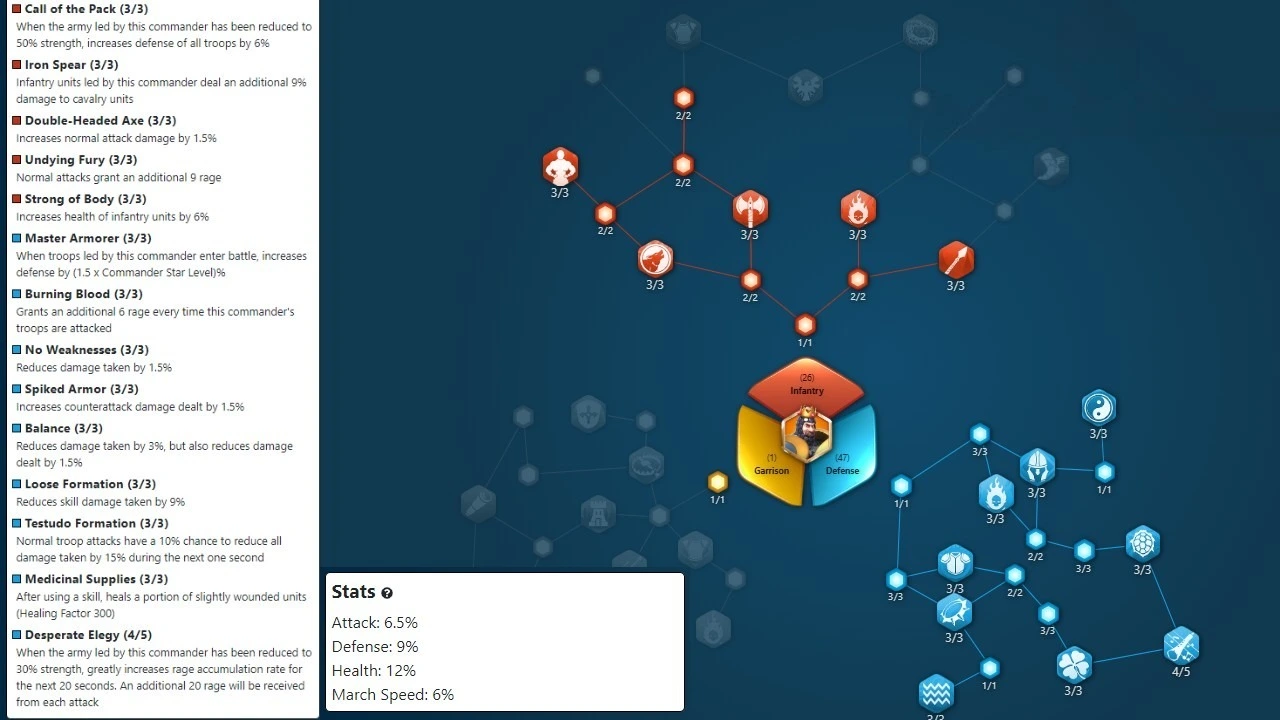
This is the main Richard talent tree for open field, Canyon, and Barbarian chaining. It emphasizes Health, damage reduction, healing support, Rage generation, and Infantry durability.
Recommended Talent Route
- Start in Infantry and take Fleet of Foot. Richard needs March Speed because his natural movement is slow.
- Add Strong of Body. Infantry Health improves both field durability and chaining efficiency.
- Move into Defense and take Loose Formation. This reduces incoming skill damage.
- Add Burning Blood. Extra Rage when attacked improves healing frequency.
- Take Medicinal Supplies. Additional healing after active-skill use supports sustain.
- Add Testudo Formation and No Weaknesses. These provide further defensive value.
- Return to Infantry and complete the full-Infantry route.
- Take Elite Soldiers or the strongest reachable Infantry endpoint.
Do not build Richard as a pure damage commander. His purpose is surviving, applying debuffs, and keeping a stronger secondary commander active.
Richard Barbarian Talent Tree
Richard does not have a Peacekeeping tree. For Barbarian chaining, use the same Defense and Infantry sustain core as the open-field build.
Prioritize:
- Healing-related talents
- Damage reduction
- Infantry Health and Defense
- Rage generation
- Enough March Speed to position the chain
This is not an efficient build for attacking individual Barbarians repeatedly because Richard has no Action Point reduction. It becomes valuable when one paid attack is used to pull several additional Barbarians into an AOE skill.
Optional Early Garrison Build
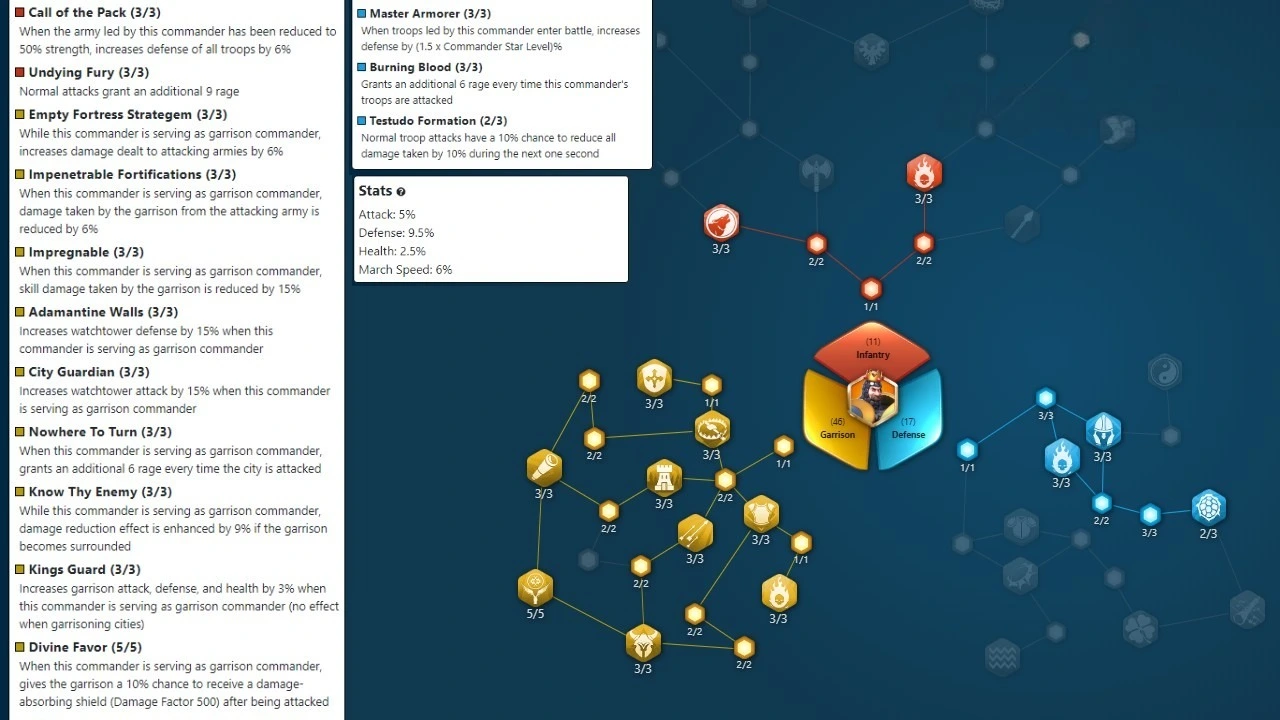
Use the garrison build only in a young kingdom where better defensive commanders are unavailable. Adjust City Guardian and King’s Guard according to whether Richard protects a city or an alliance structure.
Do not use this tree for open field or Barbarian chaining. Several Garrison talents remain inactive outside defensive structures.
Best Richard I Pairings
| Pairing | Primary | Best Use | Main Strength | Main Limitation |
| Richard and YSG | Richard | Barbarian chaining | Healing with circular AOE | Requires expertised YSG for the best results |
| Richard and Sun Tzu | Depends on talents | KvK 1 and early field | Rage generation and AOE | Limited mature-kingdom damage |
| Richard and Charles Martel | Richard or Charles | Early tank march | Very high durability | Low damage and poor later trades |
| Richard and Joan of Arc | Richard | Canyon and support | Durability with allied buffs | Very low direct pressure |
| Guan Yu and Richard | Guan Yu | Legacy backup march | Skill damage with additional sustain | Better modern secondaries exist |
| Alexander and Richard | Alexander | Legacy Infantry march | Shields, healing, and durability | Insufficient modern damage |
Richard and Yi Seong-Gye
Richard provides healing and durability while expertised YSG supplies circular AOE. This remains Richard’s most recognizable Barbarian-chaining setup.
The march can still produce hospital costs during long chains. Therefore, stop when severely wounded units, healing resources, or reduced troop count make the next pull inefficient.
Richard and Sun Tzu

Sun Tzu provides AOE damage and Rage generation. Use Richard as primary for maximum sustain or Sun Tzu as primary when faster skill cycles provide more value.
Richard and Charles Martel

This pairing is difficult to remove in a young kingdom. However, it deals limited damage and can create inefficient trades when opponents simply surround or ignore it.
Best Troops, Equipment and Formation
Troop Type
Use full Infantry when Richard leads a combat march. The Lionheart and his Infantry talents require Infantry units.
For Barbarian chaining, some players use their strongest available troop type, but Infantry remains the standard choice when Richard’s third skill and talents are developed.
Equipment Priorities
- Infantry Health
- Infantry Defense
- Damage reduction
- Infantry Attack
- March Speed
Richard already has substantial sustain. Therefore, equipment should not focus only on survival. The march also needs enough damage from its secondary commander to complete battles and chains efficiently.
Formation
Arch Formation is a practical starting point for a tank or counterattack-focused Richard march. However, Wedge may provide more value when Richard is paired with a skill-damage secondary such as YSG.
Choose the final formation according to:
- The secondary commander
- Available armament attributes
- Relevant inscriptions
- Open-field versus chaining use
- Whether counterattack or active-skill damage is the main output
How to Use Richard for Barbarian Chaining
- Use Richard as primary with a Defense and Infantry sustain build.
- Place an AOE commander such as expertised YSG in the secondary position.
- Attack one Barbarian normally and pay the initial Action Point cost.
- Position the primary target close to other Barbarians.
- Allow the secondary commander’s AOE to damage and pull nearby targets.
- Move carefully so the march does not become surrounded by too many enemies.
- Monitor troop strength and hospital accumulation.
- Return to the city when healing costs become inefficient.
Richard is not ideal for repeatedly attacking individual Barbarians because he lacks Peacekeeping Action Point talents. His value comes from surviving long enough to defeat several Barbarians after paying for one initial attack.
Common Richard I Mistakes
- Believing Richard unlocks after 120 days: He appears in early Wheel rotations.
- Searching for a Peacekeeping talent tree: Richard has Infantry, Garrison, and Defense trees.
- Expertising him automatically: Most accounts receive enough value at 5-1-1-1 or 5-5-1-1.
- Using a Garrison build in open field: Several talents remain inactive.
- Using Richard as secondary while relying on his talents: Secondary talent trees do not apply.
- Pairing two tanks without damage: The march survives but may produce poor trades.
- Using mixed troops with Richard primary: This wastes The Lionheart and Infantry talents.
- Treating healing as free: Long battles can still create expensive hospital losses.
- Presenting legacy pairings as current meta: Their value depends on kingdom age.
- Adding elemental attributes: Lightning Richard belongs to Infinity Kingdom, not ROK.
FAQ
What is the best Richard I talent tree?
Use a Defense and Infantry tank build with Infantry Health, damage reduction, healing support, Rage generation, and enough March Speed for positioning.
What talent tree should Richard use for Barbarians?
Richard has no Peacekeeping tree. Use his open-field Defense and Infantry sustain build, then pair him with an AOE secondary commander.
Is Richard I good at 5-1-1-1?
Yes. A 5-1-1-1 Richard provides maximum healing and enemy debuffs and is sufficient for basic chaining, Canyon, and early tanking.
Is Richard I worth taking to 5-5-1-1?
Yes, when Richard has a defined PvE or early PvP role. The second skill adds maximum damage reduction and counterattack damage.
Should Richard I be expertised?
Usually no. Expertise is most reasonable for an existing developed account that still uses Richard heavily for chaining, Canyon, or legacy content.
Who is the best pairing for Richard?
Richard and expertised YSG is the best-known chaining pairing. Sun Tzu, Charles Martel, and Joan of Arc are accessible early alternatives.
How do you unlock Richard I?
Richard is obtained through early Wheel of Fortune rotations. Check the live event interface because exact timing may vary.
Is Richard I still good in Season of Conquest?
He remains useful for Barbarian chaining and selected PvE or Canyon roles. However, mature accounts should not normally start investing in him from 1-1-1-1.
Comparing established Infantry rosters? Richard remains useful for early Infantry marches, Barbarian chaining, and Sunset Canyon, but his long-term value depends on skill level, equipment, and the rest of the commander roster. Players comparing ROK accounts for sale should also review Infantry technology, equipment, formations, resources, migration eligibility, and kingdom status.
Conclusion
Richard I remains a practical early tank and one of the most accessible commanders for sustained Barbarian chaining. His healing, damage reduction, and multi-target debuffs can keep an AOE secondary active through long battles.
For most players, 5-1-1-1 is enough for basic PvE use, while 5-5-1-1 provides the best balance between cost and durability. Continue to 5-5-5-1 only when Richard will lead a full-Infantry march for a meaningful period.
Use a Defense and Infantry talent route in open field and chaining. The optional Garrison tree should be limited to young kingdoms where dedicated defensive commanders are unavailable.
Most importantly, evaluate Richard by account stage. He remains useful in early kingdoms, Canyon, and PvE, but he should not consume the sculptures needed for a stronger modern field march.
Explore more commander, event, alliance, and progression content in the Rise of Kingdoms guide collection.