 Knowing the red flags when buying game currency online can help you avoid fake stores, misleading offers, suspicious payment requests, and sellers that disappear when an order goes wrong.
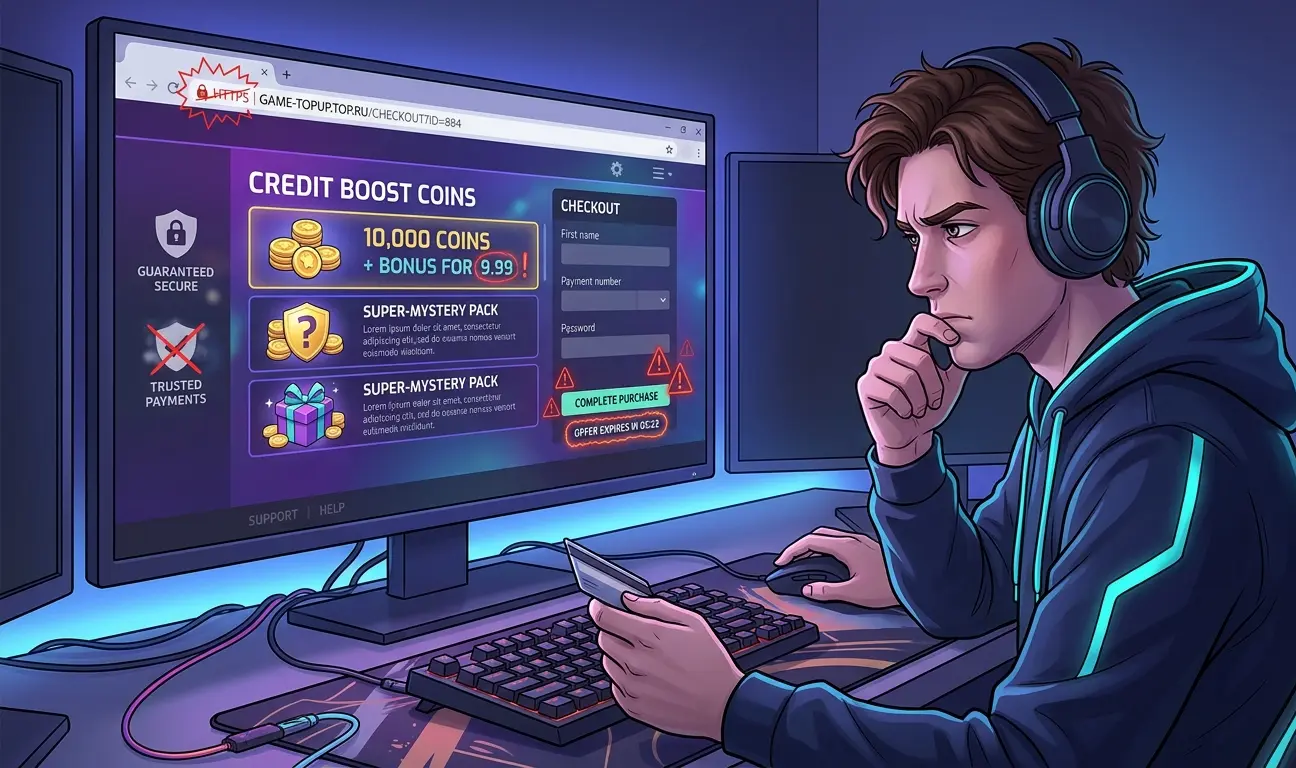
The difficult part is that a risky top-up website does not always look obviously fake. A professionally designed page, HTTPS connection, attractive prices, and familiar game artwork can make an unreliable seller look convincing at first glance.
Instead of judging a site by appearance alone, look at the entire purchase experience: the URL, price, product description, payment terms, policies, reputation, and support options. This guide explains the warning signs worth checking before you send any money.
Why Risky Game Currency Websites Can Still Look Convincing
A polished website is a presentation layer, not proof that the business behind it is trustworthy.
Fake or unreliable online stores can copy familiar design patterns, use professional graphics, display recognizable payment logos, and create product pages that initially look legitimate. Even an HTTPS connection only tells you that information sent between your browser and that website is encrypted; it does not independently prove that the seller itself is legitimate.
For that reason, players should look for consistency and transparency. The product, price, payment method, policies, support information, domain name, and outside reputation should all make sense together.
Red Flag #1: The Price Is Unrealistically Low
Extremely cheap game currency is one of the easiest ways to attract attention and encourage an impulsive purchase.
A lower price is not automatically suspicious. Legitimate sellers can offer discounts, regional pricing differences, or temporary promotions. The warning sign appears when an offer is dramatically cheaper than comparable options and the seller provides no credible reason for the difference.
Before choosing the lowest number you can find, compare several sources and ask:
- Is this price substantially below every comparable seller?
- Is the discount explained clearly?
- Are extra fees added later in the transaction?
- Is the advertised amount actually what you receive?
- Does an unusually cheap offer come with other warning signs?
If the deal only makes sense when you ignore everything else about the website, the price should not be the reason you proceed.
Red Flag #2: The Website URL Looks Wrong
Check the domain before checking the deal.
Suspicious websites may use a domain that resembles a recognizable brand but contains a spelling change, added word, unusual character, unexpected subdomain, or different domain extension.
This is especially important when you arrive through a social-media advertisement, private message, search advertisement, Discord message, email, or shortened link. A convincing page can still be hosted at the wrong address.
Do not treat the padlock icon or HTTPS as proof that a seller is legitimate. Encryption protects the connection to the website; scammers can also operate encrypted websites.
If you are expecting a particular seller, type or independently verify its correct domain rather than assuming the link you received is genuine.
Red Flag #3: You Cannot Tell Exactly What You Are Buying
A legitimate purchase should not require guesswork.
Before paying for game currency, a pack, bundle, pass, or other digital item, you should be able to understand the important order details that apply to that product. Depending on the game and service, that can include:
- the correct game title;
- the currency, pack, bundle, or item being purchased;
- the amount or package included;
- whether region, server, state, kingdom, or platform matters;
- what information the seller needs from you;
- how the purchase will be fulfilled; and
- what happens if the order cannot be completed.
Not every game uses the same delivery method, so the exact information can vary. What should not vary is clarity.
If the seller takes payment before clearly explaining what the order contains, you are accepting unnecessary uncertainty.
Red Flag #4: The Payment Process Feels Unusual or Rushed
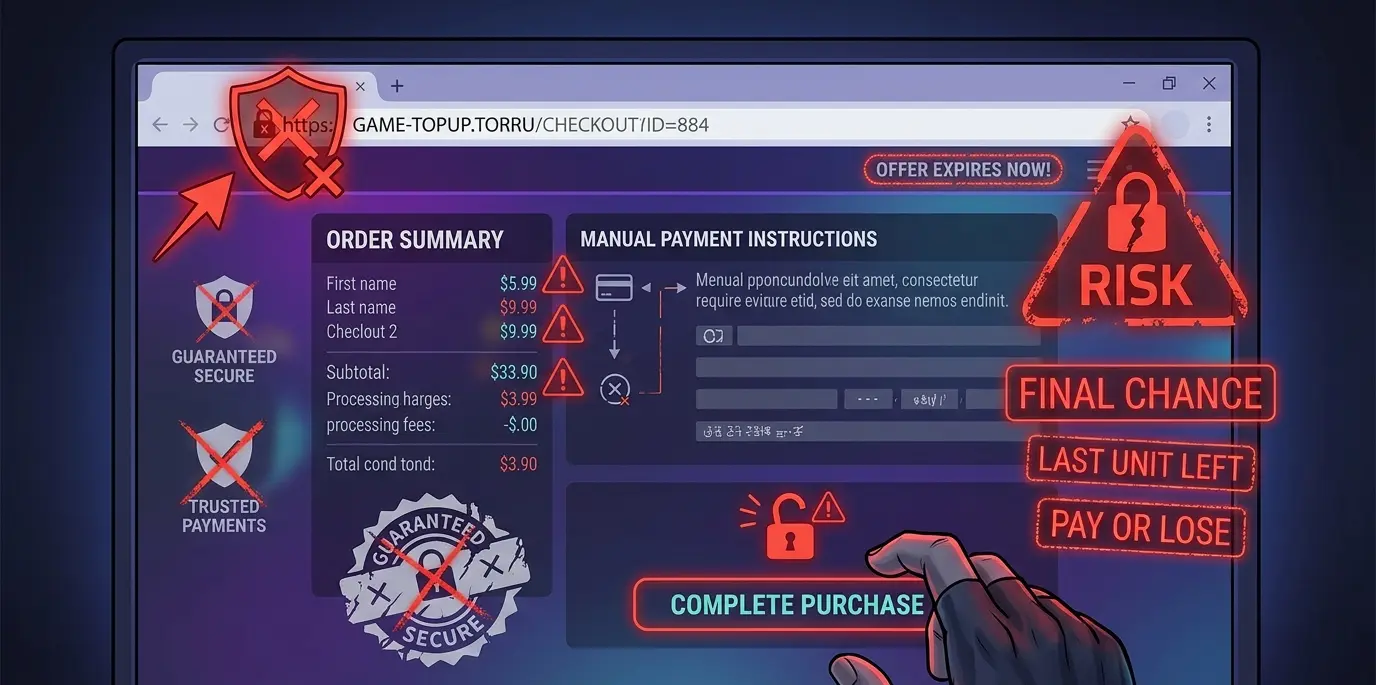 The payment stage deserves more scrutiny than almost any other part of the transaction.
Before sending money, confirm the total amount, recipient, payment type, and any protection or dispute terms associated with that method. Be cautious when a seller suddenly changes the payment instructions, sends you to an unrelated recipient, pressures you to pay immediately, or refuses to explain why a particular method must be used.
Also remember that the name of a payment provider does not automatically tell you what protections you receive. Different transaction types within the same platform can have very different rules.
For example, Heaven Guardian’s current game top up service page lists Crypto and PayPal (Friends & Family) as its current payment options. PayPal identifies Friends & Family as a personal-payment type rather than an eligible purchase covered by Purchase Protection. Cryptocurrency transfers can also be difficult to reverse after funds have been sent. Players should therefore understand the terms of the specific payment method before choosing it.
That does not mean a particular payment method proves a seller is fraudulent. It means you should understand exactly who you are paying, how the transaction works, and what recourse you have before sending money.
If checkout instructions are confusing or inconsistent, review why secure payment matters when buying game currency online before continuing.
Red Flag #5: Support Is Difficult to Find or Verify
A seller should not become impossible to contact as soon as money changes hands.
Before buying, determine how customers are expected to get help. The exact support method can vary between companies, but it should be visible, understandable, and connected to the actual business.
Warning signs include:
- no identifiable support route;
- support links that lead nowhere;
- contact details that contradict each other;
- responses that refuse to answer basic order questions;
- support accounts contacting you from unrelated identities; or
- instructions to move an existing conversation to an unexplained account or channel.
If you cannot determine how an unresolved order would be handled before purchase, think carefully about whether you want to discover the answer after paying.
Red Flag #6: The Website Uses Pressure Instead of Information
Limited-time promotions are normal. Excessive pressure is different.
Be careful when a website relies heavily on countdown timers, repeated warnings that you will lose the deal immediately, aggressive pop-ups, or messages telling you not to verify the offer elsewhere.
Urgency becomes a problem when it discourages normal checks.
A genuine discount should still leave you enough information to understand the product, seller, price, and payment terms. If the website’s strongest argument is essentially pay before you have time to think, walk away and investigate first.
Red Flag #7: Its Reputation Exists Only on Its Own Website
Testimonials published by a seller can be useful context, but they should not be your only source of reputation information.
Search outside the store before buying. Useful searches can combine the seller’s name or exact domain with terms such as:
- review;
- complaint;
- scam;
- refund;
- delivery;
- support; and
- payment.
Do not treat one positive or negative comment as definitive proof. Look for patterns instead.
For example, repeated independent complaints about the same missing orders, unexpected charges, disappearing support, or misleading product descriptions deserve more attention than one isolated disagreement.
Reviews themselves can also be manipulated. Be cautious when every review is unusually vague, uses nearly identical wording, appears within a very short period, or provides no useful detail about the actual service.
Red Flag #8: Policies, Product Information, and Branding Do Not Match
Small inconsistencies matter when they start to form a pattern.
A site may look polished on its homepage while other pages reveal problems such as:
- broken links;
- missing or incomplete policies;
- product descriptions referring to the wrong game;
- different company names in different sections;
- contradictory prices or package descriptions;
- empty social-media links;
- copied-looking text that does not match the service; or
- checkout instructions that contradict the product page.
A typo does not make a website fraudulent. However, multiple inconsistencies can suggest that the site was assembled quickly, copied from other sellers, or is not being maintained carefully.
That should make you investigate further before trusting it with payment or account information.
Red Flag #9: Several Warning Signs Appear at the Same Time
The strongest warning is often not one dramatic problem but a combination of smaller ones.
Imagine a website with an unusually cheap price, a slightly strange domain, no clear support information, an unexplained manual payment request, and a countdown insisting you pay within minutes.
Any one of those points might have an innocent explanation. Together, they create a much higher level of uncertainty.
You do not have to prove beyond doubt that a website is fraudulent before deciding not to buy. If a seller gives you several unresolved reasons to hesitate, choosing another option is a reasonable risk-management decision.
A Better Way to Check a Game Top-Up Website
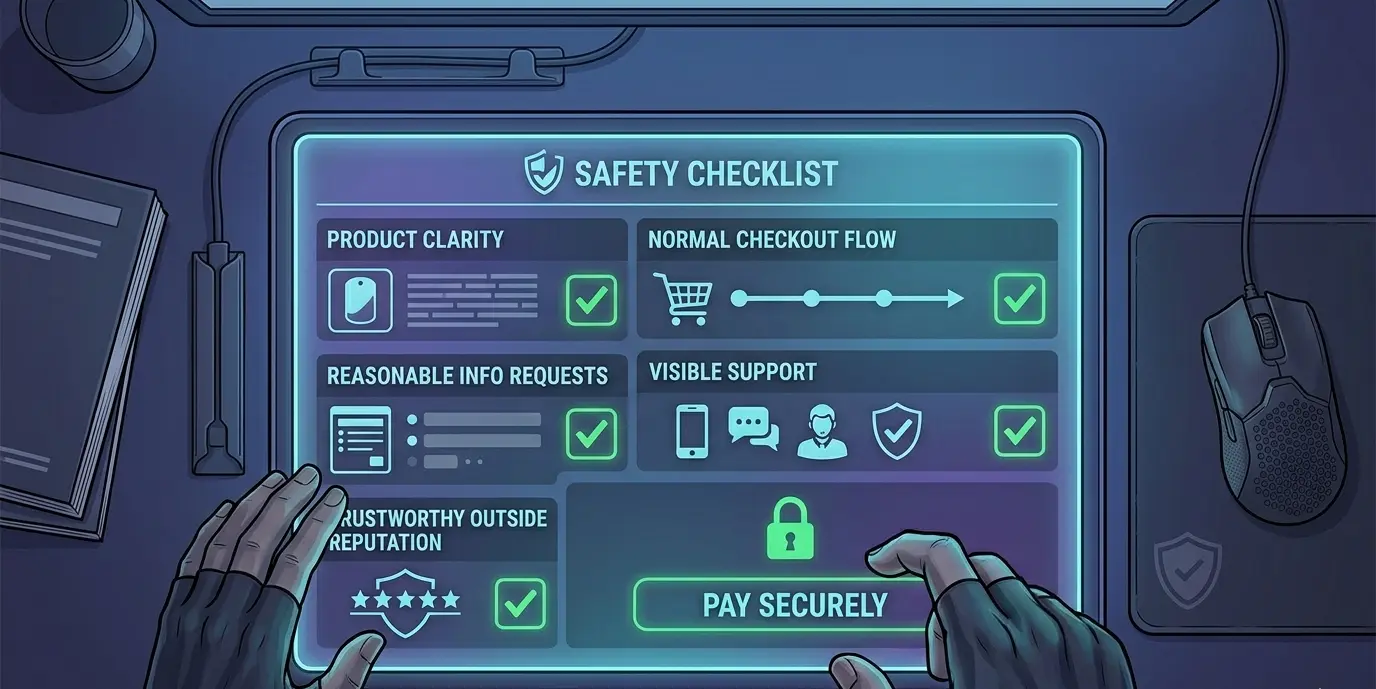 Instead of asking only, “Does this website look trustworthy?” evaluate several separate signals.
| Check | Better Sign | Warning Sign |
|---|---|---|
| URL | Domain matches the expected brand | Misspellings, strange subdomains, or unrelated domain |
| Price | Competitive and understandable | Far below comparable offers without explanation |
| Product | Clear game, amount, package, and requirements | Vague or contradictory description |
| Payment | Recipient and transaction type are explained | Unexpected recipient, changed instructions, or pressure |
| Support | A clear and verifiable way to get assistance | No visible support or inconsistent identities |
| Reputation | Independent information is available | Only unverifiable testimonials on the seller’s own site |
No single row gives you a perfect scam detector. The goal is to see whether the seller remains credible after you check several independent parts of the purchase.
What to Do If You Already Paid and Something Looks Wrong
If warning signs appear after payment, avoid sending additional money simply because the seller says another payment is required to release, verify, unlock, or complete the first transaction.
Instead:
- Save your evidence. Keep receipts, order numbers, screenshots, website URLs, usernames, payment records, and relevant messages.
- Contact the payment provider promptly. Ask what options are available for reporting fraud, stopping a pending transaction, or disputing an eligible payment.
- Secure affected accounts. If you gave credentials to a website you no longer trust, change the relevant password and review the account’s security settings. Enable multi-factor authentication when the game or connected platform supports it.
- Check connected accounts. Pay attention to the email address, platform account, or other login method connected to the game account if it may also be at risk.
- Document future contact. Be cautious if someone later contacts you claiming they can recover the money in exchange for another upfront payment.
Acting quickly does not guarantee that a payment can be recovered, especially for transaction types that are difficult to reverse, but it gives you the best chance to use whatever protections your payment provider makes available.
FAQ
What is the biggest red flag when buying game currency online?
There is no single warning sign that proves every website is fraudulent. The strongest concern is usually a combination of problems, such as an unrealistically cheap price, suspicious URL, unclear product information, unusual payment request, and poor support.
Is very cheap game currency always a scam?
No. Legitimate discounts and competitive pricing exist. However, an offer far below comparable prices should make you verify the seller, product, payment terms, and reputation more carefully before paying.
Does HTTPS mean a game top-up website is legitimate?
No. HTTPS means the connection between your browser and the website is encrypted. It does not verify that the person or company operating the website is trustworthy.
How can I check whether a game currency website is trustworthy?
Verify its exact domain, compare its pricing with other sellers, read the product requirements carefully, inspect its support and policy information, understand the payment method, and research the seller outside its own website.
Should I trust reviews shown on the seller’s website?
Do not rely on them alone. Look for independent information as well, and focus on patterns rather than individual comments. Reviews that are repetitive, vague, or overwhelmingly positive without useful detail deserve additional scrutiny.
What payment red flags should I watch for?
Be cautious if the seller unexpectedly changes the recipient or payment method, pressures you to pay immediately, refuses to explain the transaction type, or asks for additional payments after the original amount was supposedly final.
Also check the payment provider’s actual protection terms. A familiar payment brand does not mean every transaction type receives the same dispute or purchase protection.
What should I do if I suspect a game currency scam after paying?
Stop sending additional payments, save transaction evidence, contact the payment provider as soon as possible, and secure any game or platform account that may have been exposed. The recovery options available will depend on the payment method and circumstances.
Conclusion
The most useful red flags when buying game currency online are rarely hidden. They usually appear in the price, domain, product details, payment instructions, policies, support information, or reputation of the seller.
A professional-looking website should therefore be the beginning of your checks, not the end. Compare the offer with other sellers, verify where you are paying, understand what you are purchasing, and investigate inconsistencies before money changes hands.
Most importantly, do not let a cheap price or artificial deadline override several unresolved warning signs. If the transaction does not make sense after you check it carefully, choosing not to proceed is often the simplest way to reduce your risk.
For more practical advice about evaluating recharge services and purchasing in-game items, explore our game top-up guides.