
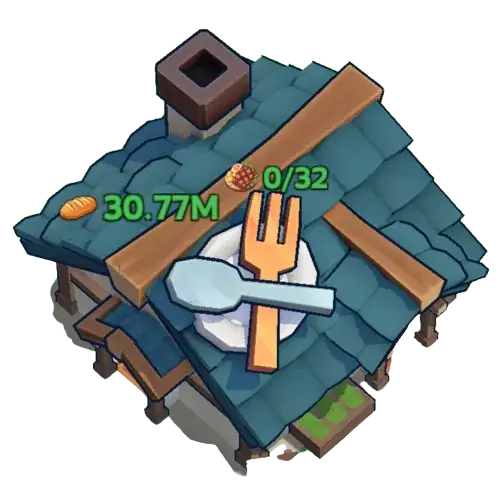
The Kingshot Kitchen prepares meals that restore survivor fullness. Higher-quality meals use more Bread but provide more fullness, which helps reduce sickness and survivor deaths. Upgrade the Kitchen and its furniture to improve cooking, distribution, eating speed, worker capacity, and warmth.
This Kingshot Kitchen guide explains how meal preparation works, which food option to choose, why survivors may still become sick, and how much every Kitchen level costs. It also covers furniture unlocks, worker increases, warmth bonuses, preparation speed, and upgrade priorities.
The Kitchen is built during the tutorial and has ten building levels. Although its construction costs are small compared with late-game military buildings, neglecting it can create settlement problems because survivors depend on it for regular meals.
What Does the Kitchen Do in Kingshot?
The Kitchen is where survivors prepare, collect, and eat meals. It uses Bread from your available food supply rather than producing Bread itself.
Its main purpose is to maintain survivor fullness. When survivors regularly receive enough food, they are less likely to become sick or die. However, meal quality, preparation speed, distribution speed, eating speed, warmth, and work schedules can all affect the final result.
The Kitchen uses three connected phases:
- Preparation: Assigned survivors cook meals with Bread and store them inside the Kitchen.
- Distribution: Survivors line up at the Sideboard to collect a meal.
- Eating: They sit at the Dining Tables and consume the food to restore fullness.
A delay in any phase can prevent some survivors from finishing their meals before their work shift resumes. Therefore, upgrading only the Kitchen building is not enough. Its internal items also need to keep pace.
Kingshot Kitchen Meal Types
The Kitchen provides three meal choices: Sawdust Bread, Cheese Pizza, and Deluxe Feast. Better meals use more Bread, but they restore more fullness.
| Meal | Fullness | Bread Use | Recommended Use |
|---|---|---|---|
| Sawdust Bread | 40 | Lowest of the three meals | Temporary option when Bread is severely limited |
| Cheese Pizza | 50 | Moderate | Balanced option for a developing settlement |
| Deluxe Feast | 60 | Highest of the three meals | Best regular choice when your Bread supply can sustain it |
Which Kitchen meal is best?
Deluxe Feast is generally the best meal because it provides the highest fullness. Greater fullness gives survivors a larger buffer before hunger begins affecting their health.
However, Deluxe Feast also consumes more Bread. A settlement with weak food production may not be able to maintain it continuously. In that situation, Cheese Pizza can provide a more sustainable middle option.
Sawdust Bread should usually be treated as an emergency or temporary choice. Its lower fullness may be insufficient when survivors have long work periods or limited time to eat.
The best practical meal strategy
- Use Deluxe Feast when your Bread income remains comfortably positive.
- Switch to Cheese Pizza when Deluxe Feast is draining food storage too quickly.
- Use Sawdust Bread only when conserving Bread is more urgent than maximizing fullness.
- Check survivor fullness after changing meals instead of assuming the selected option is sustainable.
- Improve Mill output and Bread storage if you cannot support the meal quality your population needs.
Why Are Kingshot Survivors Getting Sick?
Upgraded Survivor Houses do not guarantee that everyone will remain healthy. Survivors may still become sick when their food quality, fullness, warmth, or meal timing is insufficient.
Check the following causes in order:
Low-quality meals
Sawdust Bread restores less fullness than the other meal types. If survivors repeatedly return to work with a low fullness level, illness can continue even when their housing is fully upgraded.
Switch to Cheese Pizza or Deluxe Feast and observe whether the health problem improves.
Not enough Bread
The Kitchen cannot prepare meals without an available food supply. If the Mill and storage cannot support your selected meal, survivors may miss meals or receive food inconsistently.
Check Bread production, available storage, and consumption before assuming that the Kitchen building itself is the problem.
Slow meal preparation
A low-level Stove or insufficient number of workers can slow the preparation phase. Meals may not be ready quickly enough for every survivor.
Upgrade the Kitchen and its Stove items when preparation is the visible bottleneck.
Slow distribution
Survivors collect meals from the Sideboard. If distribution is too slow, a long queue can form and some survivors may not collect food before returning to work.
Upgrade the Sideboard when prepared meals are available but survivors remain stuck in the collection phase.
Not enough time to eat
Dining Table upgrades reduce eating time. When this phase is too slow, survivors may collect food but fail to complete the meal before the eating window ends.
Upgrade the Dining Tables when collection works correctly but survivors remain seated for too long.
Insufficient warmth
The Kitchen provides increasing warmth as its utility items are upgraded. However, Kitchen warmth is only one part of settlement temperature management.
Also check the Furnace and other relevant warmth systems, especially during colder conditions.
Kingshot Kitchen Upgrade Costs and Requirements
The Kitchen caps at Level 10. Every level requires the matching Town Center level, while later upgrades add Stone and Iron costs.
The table below uses base construction times. Your displayed time may be shorter after construction-speed bonuses, applicable skills, kingdom bonuses, and Alliance Help.
| Level | Requirement | Building Cost | Base Time | Key Unlocks | Power | Cost to Max Items at This Stage | Maximum Building Effects |
|---|---|---|---|---|---|---|---|
| 1 | Built during tutorial | 35 Wood | 00:00:02 | Stove A, Sideboard, Dining Table A, Larder | 100 | 68 Wood | +1 worker Cook: 8s Distribution: 0.8s Eating: 6.5s |
| 2 | Town Center Lv. 2 | 50 Wood | 00:00:09 | Item-level increases | 190 | 175 Wood | Cook: 7.4s Distribution: 0.7s Eating: 5.3s |
| 3 | Town Center Lv. 3 | 240 Wood | 00:00:45 | Item-level increases | 325 | 620 Wood | Cook: 7s Distribution: 0.6s Eating: 4.9s |
| 4 | Town Center Lv. 4 | 540 Wood 105 Stone |
00:02:15 | Stove B, Dining Table B, Heater | 505 | 1,561 Wood 324 Gold |
+1 worker +0.1 Warmth Cook: 6.6s Distribution: 0.5s Eating: 4.7s |
| 5 | Town Center Lv. 5 | 2,200 Wood 455 Stone |
00:04:30 | Bin | 775 | 3,340 Wood 714 Gold |
+0.1 Warmth Cook: 5.6s Distribution: 0.5s Eating: 4.5s |
| 6 | Town Center Lv. 6 | 5,700 Wood 1,100 Stone 285 Iron |
00:09:00 | Water Bucket | 1,180 | 2,400 Wood 890 Stone 1,284 Gold |
+0.12 Warmth Cook: 5.6s Distribution: 0.4s Eating: 4.5s |
| 7 | Town Center Lv. 7 | 20,000 Wood 4,100 Stone 865 Iron |
00:18:00 | Stove C, Washbasin | 1,765 | 1,088 Wood 3,495 Stone 2,074 Gold |
+1 worker +0.14 Warmth Cook: 3.8s Distribution: 0.3s Eating: 4.1s |
| 8 | Town Center Lv. 8 | 37,000 Wood 7,500 Stone 1,800 Iron |
00:27:00 | Item-level increases | 2,350 | 2,850 Stone 570 Iron 1,620 Gold |
+0.16 Warmth Cook: 3.2s Distribution: 0.3s Eating: 3.9s |
| 9 | Town Center Lv. 9 | 78,000 Wood 15,000 Stone 3,900 Iron |
00:40:30 | Cask | 2,935 | 26,400 Wood 5,870 Stone 4,104 Gold |
+0.18 Warmth Cook: 2.6s Distribution: 0.2s Eating: 3.7s |
| 10 | Town Center Lv. 10 | 130,000 Wood 27,000 Stone 6,900 Iron |
00:54:00 | Final item levels | 3,785 | 5,015 Iron 3,200 Gold |
+0.2 Warmth Cook: 2s Distribution: 0.1s Eating: 3.5s |
Total Kitchen Building and Item Costs
Using the displayed level costs, upgrading the Kitchen building from Level 1 through Level 10 requires approximately:
- Wood: 273,765
- Stone: 55,260
- Iron: 13,750
- Base construction time: 2h 36m 11s
- Maximum listed building power: 3,785
Maxing the Kitchen items at every building stage requires approximately:
- Wood: 35,652
- Stone: 13,105
- Iron: 5,585
- Gold: 13,320
These totals are based on the rounded values shown in the building table. Check the in-game screen before committing resources because displayed costs or item requirements may change after updates.
Players evaluating the time and resources required to develop a complete settlement may also compare that progression with a developed Kingshot account for sale. Review the kingdom age, Town Center, heroes, research, troop development, and remaining resources instead of judging an account only by its total power.
Which Kitchen Items Should You Upgrade First?
The best item priority depends on where survivors are losing time. Watch one complete meal cycle before spending resources, then upgrade the stage that creates the largest queue.
Prioritize Stoves when preparation is slow
Stoves affect the preparation phase. Upgrade them when workers cannot produce meals quickly enough or when the Kitchen frequently runs out of prepared food before every survivor is served.
Additional Stoves become available at Kitchen Levels 4 and 7, which creates important improvements in preparation capacity.
Prioritize the Sideboard when collection queues form
The Sideboard controls the distribution stage. Upgrade it when meals are ready but survivors spend too long waiting to collect them.
At maximum Level 10 output, distribution time falls to approximately 0.1 seconds.
Prioritize Dining Tables when eating takes too long
Dining Tables affect the final eating phase. Upgrade them when survivors successfully collect meals but remain seated long enough to miss the end of the meal period.
A second Dining Table unlocks at Kitchen Level 4, which helps the Kitchen serve a larger population.
Do not ignore utility items
The Heater, Bin, Water Bucket, Washbasin, Cask, and related items contribute to the Kitchen’s maximum effects and warmth progression.
They may not appear as urgent as Stoves or Dining Tables, but leaving them far behind can prevent the Kitchen from reaching the listed performance for its current building level.
Best Kingshot Kitchen Upgrade Strategy
1. Keep the Kitchen close to your Town Center level
The Kitchen only has ten levels, and each upgrade requires the matching Town Center level. Its timers and construction costs are small compared with most later buildings.
Therefore, there is little reason to leave it several levels behind during the early settlement phase.
2. Upgrade items before assuming you need another building level
Kitchen level and item level work together. A higher building unlocks new items and higher item caps, but those benefits are not fully realized until the furniture is upgraded.
When meal service is slow, inspect the Stoves, Sideboard, Dining Tables, and utility items before spending elsewhere.
3. Match meal quality to Bread income
The best meal is not simply the most expensive one. It is the highest-quality meal your economy can maintain without repeatedly emptying storage.
Use Deluxe Feast when sustainable, Cheese Pizza when a balanced option is needed, and Sawdust Bread only when preserving Bread is essential.
4. Increase food production before reducing meal quality
When possible, solve Bread shortages by improving the Mill, applicable research, production bonuses, and resource management before permanently lowering meal quality.
Lower-quality food may protect storage temporarily, but it can create fullness and health problems if used for too long.
5. Watch an actual meal cycle
A table can show maximum values, but your settlement reveals the real bottleneck. Observe whether survivors are waiting for meals, queuing at the Sideboard, or remaining at the Dining Tables.
This approach prevents resources from being spent on an item that is not limiting performance.
6. Coordinate Kitchen and Furnace management
Food does not solve every health problem. A survivor can have sufficient fullness and still become sick if the settlement is too cold.
Keep the Furnace and warmth systems properly managed while improving the Kitchen.
Common Kitchen Mistakes
Assuming the Kitchen produces Bread
The Kitchen prepares meals with Bread from your available supply. Bread production belongs to the Mill and other applicable production systems.
Always selecting the cheapest meal
Sawdust Bread saves Bread but provides only 40 fullness. Repeatedly using it can contribute to low fullness and survivor health problems.
Upgrading only the Kitchen building
The internal items control preparation, distribution, eating, worker capacity, and warmth. A high-level building with underdeveloped items may still perform poorly.
Blaming Survivor Houses for every illness
Housing is only one part of survivor health. Food quality, fullness, warmth, meal timing, and Bread availability must also be checked.
Using Deluxe Feast without monitoring storage
Deluxe Feast provides the most fullness, but it also uses the most Bread. Confirm that your food production can support it over time.
Ignoring the visible queue
Upgrade the item connected to the actual bottleneck. A preparation problem, Sideboard queue, and slow eating phase require different solutions.
FAQ
What does the Kitchen do in Kingshot?
The Kitchen uses Bread to prepare meals for survivors. Those meals restore fullness and help maintain survivor health.
What is the best Kitchen meal?
Deluxe Feast is generally the best option because it provides 60 fullness. However, it should only be used continuously when your Bread supply can support the higher consumption.
Why are my Kingshot survivors still getting sick?
Common causes include low meal quality, insufficient Bread, slow meal preparation, long distribution queues, insufficient eating time, or poor settlement warmth.
How much fullness does each meal provide?
Sawdust Bread provides 40 fullness, Cheese Pizza provides 50, and Deluxe Feast provides 60.
What is the maximum Kitchen level?
The Kitchen has ten building levels. Kitchen Level 10 requires Town Center Level 10.
How much does it cost to max the Kitchen building?
Based on the displayed rounded values, Levels 1-10 require approximately 273,765 Wood, 55,260 Stone, and 13,750 Iron. Item upgrades require additional resources and Gold.
Which Kitchen item should I upgrade first?
Upgrade the item connected to the visible bottleneck. Prioritize Stoves for slow preparation, the Sideboard for distribution queues, and Dining Tables when eating takes too long.
Does the Kitchen produce Bread?
No. The Kitchen consumes Bread from your available food supply to prepare meals. Improve the Mill and applicable production bonuses when Bread income is insufficient.
Conclusion
The Kingshot Kitchen is a small early-game building with an important role in settlement health. Its meals restore survivor fullness, while its workers and internal items control how quickly food is prepared, distributed, and eaten.
Use Deluxe Feast when your Bread economy can sustain it, keep the Kitchen close to your Town Center level, and upgrade the item connected to the visible meal-service bottleneck. If survivors continue becoming sick, check fullness, meal quality, Bread supply, warmth, and the complete meal cycle rather than focusing only on Survivor Houses.
For more settlement development, building requirements, hero advice, and event strategies, explore the latest Kingshot guides and tips.