
Finder’s Fortune is a hidden-object event in Kingshot where players search illustrated maps for specific items before the timer expires. Completing stages earns Finder Points, while event progression provides access to additional rewards.
The most effective strategy is to memorize item locations, avoid unnecessary failed attempts, and manage Buttery Bones and Focusbells carefully. Since hidden objects appear in fixed positions, knowing each map makes subsequent challenges considerably easier.
Each successfully found item contributes 80 Finder Points, but points are awarded only when the entire stage is completed. If the timer expires before you find every required object, the unfinished stage does not award Finder Points.
How Does Finder’s Fortune Work in Kingshot?
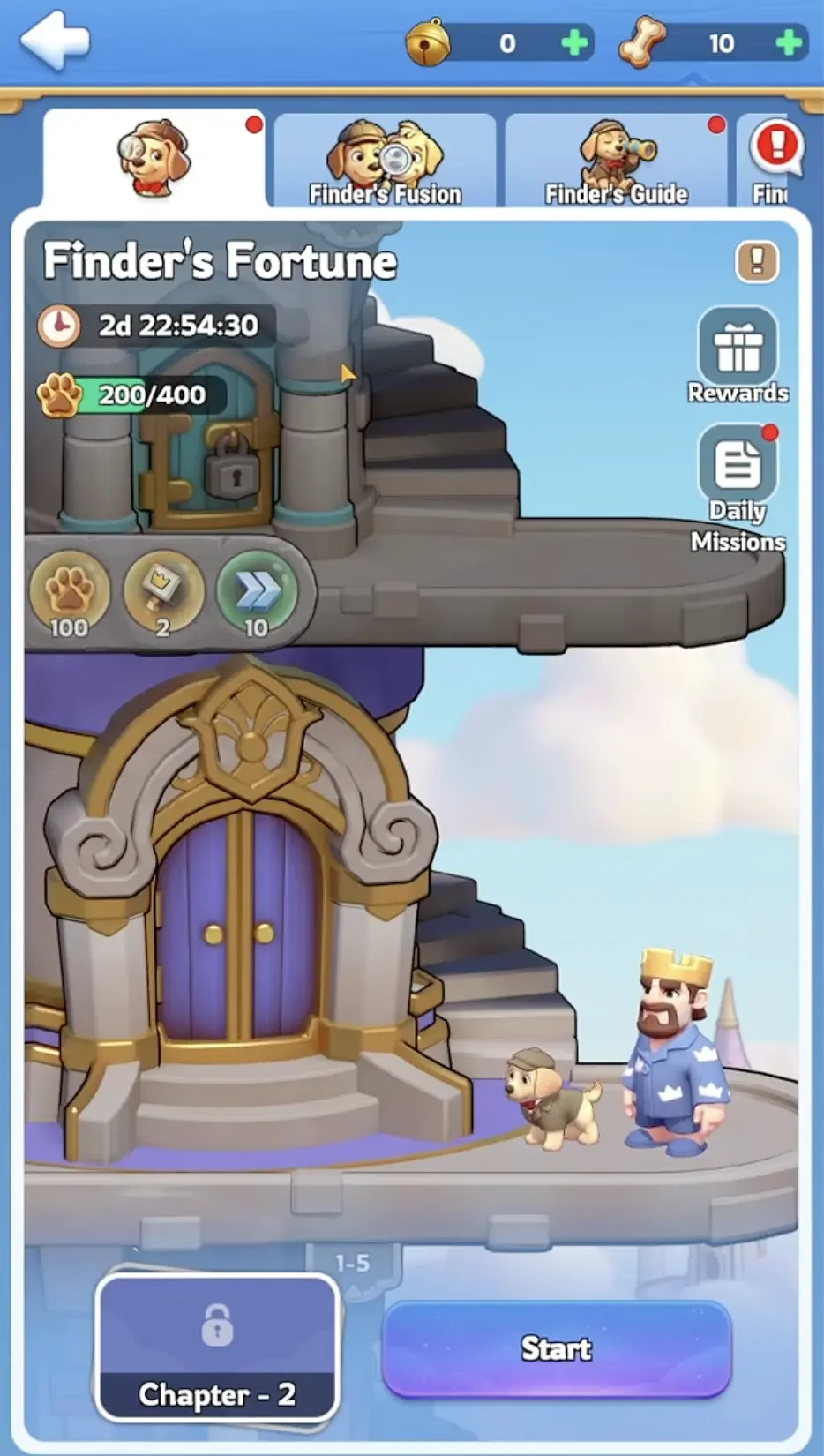

Finder’s Fortune challenges players to identify hidden objects across several illustrated environments. Each stage features a timed search with a list of requested items.
The basic gameplay follows these steps:
- Use Buttery Bones to begin a stage.
- Examine the map and identify the three objects currently requested.
- Tap each object to register it as found.
- New object requests appear as you complete existing ones.
- Find every required item before the timer expires to clear the stage and receive Finder Points.
The main difficulty comes from locating small objects hidden among buildings, decorations, tools, and environmental details.
Players who learn the maps can recognize these objects immediately instead of searching the entire illustration repeatedly.
Finder Points vs. Finder XP
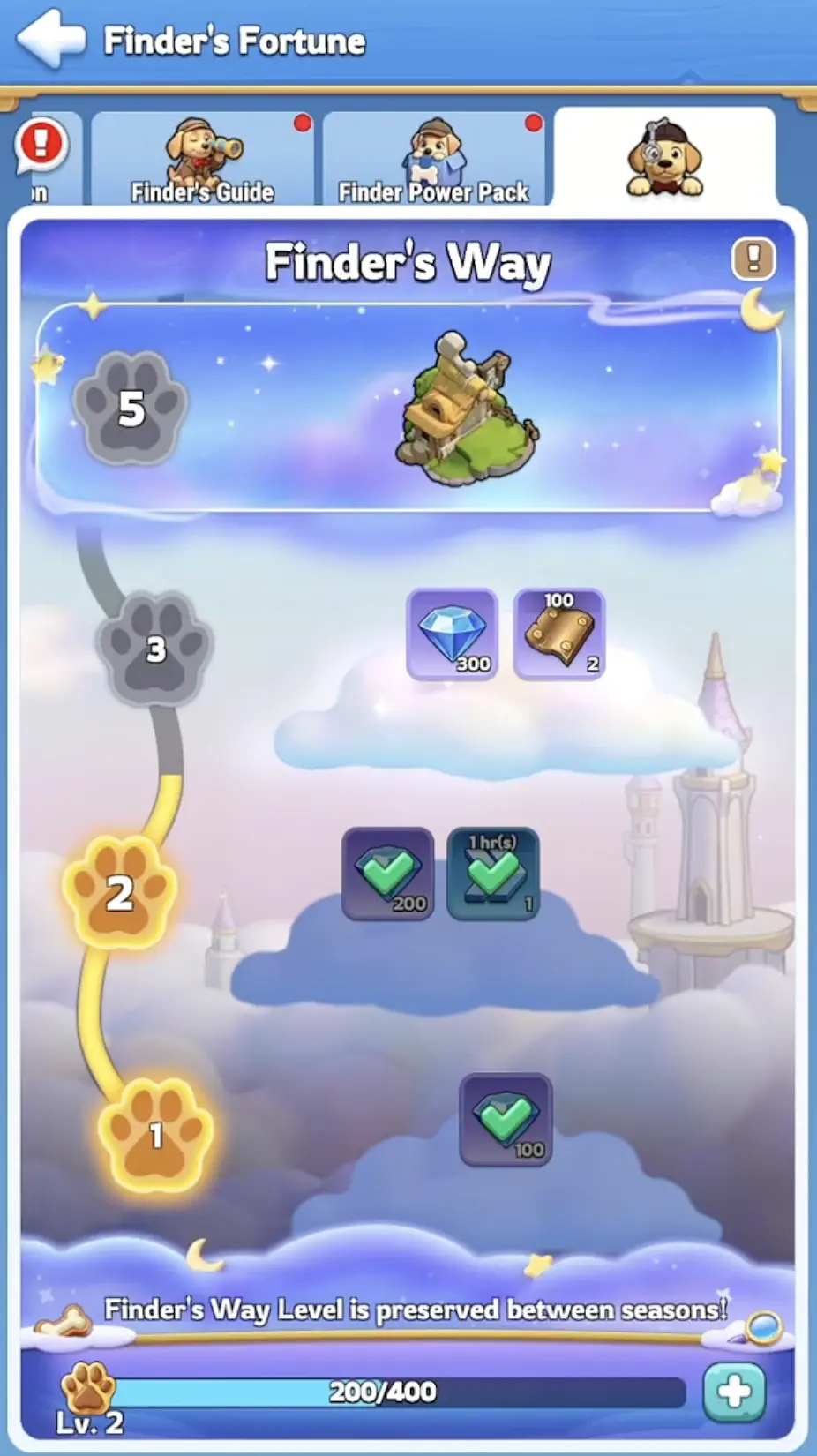
Finder’s Fortune uses two different progression measurements. Understanding their purposes is important when evaluating event performance and rewards.
| System | Purpose | How It Works |
|---|---|---|
| Finder Points | Event scoring | Earn 80 points per required item after successfully clearing a stage. |
| Finder XP | Reward-track progression | Advances event rewards and can receive bonuses from eligible paid tracks. |
Finder Points and Finder XP are separate systems. Purchasing an XP bonus does not mean every item becomes worth more Finder Points.
All Finder’s Fortune Maps and Chapters
Finder’s Fortune features three documented hidden-object environments containing 130 distinct item locations.
Although individual stages request different combinations of objects, each item’s position remains consistent within its map.
| Map | Introduction | Hidden Items | Main Challenge |
|---|---|---|---|
| Forest Camp | Tutorial | 30 | Small objects around the tent, trees, and campfire |
| Village Square | Chapter 1 | 50 | Objects blending into buildings, rooftops, and the fountain |
| Lumber Yard | Chapter 2 | 50 | Tools and small objects scattered among wooden structures |
These are map layouts rather than a complete list of every stage in the event. The same environments can appear in multiple challenges with different requested objects.
Forest Camp: Learn the Basic Item Positions
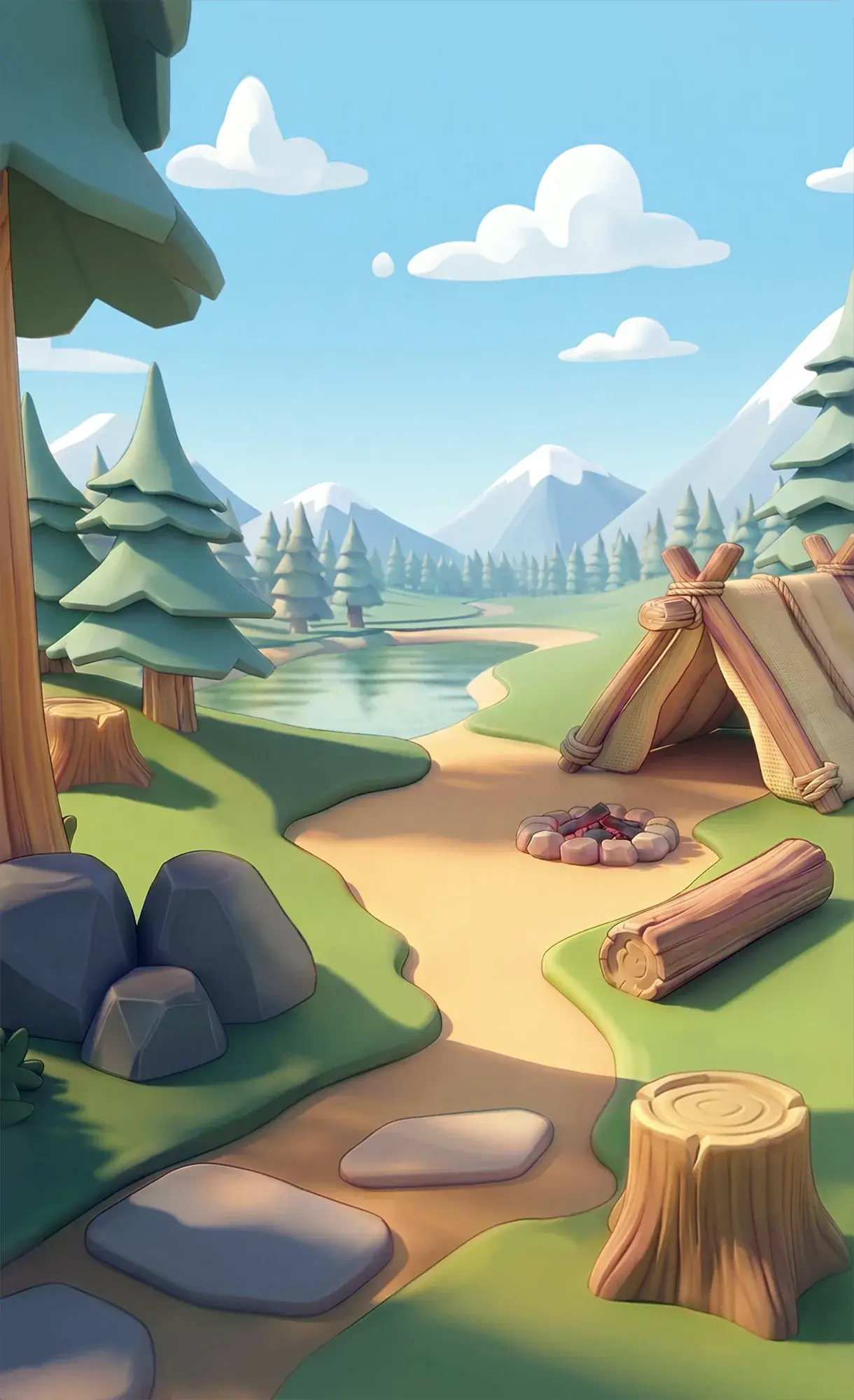
Forest Camp introduces the hidden-object mechanics using a relatively compact environment.
Many objects are concentrated around the tent and campfire on the right side of the map. However, players should also inspect the trees and ground on the left.
Pay particular attention to the tent entrance, campfire equipment, tree trunks, and sandy pathways. These areas contain several small items that are easy to overlook.
Village Square: Check Buildings and Rooftops

Village Square contains 50 hidden objects, with many positioned near the central plaza, timber houses, stone archway, and fountain.
A common mistake is concentrating exclusively on objects near ground level.
Some items appear higher up, including the Key on the right-hand roof and the Anemometer on the tower. The Shield is another object worth remembering when searching above the plaza.
When an object seems impossible to find, inspect rooftops, walls, ledges, and the upper portions of buildings before repeatedly scanning the ground.
Lumber Yard: Search by Sections

Lumber Yard is particularly challenging because hidden objects are distributed across a wider area.
Wooden structures also make tools and similarly colored items harder to distinguish from the background.
Rather than relying on color alone, look for recognizable outlines. Objects such as the Hammer, Knife, and Toolbox can blend into nearby timber.
Do not ignore the bottom of the map. Several objects appear around the sawmill deck, wagon, fences, and nearby ground.
Finder’s Fortune Hidden Item Locations
Memorizing every object immediately is unnecessary. A better approach is to learn the smallest and least obvious objects first.
The following locations are particularly useful when a stage becomes difficult.
Forest Camp Item Locations
| Item | Location |
|---|---|
| Dagger | Inside the tent doorway |
| Grilled Skewer | Standing near the campfire ring |
| Brush | Attached to the tree trunk at the far left |
| Pinecone | On the sandy path below the campfire |
Village Square Item Locations
| Item | Location |
|---|---|
| Pouch | On the ground near the stone archway, left of the fountain |
| Starfish | On the stone ledge beside the fountain’s right-side steps |
| Rubber Duck | Floating inside the fountain basin |
| Fish | On the upper wall of the left timber house |
Lumber Yard Item Locations
| Item | Location |
|---|---|
| Beast Trap | On the central dirt path beyond the sawmill roof |
| Bone | Beside the wooden fence near the sawmill deck |
| Scarf | Hanging inside the doorway of the right-side cottage |
| Bottle | In the grass near the bottom fence |
These are not the only items available, but they are useful starting points because their size or placement can make them difficult to identify quickly.
If your event presents an unfamiliar item, use its exact in-game name when consulting a map reference. Learning its position once can save time across future stages.
Prioritize memorizing small objects over large landmarks. A Horse, Chimney, or Hot Air Balloon is usually much easier to recognize than a Bottle, Bone, or Pouch. Learning the difficult objects first reduces the chance of losing an otherwise successful stage.
Best Strategies to Complete Finder’s Fortune Stages
Because Finder Points depend on completing a stage, reliable clears matter more than rushing through individual searches.
1. Divide Each Map Into Search Zones
Instead of scanning randomly, mentally separate the environment into sections.
- Forest Camp: Left trees, central path, campfire, and tent.
- Village Square: Left buildings, central plaza, fountain, right buildings, and rooftops.
- Lumber Yard: Upper structures, central sawmill, cottage, fences, and bottom edge.
When a new object is requested, begin with the area where it logically belongs.
For example, a household decoration may be easier to locate around a building, while a tool may be positioned near the sawmill.
These associations are only search shortcuts. The actual fixed item positions should take priority once you know them.
2. Focus on the Three Active Requests
The game displays three requested objects at a time.
Identify their likely locations before tapping whenever possible. Once an object is completed, check the newly introduced request and adjust your search.
This keeps your attention on the current objectives instead of unrelated map decorations.
3. Learn From Failed Attempts
If an unfamiliar object causes a failed stage, make that specific item your next learning priority.
Remember the object name, find its location, and associate it with a nearby landmark.
Because item positions are fixed, this knowledge remains useful when the same map appears again.
4. Avoid Unnecessary Panic Tapping
When the timer is nearly finished, repeatedly tapping uncertain locations is rarely a reliable solution.
Use your remaining time to inspect the most likely area or decide whether continuing the stage with a Focusbell makes sense.
The objective is to finish the entire stage, not simply identify as many objects as possible before failing.
Buttery Bones: How to Use Them Efficiently
Buttery Bones are the event resource used to start Finder’s Fortune stages.
Managing them efficiently is especially important because incomplete stages do not award the Finder Points you would receive from successfully clearing them.
The best approach is to improve your familiarity with the maps before committing resources to more difficult challenges.
Should You Save Buttery Bones?
You can hold Buttery Bones while preparing for a difficult stage, but they should not be saved beyond the event’s ending time.
Unused Buttery Bones do not carry over to future event periods and are excluded from the end-of-event reward mail.
For efficient resource management:
- Review unfamiliar maps before beginning a stage.
- Practice recognizing the smallest hidden objects.
- Prioritize completing stages rather than attempting them carelessly.
- Use your remaining Buttery Bones before the event closes.
Any Buttery Bones needed for additional attempts are more valuable when you already understand the map.
Focusbells: When Should You Use Extra Time?
Focusbells allow players to continue a failed stage by adding extra time.
Using a Focusbell to continue also provides one free Hint, helping locate an item that may have caused the failure.
Additional time can be purchased more than once, but that does not mean continuing is always worthwhile.
Good Situations for Using Focusbells
- Only one or two requested items remain.
- You already know where the remaining items are located.
- The free Hint is likely to resolve the final missing object.
- The additional time gives you a realistic opportunity to complete the stage.
When to Avoid Using Focusbells
- Many requested objects remain unfinished.
- You have not learned the map and are still searching randomly.
- You cannot identify a likely location for the missing items.
- Continuing would consume resources without a reasonable chance of success.
If several objects remain unknown, restarting after learning their positions may be a more sensible choice than repeatedly extending the timer.
Do not automatically spend Focusbells whenever a stage fails. Extra time is most valuable when completion is already within reach. Repeated extensions cannot compensate for unfamiliarity with most of the required item locations.
Finder’s Fortune Co-op Strategy
Finder’s Fortune also supports cooperative challenges where players work together to complete hidden-object stages.
Coordination can make these challenges more manageable, especially when the map contains numerous small items.
Divide the Search Area
Before starting, agree on which parts of the map each player will focus on.
For example, one player can concentrate on the left side while another searches the right.
This reduces duplicated searching and helps the team cover more of the environment.
Communicate Difficult Item Locations
When a player recognizes a small object, sharing its location immediately can help teammates react faster.
Use recognizable landmarks such as the fountain, tent, sawmill, or cottage instead of vague directions.
For consistent co-op performance, prioritize accurate item identification and successful stage completion over unnecessary speed.
Finder’s Fortune Rewards and Paid Tracks
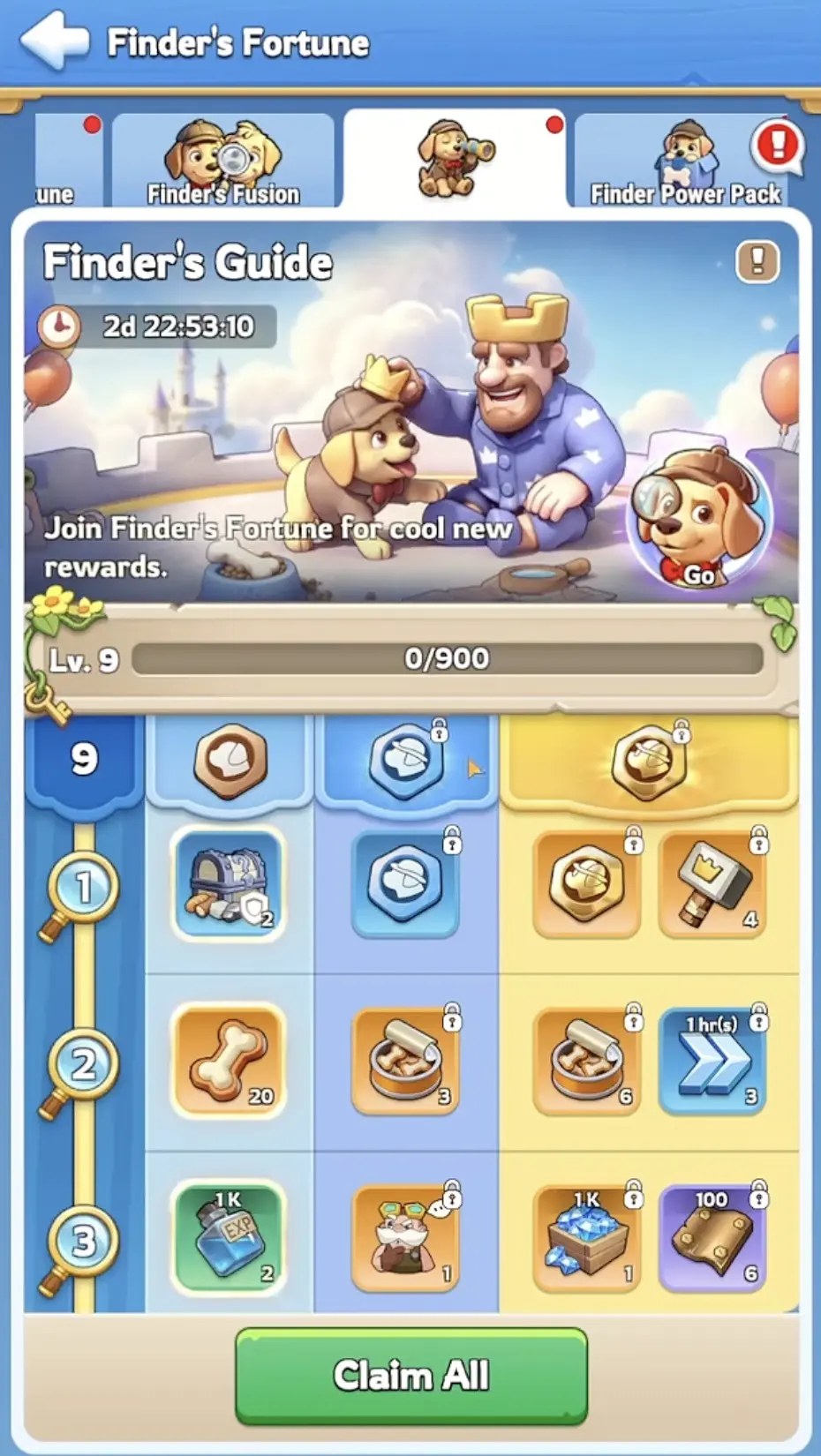
Finder’s Fortune includes reward-track progression through Finder XP.
Two paid options, Treasure Guide and Trove Map, provide additional rewards alongside Finder XP bonuses.
The bonuses from these tracks can stack when both are active.
However, an important limitation applies: bonus Finder XP is only awarded for XP earned after the relevant track has been unlocked.
Treasure Guide vs. Trove Map
| Option | Main Benefit | Important Consideration |
|---|---|---|
| Treasure Guide | Additional rewards and Finder XP bonus | The XP bonus is not retroactive |
| Trove Map | Additional rewards and Finder XP bonus | The XP bonus is not retroactive |
| Both Tracks | Stacking Finder XP bonuses | Greater potential benefit when unlocked early |
Are the Paid Tracks Worth Buying?
Players considering either track should evaluate the rewards against their own progression needs and spending budget.
If you intend to purchase a track, unlocking it early allows its Finder XP bonus to apply to more of your subsequent event activity.
Purchasing near the end can still provide access to track rewards, but it offers less opportunity to benefit from the XP multiplier.
Finder Power Packs are another optional spending choice. Additional Buttery Bones are most useful when you can reliably complete stages rather than repeatedly fail them.
Check the rewards, prices, and event rules displayed in your game before purchasing, since availability and event details may change.
What Happens to Unclaimed Rewards?
Rewards you have already earned but forgotten to claim are sent through in-game mail when the event ends.
Buttery Bones are different: unused Bones expire rather than being preserved for later use.
This distinction is important when managing resources near the event deadline.
Common Finder’s Fortune Mistakes
Several avoidable mistakes can reduce event efficiency.
- Ignoring small objects: Spending too much time searching for tiny items can cause the timer to expire.
- Searching the same area repeatedly: A structured search pattern covers the map more effectively.
- Forgetting rooftops: Village Square includes objects above ground level.
- Ignoring the bottom edge: Lumber Yard contains several objects near the sawmill deck and wagon.
- Using Focusbells without a clear plan: Additional time is less useful when many item locations remain unknown.
- Buying XP bonuses late: Earlier Finder XP does not receive retroactive paid-track bonuses.
- Leaving Buttery Bones unused: They expire when the event ends.
Most of these problems can be avoided through preparation and learning the maps instead of depending on repeated attempts.
FAQs
No. Each map uses fixed item locations. The requested objects can change from stage to stage, but an individual object appears in the same place whenever it is included.
The three documented maps contain 130 item locations in total: 30 in Forest Camp, 50 in Village Square, and 50 in Lumber Yard.
How many Finder Points do you earn per item?
Each required item contributes 80 Finder Points after successful stage completion. An unfinished stage does not award Finder Points for the items found before failure.
What happens if I fail a stage?
You do not receive Finder Points for an incomplete stage. Depending on your resources, you can continue using Focusbells or attempt the challenge again using Buttery Bones.
Do Focusbells provide a Hint?
Yes. Continuing a failed stage using Focusbells provides additional time and one free Hint.
Can Finder XP bonuses be applied retroactively?
No. The bonuses associated with Treasure Guide and Trove Map apply only to eligible Finder XP earned after their perks are unlocked.
Should free-to-play players participate in Finder’s Fortune?
Yes. The hidden-object gameplay rewards map familiarity, careful searching, and successful stage completion. Players can focus on improving their clear rate and collecting available rewards without purchasing optional tracks.
For players exploring broader account progression options beyond this event, Heaven Guardian also offers Kingshot accounts for sale. Account progression is separate from Finder’s Fortune, where understanding the maps remains essential.
Conclusion
Finder’s Fortune is a Kingshot event where preparation and map knowledge make a significant difference. Learning fixed item locations, concentrating on difficult objects, and completing stages consistently are the foundations of an effective strategy.
Use Buttery Bones before they expire, reserve Focusbells for recoverable attempts, and consider paid reward tracks only when their benefits match your priorities. In cooperative challenges, divide the map and communicate item locations to improve consistency.
For additional event strategies, progression advice, and gameplay tips, explore our more Kingshot guides on Heaven Guardian.