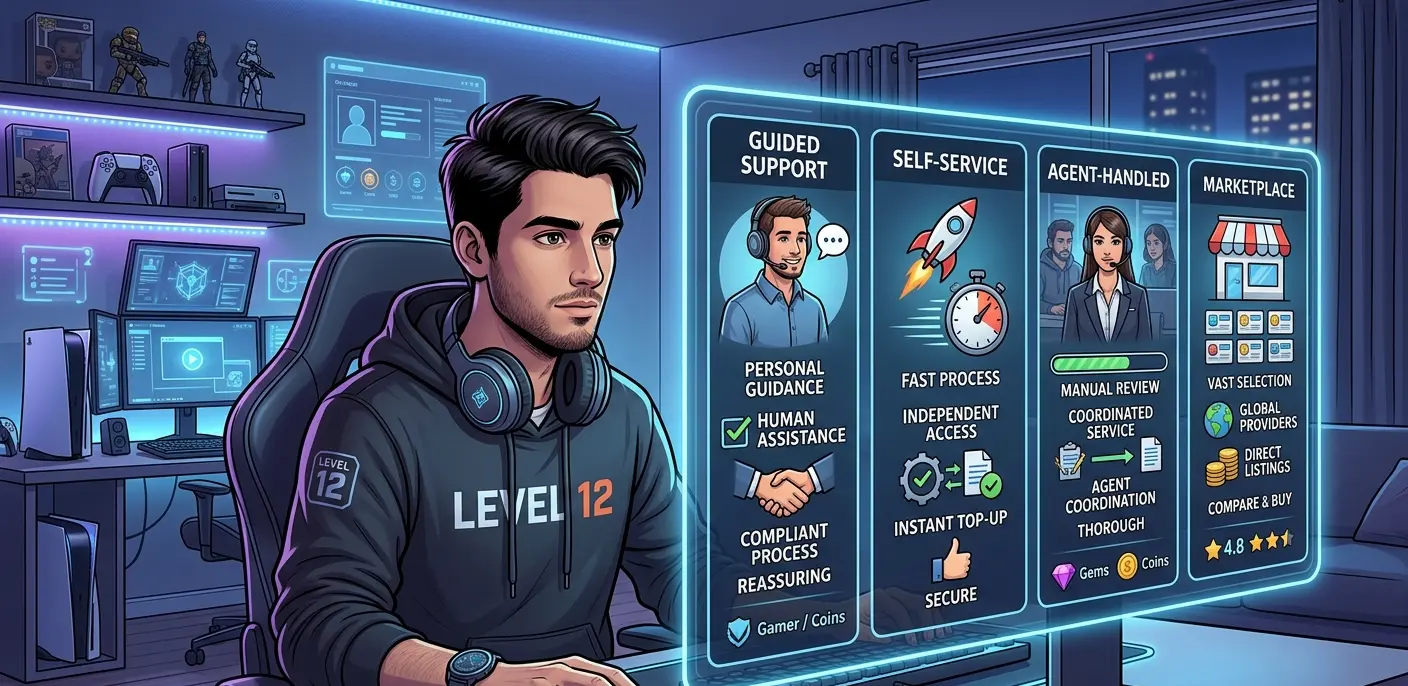
 A Skycastle top up works differently from many self-service game recharge platforms. Skycastle uses an agent-handled purchasing model, while services such as LootBar, G2A, and Heaven Guardian approach game purchases in different ways.
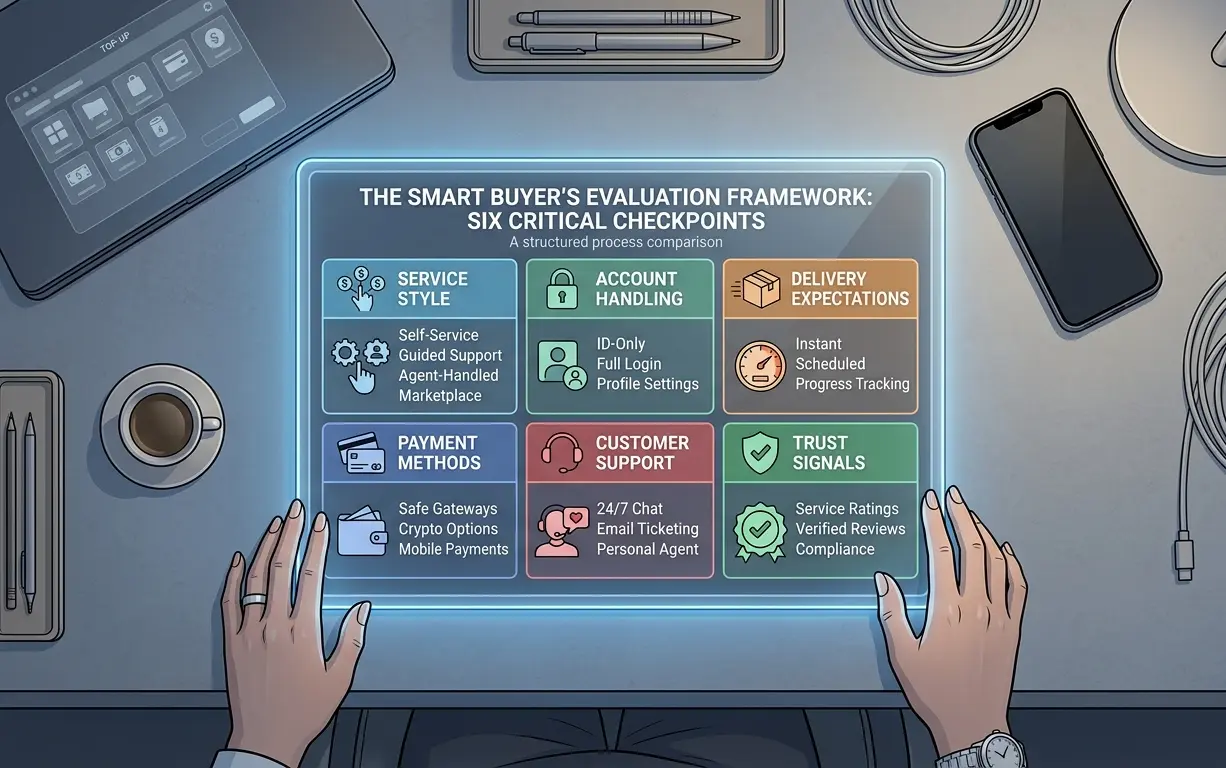
Those differences matter because comparing game top-up platforms only by price can hide important details about account access, payment methods, processing time, ordering flow, and customer support.
This comparison explains how Skycastle, LootBar, G2A, and Heaven Guardian currently differ so you can choose a purchasing model that matches your expectations rather than assuming every top-up website works the same way.
Skycastle Top Up vs Other Platforms: Quick Comparison
| Platform | Service Model | Account Handling | Published Processing Information | Best Fit |
|---|---|---|---|---|
| Heaven Guardian | Guided, ticket-based service | Temporary login access is required for the top-up process | Most top-ups are estimated at 5–30 minutes after payment confirmation | Buyers who prefer direct assistance |
| LootBar | Self-service platform with multiple top-up methods | May use UID/Game ID or account information depending on the game and method | LootBar currently states that top-ups are usually completed within 3–5 minutes | Buyers who prefer independent checkout |
| Skycastle | Agent-handled in-app purchasing | Account information is provided so an agent can log in and make the purchase | Skycastle currently describes around 30 minutes as typical, with possible delays | Buyers comfortable with an agent-managed purchase |
| G2A | Digital marketplace | Depends on the particular digital product or seller listing | Varies by product and seller | Buyers comfortable comparing marketplace listings |
Important: Processing times above are published estimates or platform descriptions, not guaranteed completion times. Availability, game requirements, server conditions, payment confirmation, and the individual product can affect an order.
Why You Should Compare the Service Model First
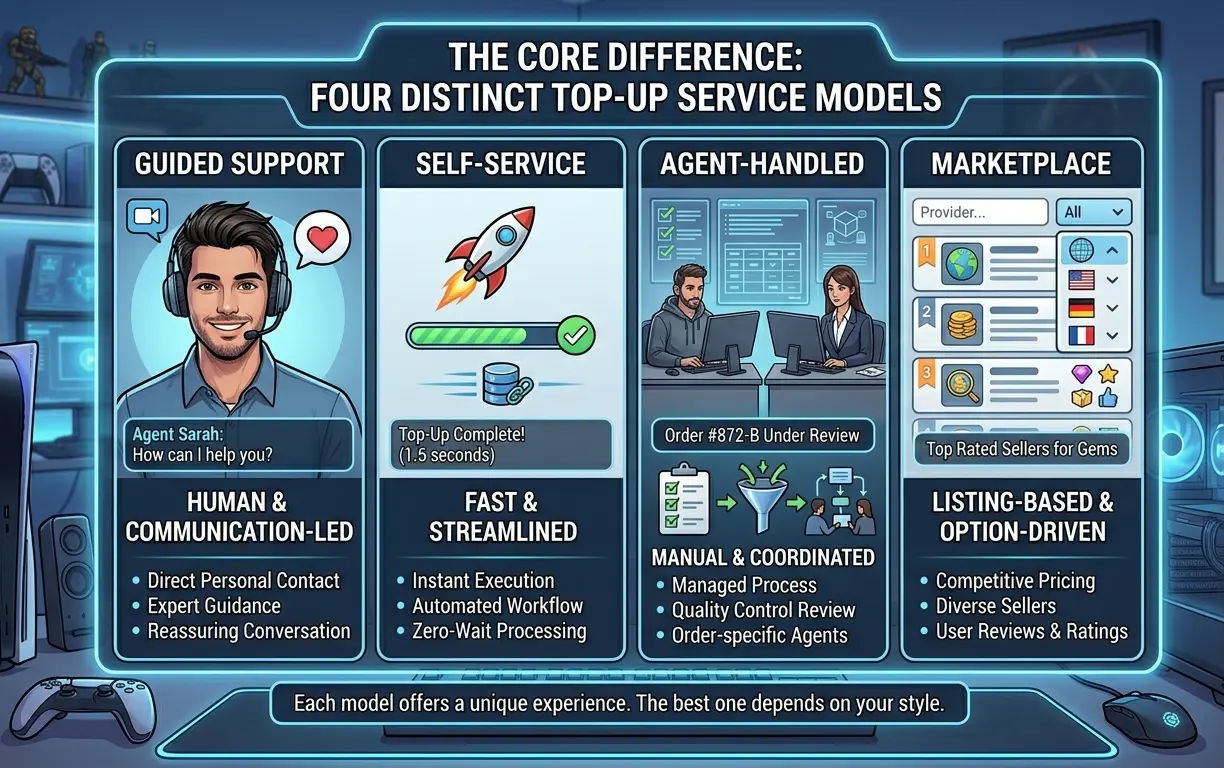 Searching for the lowest advertised price is easy. Understanding how the purchase is actually completed is more important.
One platform may let you enter a player ID and check out independently. Another may require temporary account access so an agent can buy the requested package inside the game. A marketplace may instead sell a digital code or another product supplied by an individual business seller.
None of those models is automatically suitable for every player. The important part is knowing which model you are accepting before paying.
Heaven Guardian: Guided and Ticket-Based
Heaven Guardian uses a more support-led ordering flow. Its current process begins through the official Discord ticket system, where the customer identifies the game and package, confirms the order, completes payment, and provides the account access needed for processing.
This makes Heaven Guardian different from a pure UID-only service. Temporary access is for completing the requested top-up; it does not mean transferring ownership of the player’s account.
Players should never publish login information in public Discord channels, comments, reviews, or social media posts. They also should not provide unrelated sensitive information such as an email-account password, banking password, cryptocurrency seed phrase, private key, or recovery phrase.
The guided model is likely to appeal most to players who want to communicate with someone before or during the purchase rather than complete the entire transaction through an automated checkout.
LootBar: More Self-Service Options
LootBar currently operates more like a conventional online game recharge platform. Its top-up catalogue covers many games, and its published process supports both direct top-up using game identifiers and self-top-up options.
The exact requirement varies by game. LootBar states that a transaction may involve entering a Game ID or providing account information after payment. This means buyers should check the instructions for the specific title instead of assuming that every LootBar purchase follows an identical UID-only process.
This structure is better suited to players who already know which game and package they want and prefer a more independent checkout experience.
How Does a Skycastle Top Up Work?
Skycastle describes itself as an in-app purchase service in which its agents buy digital products for the customer from the game’s store.
Its current ordering information states that the customer first provides the account information required for the top-up. The customer should then give the agent precise information about the item to buy. Skycastle recommends clearly identifying the requested item so the wrong purchase is not made.
During processing, Skycastle says the customer should remain logged out because the agent needs to log into the game account. After the purchase is completed, the customer is informed and can log back in to confirm the item.
Skycastle also currently states that it stores the supplied account information in its database so repeat customers do not need to provide the same information for every purchase.
G2A: A Marketplace Rather Than One Top-Up Workflow
G2A needs a different comparison standard because it operates as a digital marketplace. Businesses list digital products for buyers rather than G2A functioning as one uniform agent-handled game top-up service.
Available products can include activation codes, game keys, gift cards, subscriptions, in-game items, and currencies. Therefore, the exact buying and delivery process depends on what is being sold and the individual listing.
When comparing G2A with Skycastle or another direct service, check the actual product type, seller information, region or activation restrictions, and listing terms rather than relying only on the marketplace name.
Account Access Is One of the Biggest Differences
Account handling deserves close attention because it changes both convenience and the amount of access involved in completing a top-up.
- Heaven Guardian: uses temporary account access as part of its guided top-up workflow and states that the account information is not stored.
- Skycastle: says account information is needed for its agents to perform the in-game purchase and that the information is stored for repeat purchases.
- LootBar: supports several methods, including direct Game ID/UID-based top-ups for supported games and processes that can require account information.
- G2A: does not have one universal account-access method because it is a marketplace and requirements depend on the product being purchased.
This distinction is more useful than asking whether a platform “needs a password” in general. The correct question is what access does this specific transaction require, why is it required, and how does the provider say it handles that access?
Compare Payment Methods and Payment Protection Separately
 A long list of payment methods can make checkout more convenient, but payment availability and buyer protection are not the same thing.
Heaven Guardian Payment Options
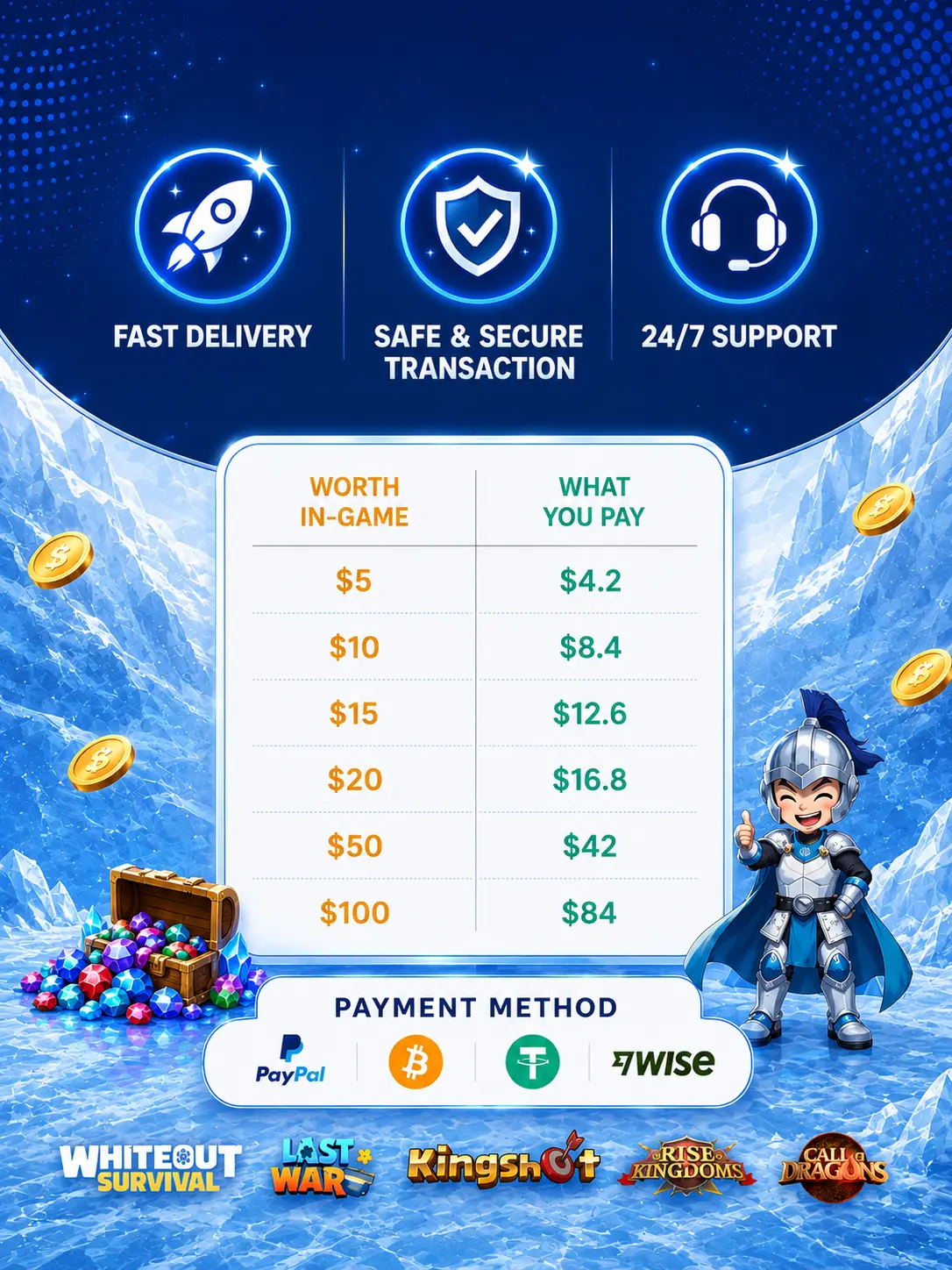
Heaven Guardian’s current Game Top Up page lists Crypto and PayPal Friends & Family for top-up orders.
Players considering PayPal should understand the distinction between payment types. PayPal treats Friends & Family as a personal payment rather than a standard Goods & Services transaction, and personal payments are not covered by PayPal Purchase Protection.
That does not determine whether an individual order will succeed or fail. It does mean buyers should understand the payment arrangement and Heaven Guardian’s own refund policy before sending payment.
Skycastle Payment Options
Skycastle’s current Q&A lists several payment options, including cryptocurrencies, PayPal, Wise, Western Union, MoneyGram, and Ria. It also states that orders are processed in USD.
Availability can still differ by customer location or payment-provider restrictions, so buyers should confirm the method currently available to them before arranging an order.
LootBar Payment Options
LootBar currently lists cards, PayPal, and numerous regional payment methods. This gives it a more conventional checkout structure, although the exact payment choices visible to a buyer can depend on country, currency, and product.
G2A Payment Options
G2A currently supports major global payment methods alongside various local options. However, buyers should still inspect the final checkout amount, individual listing, region, and seller terms before purchasing.
Processing Time: Published Estimate vs Guarantee
Speed is another area where comparison articles can become misleading. A platform’s published processing time should generally be read as an estimate rather than a promise for every transaction.
Heaven Guardian
Heaven Guardian currently says most top-ups are completed within approximately 5–30 minutes after payment confirmation. It also notes that peak periods can affect processing.
LootBar
LootBar currently says its game top-ups are usually completed within approximately 3–5 minutes. Individual game requirements and top-up methods can still differ.
Skycastle
Skycastle currently describes its process as usually taking around 30 minutes. Its Q&A specifically notes that the process can take longer after game resets or during busy periods.
G2A
G2A does not fit neatly into the same timing comparison because delivery depends on the particular digital product and seller listing. A digitally delivered key and an in-game product are not necessarily fulfilled in the same way.
Therefore, avoid choosing a service purely because one number appears lower. Check what that number actually describes and whether the method is comparable to the other platform.
How Heaven Guardian’s Ordering Process Differs
Because this comparison already covers ordering models, it is useful to explain the current Heaven Guardian flow rather than treating it as a standard automated checkout.
- Open an official ticket: access Heaven Guardian’s official Discord and use the designated top-up ordering channel.
- Provide the order details: tell the team which game and package you want.
- Confirm the order: verify the requested product and agreed details before payment.
- Complete payment: use one of the currently accepted payment methods.
- Provide temporary account access: supply the required game login information only through the private ordering process.
- Allow the team to process the purchase: most top-ups are currently estimated at 5–30 minutes after payment confirmation, although this is not a guaranteed deadline.
- Verify the result: check that the requested currency, bundle, pack, or other purchase appears on the correct account.
Players who prefer this type of assisted transaction can review Heaven Guardian’s game top up service information before deciding whether its workflow matches their preferences.
How to Compare Game Top-Up Platforms More Safely
Whether you are researching Skycastle top up, LootBar, G2A, Heaven Guardian, or another provider, compare more than the advertised discount.
- Confirm the exact website or official contact channel. Impersonation is especially important to watch for when a service relies on Discord, agents, or direct messages.
- Understand the service model. Know whether you are buying through UID delivery, temporary login, an agent-managed purchase, a self-top-up system, or a marketplace listing.
- Check account-access requirements before paying. Do not discover after payment that an agent needs access you are uncomfortable providing.
- Compare the final price. Advertised discounts can depend on currency, game pricing, package, region, or temporary promotions.
- Read the payment terms. Different payment types provide different dispute and protection mechanisms.
- Treat delivery estimates as estimates. Game resets, payment confirmation, server conditions, manual processing, and other factors can affect completion.
- Verify what happens if something goes wrong. Read the service’s current refund, dispute, and support policies before paying.
- Keep private information private. Never post game credentials, recovery codes, banking information, wallet seed phrases, or other sensitive data publicly.
To compare platforms more confidently, it also helps to understand common top up scams and how to avoid them before choosing any service.
Which Type of Buyer May Prefer Each Service?
Heaven Guardian May Suit Players Who:
- want direct communication during the purchase;
- prefer a guided ticket-based process;
- are comfortable providing temporary game-account access through a private official channel;
- want to confirm the package with a support team before completion.
LootBar May Suit Players Who:
- prefer a more independent online checkout;
- want to browse a large top-up catalogue;
- use games supporting direct Game ID or UID recharge;
- want a selection of global or local payment methods.
Skycastle May Suit Players Who:
- specifically want an agent to handle the in-game purchase;
- are comfortable with Skycastle’s stated account-information requirements;
- understand that its agents need to log into the game account during processing;
- prefer direct coordination instead of a standard automated recharge.
G2A May Suit Players Who:
- are already comfortable shopping on digital marketplaces;
- want to compare individual seller listings;
- are purchasing digital codes, gift cards, keys, currencies, or similar products;
- are willing to check seller, region, activation, and product conditions themselves.
The right choice is therefore less about finding a universal winner and more about finding the transaction model that matches your expectations.
FAQ
Is Skycastle top up a self-service recharge?
No. Skycastle currently describes an agent-handled service in which the company purchases the requested in-game product for the customer. Its published process requires account information so an agent can log into the game and complete the purchase.
Does Skycastle need access to my game account?
According to Skycastle’s current ordering information, yes. Skycastle says customers provide account information and remain logged out while the agent enters the account to perform the purchase.
Skycastle also states that it stores this account information for future orders, so customers should understand that policy before proceeding.
How long does a Sky Castle top up take?
Skycastle currently says the process usually takes around 30 minutes. It also notes that completion can take longer after game resets or during busy periods, so the stated time should be treated as an estimate.
Is LootBar more self-service than Skycastle?
Generally, yes. LootBar currently offers direct top-up and self-top-up methods, while Skycastle’s published model centers on an agent entering the player’s account and performing an in-game purchase.
However, LootBar requirements vary by game, and some purchases can require account information rather than only a UID or Game ID.
Is G2A the same type of service as Skycastle?
No. G2A operates as a digital marketplace where business sellers offer digital products. Skycastle operates as an agent-handled in-app purchasing service. Therefore, comparing them solely by price does not compare equivalent transaction models.
Does Heaven Guardian require temporary login access?
Yes. Heaven Guardian’s top-up workflow requires temporary game-account access so the requested purchase can be processed. Login information should be provided only through the official private ordering channel. Heaven Guardian states that the account information is not stored.
This temporary access is for completing the requested transaction and does not transfer ownership of the account.
What payment methods does Heaven Guardian currently accept?
Heaven Guardian currently lists Crypto and PayPal Friends & Family for game top-ups. Buyers should verify the accepted method at the time of purchase because payment availability can change.
PayPal Friends & Family is a personal-payment type and does not provide PayPal Purchase Protection, so it should not be treated as equivalent to a standard Goods & Services payment.
What should I compare before choosing a game top-up platform?
Compare the service model, account-access requirements, final price, payment method, payment protections, processing estimate, refund policy, and support process. Also confirm that you are communicating with the genuine provider rather than an impersonator.
Conclusion
A Skycastle top up is best understood as an agent-handled in-app purchasing service rather than a simple self-service recharge. Skycastle’s current process involves account access, agent login, and direct coordination with the customer.
LootBar follows a more self-service-oriented model with direct and self-top-up options, while G2A works as a marketplace where the actual purchase depends on the individual digital product and seller. Heaven Guardian uses a guided ticket-based workflow that requires temporary account access.
Instead of searching for one universal winner, compare the type of access required, how payment works, published processing expectations, support, and what happens when an order encounters a problem. Those differences usually matter more than a headline discount alone.
For more practical comparisons, purchasing advice, and game-specific information, explore our latest game top-up guides.