
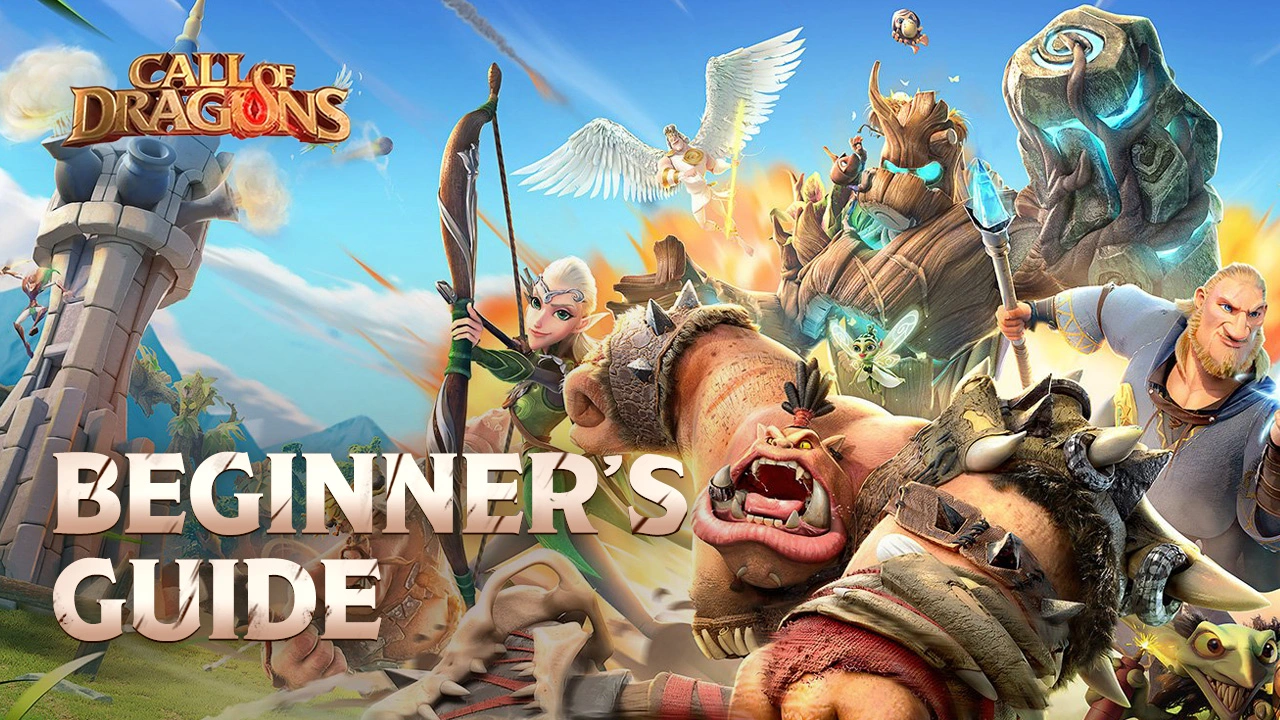
Starting Call of Dragons can feel overwhelming because Heroes, city upgrades, Technology, troops, Artifacts, Alliances, Behemoths, War Pets, events, and map progression all compete for your attention at once.
The good news is that beginners do not need to maximize everything immediately. A strong account usually develops faster when you concentrate resources on a small number of useful Heroes, keep core city progression moving, join an active Alliance early, and avoid wasting limited progression items.
This Call of Dragons beginner guide gives you a practical early-game roadmap and links to more detailed guides when you are ready to specialize.
What Is Call of Dragons?
Call of Dragons is a fantasy MMO strategy game built around city development, Hero-led Legions, open-field combat, Alliance warfare, exploration, resources, Behemoths, and large-scale PvP.
You upgrade buildings and Technologies, train troops, develop Heroes, gather resources, fight PvE enemies, explore the world, and cooperate with other players to control territory.
Combat is especially important because Legions move freely across the battlefield instead of simply being sent through a static battle screen. Therefore, positioning, range, terrain, Hero abilities, and Alliance coordination all become increasingly important as you progress.
You Do Not Tame Personal Dragons
One outdated beginner myth is that players should find dragon lairs, defeat the guardians, and then raise a personal dragon.
That is not the core progression system.
Call of Dragons features powerful fantasy creatures and large dragon encounters, while Behemoths are major Alliance objectives. Alliances can defeat Behemoths and later use their power in large-scale warfare.
Therefore, beginners should focus on joining an Alliance capable of participating in Behemoth content rather than searching for a personal dragon-taming system.
Call of Dragons Beginner Priorities
| Priority | What to Do | Why It Matters |
| 1 | Join an active Alliance | Unlocks support, territory, rallies, Behemoths, rewards, and faster cooperation |
| 2 | Progress your city | Unlocks stronger buildings, troops, research, and account systems |
| 3 | Keep Technology progressing | Improves economy and long-term military strength |
| 4 | Build one strong Legion | Prevents Hero and Skill resources from being spread too thin |
| 5 | Farm PvE efficiently | Provides Hero EXP and general progression rewards |
| 6 | Progress Dragon Trail | Adds recurring progression value as your account becomes stronger |
| 7 | Develop Artifacts and War Pets | Improves complete Legion performance |
| 8 | Learn PvP and city defense | Reduces expensive mistakes once serious war begins |
1. Join an Active Alliance as Early as Possible
Call of Dragons is heavily Alliance-driven. Even players who enjoy individual progression benefit from being surrounded by active members.
An active Alliance can provide:
- Alliance Help for progression.
- Group rallies against PvE targets.
- Territory and map access.
- Behemoth participation.
- Alliance event rewards.
- Reinforcements and protection.
- Information about upcoming wars and objectives.
- Experienced players who can answer server-specific questions.
Activity matters more than simply joining an Alliance with an impressive name or Power number.
Move Near Your Alliance
Once your Alliance begins organizing territory, avoid remaining isolated on the map.
Living near active members makes rallies, gathering, reinforcement, PvP, and defensive responses much easier.
It also makes your city less attractive as an isolated target.
2. Keep Your City Progression Moving
Your city unlocks the systems that determine long-term account strength.
Therefore, avoid upgrading random buildings simply because their timers are short. Prioritize the buildings required for your next major progression milestone, followed by the military, research, and economic structures that support your actual goals.
Keep Builders Working
Idle building time slows your account without providing any benefit.
Before logging off, check whether your important construction queues can continue while you are away.
Long upgrades are especially useful overnight or during periods when you know you will not be playing actively.
Do Not Spend Every Speedup Immediately
Speedups are more valuable when they help you reach a meaningful unlock, complete an event objective, prepare for an Alliance requirement, or finish an important Technology milestone.
Using them simply because you dislike waiting can leave you short when progression actually matters.
3. Research Economy and Military Technology
Technology is one of the most important forms of permanent account progression.
Economic development helps support your city, while military research strengthens the Legions you eventually take into serious battles.
Beginners should avoid two extremes:
- Researching only economy while becoming too weak to participate in useful combat.
- Researching only military bonuses while lacking the economy needed to support continued growth.
Instead, maintain enough economic progression to sustain your account while gradually concentrating military research around the troop types you actually plan to field.
4. Build One Strong Hero Pair First
New players unlock many Heroes, which creates a strong temptation to level all of them.
A better approach is to develop one useful primary Legion first.
Choose Heroes that:
- Support the same troop type.
- Have compatible damage or support mechanics.
- Fit the same activity.
- Can realistically be developed with the resources available to you.
A Legendary Hero is not automatically a better early investment than an accessible Epic Hero. A partially developed Legendary can perform poorly compared with an Epic Hero whose important Skills and Awakening are actually obtainable.
For EXP priorities and reaching the current Hero level cap efficiently, read the Call of Dragons Hero Leveling Guide.
Primary and Deputy Heroes Are Different
Your primary Hero is particularly important because the primary Hero’s Talent Tree affects the Legion.
That means primary Heroes usually deserve more urgent leveling investment than deputies.
For role-based Talent builds, see the Call of Dragons Hero Talent Trees Guide.
You can also review the Call of Dragons Hero Skills Guide before spending scarce Hero Tokens on a long-term commander.
5. Match Heroes With the Correct Troops
Do not create random mixed Legions simply because several different troop types have high Power.
Many Hero Skills, Talents, Artifacts, and other effects depend on specific troop types or combat conditions.
Therefore, start by asking:
- What troop type does this Hero support?
- Does the deputy support the same troop type?
- Do their Skills complement each other?
- Does the Artifact match the Legion?
- Does the War Pet activate reliably with this pairing?
A coherent Legion is generally much easier to optimize than a march assembled from your individually strongest-looking units.
6. Train Troops Consistently
Your Heroes cannot fight effectively without a healthy troop pool behind them.
Keep relevant troop-training buildings active whenever your economy allows it.
However, avoid assuming you need to develop every troop type equally from the beginning. Your strongest PvP Legions should eventually align with the Heroes and military Technology receiving your largest investments.
Higher-Tier Troops Come From Account Progression
Hero leveling does not directly unlock stronger troop tiers.
Troop progression comes through your broader city and Technology development.
Therefore, do not spend Hero EXP expecting it to replace military research.
7. Farm Darklings and PvE Efficiently
PvE enemies are an important early source of progression and Hero EXP.
Use your available PvE energy efficiently rather than repeatedly fighting targets far below what your Legion can comfortably defeat.
As your account becomes stronger, increase the difficulty of the PvE content you farm.
Peacekeeping Heroes Have a Purpose
Some Heroes are designed to improve PvE efficiency through Peacekeeping-related Skills and Talents.
A Hero that is not part of your final PvP lineup can therefore still be extremely valuable for Darkling farming and account progression.
This is another reason not to judge every Hero only by open-field PvP tier lists.
8. Push Dragon Trail Regularly
Dragon Trail is easy to forget once the open world becomes busy.
However, every major improvement to your Heroes, troops, Artifacts, Technology, or overall Legion strength can allow you to progress farther.
Revisit Dragon Trail periodically instead of waiting until the end of a season or progression stage.
Small improvements across your account can often turn a previously difficult stage into an easy clear.
9. Learn Artifacts Early
Artifacts are part of your Legion build rather than separate collectibles that should be upgraded randomly.
A good Artifact should support the Hero pairing, troop type, damage style, range, and activity for which the Legion is intended.
For example, an Artifact that is excellent for one Magic Legion may provide little value to a Physical Cavalry setup.
Before spending rare Artifact progression resources, decide which of your primary Legions the Artifact is expected to support.
10. Build War Pets Around a Legion
War Pets provide another layer of Legion optimization.
The best Pet is not simply the rarest one you capture. Its Talent Skill, attributes, Common Skills, triggers, troop preference, and Hero pairing should work together.
For beginners, the safest strategy is to develop a Pet for your strongest existing Legion instead of trying to build separate high-end Pets for every troop type immediately.
For capture, Skill Cards, attributes, Talent Skills, and reroll priorities, use the Call of Dragons War Pets Guide.
11. Participate in Behemoth Content
Behemoths are one of Call of Dragons’ defining Alliance systems.
They are not personal pets that each player collects independently. Instead, Behemoth encounters reward organized Alliance participation.
As a beginner, your job is usually to:
- Follow Alliance instructions.
- Bring the requested troop type or Legion.
- Avoid unnecessary deaths before the main attempt.
- Learn the encounter mechanics.
- Participate consistently even if stronger members carry more of the damage initially.
Later, Behemoths also become part of large-scale Alliance warfare.
12. Do Not Ignore Gathering
Fighting may be the most visible part of Call of Dragons, but economic progression supports everything else.
Keep gathering Legions active when you are not using them for another purpose.
Dedicated Gathering Heroes can improve efficiency without consuming the same Hero-development priorities as your main PvP commanders.
Moreover, gathering can support supplementary Hero EXP strategies once the appropriate Talents are available.
13. Save Gems and Rare Resources Until You Understand Their Value
Beginners often make their most expensive mistakes during the first few days because almost every shop item or upgrade feels important.
Be cautious with:
- Gems.
- Universal Legendary Hero resources.
- Rare Artifact materials.
- War Pet Skill resources.
- Large speedup reserves.
- Seasonal or limited progression currencies.
Before spending a rare item, ask whether you could easily obtain another one and whether the upgrade supports a Legion or system you will still use later.
14. Learn City Defense Before War Starts
Your city becomes much harder to protect if you wait until an enemy rally is already approaching before learning how defense works.
Before serious PvP begins:
- Stay near your Alliance.
- Understand your garrison.
- Keep unnecessary resources protected or spent.
- Know when your Alliance expects you to shield.
- Keep important Legions available during active wars.
- Learn when defending is worse than relocating.
A larger Power number does not mean you should absorb every enemy rally.
For garrisons, resource protection, Peace Shields, Alliance reinforcement, and rally decisions, read the Call of Dragons City Defense Guide.
15. Learn PvP Positioning Before Chasing Kills
Open-field combat is more than selecting an enemy and watching the battle resolve.
Good players pay attention to:
- Attack range.
- Terrain.
- Enemy reinforcement.
- Alliance positioning.
- March speed.
- Hero Skill range.
- Artifact timing.
- Whether they have a safe retreat.
One of the easiest beginner mistakes is chasing a weak-looking Legion too far from friendly players and discovering that several enemy marches were waiting nearby.
16. Wounded Units Are More Forgiving Than in Many Strategy Games
Call of Dragons reduces some of the traditional resource pressure associated with wounded troops.
This encourages players to participate in combat rather than permanently avoiding every fight because healing would destroy their economy.
However, easier recovery does not mean combat is free.
Time, positioning, troop availability, event efficiency, city safety, and Alliance objectives still matter. Avoid taking pointless fights simply because wounded-unit recovery is relatively forgiving.
17. Follow Events, but Do Not Let Events Control Your Account
Events can reward activities you already need to perform, such as Hero development, building, research, troop progression, PvE, or Alliance participation.
Whenever possible, align major upgrades with useful event objectives.
However, do not spend rare long-term resources purely to finish a small event milestone.
A good rule is to ask:
Would I make this upgrade even if the event did not exist?
If the answer is no, consider whether the event reward really justifies the investment.
18. Do You Need a Jumper Strategy?
Some competitive players prepare their early account around a specific server, Alliance, relocation, or progression plan.
This is often described as a jumper account.
Beginners do not need to use a jumper strategy to enjoy or progress in Call of Dragons. In fact, learning the normal game systems first can make a complicated server plan easier to understand later.
If you are specifically preparing a competitive start, read the Call of Dragons Jumper Account Guide.
19. Understand Relocation and Migration Before Moving
Relocating your city on the current map and migrating between eligible server environments are not the same process.
Do not spend movement resources or plan a server transfer based on old screenshots or community terminology without checking the current in-game requirements.
Players considering a later server move can review the Call of Dragons Migration Guide for the broader system and planning considerations.
A Simple First-Week Progression Plan
| Stage | Main Priorities |
| First Session | Complete onboarding, learn map controls, begin city upgrades, join an Alliance, start developing one Hero pair |
| Day 1 | Keep builders and research active, train troops, farm useful PvE targets, gather resources |
| Days 2–3 | Improve the main Legion, progress Dragon Trail, relocate closer to Alliance activity where appropriate |
| Days 3–5 | Develop an additional useful Legion, improve Artifacts, participate in Alliance rallies and events |
| Days 5–7 | Refine troop focus, build War Pet synergy where available, learn PvP positioning and city defense |
| After Week 1 | Specialize Heroes and troop research, save premium resources, prepare for larger Alliance objectives and seasonal progression |
This is a direction rather than a rigid schedule. Server pace, Alliance expectations, events, and how much you play can all change the timing.
Common Call of Dragons Beginner Mistakes
- Trying to tame a personal dragon: Focus on the actual Behemoth and large-creature content instead.
- Playing without an active Alliance: You lose access to important cooperation, territory, rewards, and support.
- Developing every Hero: Concentrate resources on a small functional roster first.
- Investing by rarity alone: Hero synergy and realistic Skill development matter more.
- Using mismatched troop types: Read Hero Skills and Talents before building a Legion.
- Ignoring primary Hero Talents: The primary position matters when planning a complete build.
- Spending every speedup immediately: Save them for meaningful milestones or events.
- Ignoring Dragon Trail: Revisit it whenever your account becomes stronger.
- Upgrading Artifacts randomly: Build them around a specific Legion.
- Investing heavily in every War Pet: Complete one useful Pet setup before spreading resources.
- Ignoring Gathering: Economic growth supports city, troop, and Technology progression.
- Researching everything equally: Start concentrating military investment around your main troop plans.
- Chasing enemy Legions too far: Position and Alliance support matter more than one kill.
- Trying to defend every city rally: Sometimes shielding or relocating is the correct decision.
- Spending rare resources for small event rewards: Protect long-term progression from short-term temptation.
- Following old guides without checking updates: Hero balance, seasonal systems, Pets, events, and progression mechanics continue to change.
FAQ
What should a beginner do first in Call of Dragons?
Join an active Alliance, keep city and Technology progression moving, train troops, develop one useful primary Hero pair, farm PvE, gather resources, and progress Dragon Trail.
What Heroes should beginners level first?
Prioritize the primary Heroes of Legions you actually intend to use. Troop compatibility, Skill development, pairing synergy, and role matter more than Legendary rarity alone.
Should beginners upgrade every Legendary Hero?
No. Legendary Skill resources are valuable, so avoid investing heavily until you know that the Hero fits your long-term troop type and Legion plan.
Do I need to tame a dragon in Call of Dragons?
No. The game features large dragon encounters and Behemoths, but beginners should not follow old instructions about locating a dragon lair and raising a personal dragon.
Are Alliances important for beginners?
Yes. Alliances provide cooperation, territory, rallies, Behemoth participation, rewards, protection, and access to experienced players.
Should I focus on economy or military Technology?
Develop enough economy to sustain growth while gradually concentrating military research around the troop types used by your most important Legions.
Should beginners save speedups?
Yes. Use them when they reach meaningful progression milestones, support Alliance requirements, or overlap with worthwhile events rather than spending them purely to remove short timers.
When should I start developing War Pets?
Once the system becomes relevant to your account, start with a Pet that supports your strongest existing Legion. Avoid spreading rare Pet resources across several unfinished builds.
Conclusion
A strong Call of Dragons beginner account comes from focused progression rather than upgrading everything at once. Join an active Alliance, develop one reliable Legion, keep buildings and Technology moving, and save rare resources until you understand their long-term value.
As your account grows, expand into additional Heroes, Artifacts, War Pets, PvP, Behemoths, and server strategy. For more detailed help, browse the Heaven Guardian Call of Dragons guide collection.