
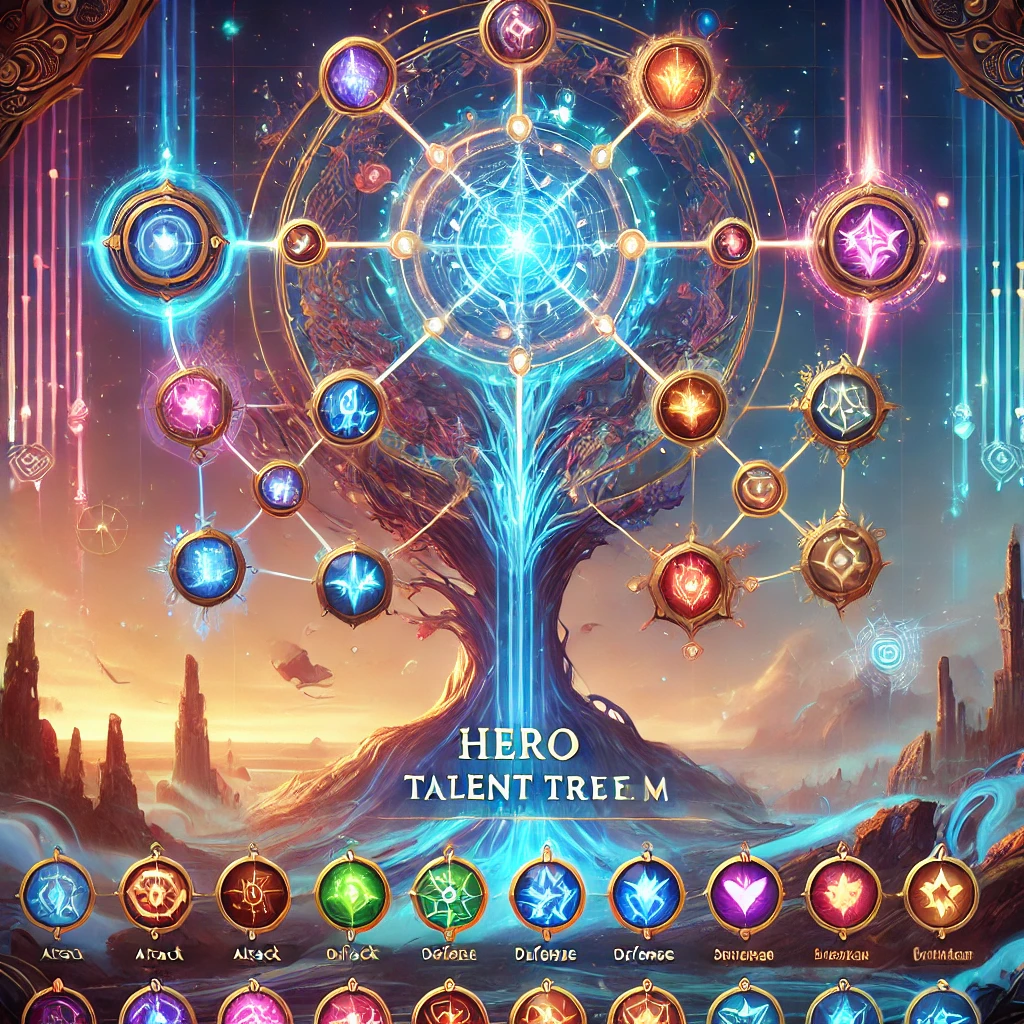
Talent trees determine how a Hero performs as the leader of a Legion in Call of Dragons. A good build can improve damage, durability, Rage generation, March Speed, gathering efficiency, rally performance, Peacekeeping rewards, or support utility.
However, there is no single talent build that works for every Hero or activity. A Hero used for open-field PvP needs different talents from one leading a rally, defending a structure, gathering resources, or fighting Darklings.
More importantly, only the main Hero’s talent tree affects the Legion. The deputy Hero contributes skills and other eligible effects, but their selected talents do not apply. Therefore, choosing the correct main Hero is just as important as selecting the right talent nodes.
Quick rule: Select the main Hero for the talent tree and the deputy Hero for skill synergy. Next, match both Heroes to the same Legion purpose, unit type, Artifact, and War Pet strategy.
Do not copy a build based only on the Hero’s rarity. Instead, decide whether the Legion is meant for open field, rallying, garrison defense, Peacekeeping, gathering, Engineering, mobility, or support.
What Are Talent Trees in Call of Dragons?
Every Hero has three talent trees based on their unit specialization, map role, and team function. Each tree contains connected nodes that provide statistics, conditional effects, or activity-specific bonuses.
For example, a Hero may combine:
- A unit tree such as Infantry, Cavalry, Marksman, or Magic
- A map-role tree such as PvP, Rally, Garrison, Peacekeeping, Gathering, or Engineering
- A function tree such as Skill, Tank, Support, Control, Mobility, Precision, or Overall
These combinations help define how the Hero should be used. For instance, a Hero with Cavalry, PvP, and Mobility trees naturally supports fast open-field movement. Meanwhile, a Hero with Rally, Infantry, and Tank trees is more suitable for durable Infantry rallies.
Talent Trees Are Not Hero Skills
Players sometimes search for a “Call of Dragons skill tree,” but Hero skills and talent trees are separate systems.
| System | How It Is Improved | What It Controls |
| Talent Tree | Hero levels and talent points | Statistics, Rage, mobility, activity bonuses, and conditional effects |
| Hero Skills | Hero Tokens and skill upgrades | The Hero’s Rage Skill, passive skills, and Awakening effect |
| Artifact | Artifact levels, stars, and skill levels | Additional statistics and an activated Artifact Skill |
| War Pet | Attributes, skills, and refinement | Conditional combat effects and additional Legion statistics |
As a result, a correct talent build cannot repair weak Hero skills, an incompatible Artifact, or a poorly matched deputy. All four systems should support the same battlefield purpose.
How Talent Points Work
Heroes gain talent points as they increase in level. Higher levels also increase the number of units the Hero can lead, which makes leveling particularly important for main Heroes.
All Hero rarities can reach level 60. However, a deputy Hero does not need maximum level solely for talents because their talent tree remains inactive while they serve as deputy.
Which Heroes Should Reach Level 60?
Prioritize level 60 for Heroes that regularly lead Legions. Good candidates include:
- Your primary open-field Heroes
- Dedicated rally leaders
- Garrison captains
- Main Peacekeeping Heroes
- Gatherers used as primary Heroes
- Engineering Heroes leading construction Legions
By contrast, a Hero used only as deputy needs enough stars to unlock the required skills and enough development to contribute effectively. Additional levels may improve Legion capacity in some formations, but they do not activate the deputy’s talents.
Do Hero Levels Reset Each Season?
Older versions of Call of Dragons reset Hero levels at the beginning of a new season. That system was later changed, and Hero levels no longer reset automatically each season.
Consequently, players do not need to rebuild every talent tree simply because a new season begins. Nevertheless, balance changes, new Heroes, different pairings, or a changed alliance role may still justify a new build.
Only the Main Hero’s Talents Apply
A Legion can include a main Hero and a deputy Hero. Although both Heroes contribute eligible skills, only the main Hero’s talent tree affects the Legion.
This rule changes how pairings should be organized. The strongest Hero is not automatically the best leader if the other Hero has a more suitable tree for the intended activity.
How to Choose the Main Hero
Choose the main Hero based on:
- The required unit-type tree
- The Legion’s main activity
- Available Rage-generation talents
- March Speed requirements
- Durability or damage priorities
- Whether Rally or Garrison talents are required
- The Hero’s current level
For example, a pairing used for open-field Cavalry combat may need a Cavalry and Mobility main Hero. Meanwhile, the same two Heroes could use a different leader when rallying an objective.
How to Choose the Deputy Hero
The deputy should provide skills that reinforce the Legion’s main purpose. Useful synergy may include:
- Matching physical or magic damage
- Compatible troop-type bonuses
- Additional Rage generation
- Healing or shields
- Defense reduction or other debuffs
- Control effects
- Normal-attack or counterattack bonuses
Since deputy talents do not apply, their tree can remain unfinished unless that Hero also leads another Legion.
How to Reset a Talent Tree
The first talent reset for each Hero is free. This allows players to correct an early mistake or change the Hero’s initial role without spending a reset item.
After the free reset has been used, additional changes generally require a Book of Alteration or the current equivalent shown by the interface.
When a Reset Is Worth Using
- The Hero is changing from Peacekeeping to PvP.
- An open-field Hero is becoming a rally leader.
- The pairing now uses a different main Hero.
- A balance update changes important talent values.
- A new Artifact or War Pet changes the best route.
- The alliance assigns the player a new role.
- The original build contains misplaced points.
On the other hand, avoid resetting a build after one poor battle report. Terrain, enemy technology, Hero skills, War Pets, troop count, Artifacts, and allied support may have affected the result.
Use Talent Popularity Percentages Carefully
The talent screen can display percentages showing how frequently other players select particular nodes. This information can reveal common routes, especially for newly obtained Heroes.
However, popularity does not prove that a choice is optimal for your activity. Many players may use the same Hero for open field, while your account needs a rally or gathering build.
Common Talent Tree Categories
| Tree Category | Typical Purpose | Best Used For |
| Infantry | Infantry statistics and durability | Infantry field, rally, or garrison Legions |
| Cavalry | Cavalry damage and movement | Fast physical Legions and flanking |
| Marksman | Ranged physical damage | Marksman field, rally, and garrison builds |
| Magic | Magic-unit statistics and Hero Skill damage | Magic damage and ranged control Legions |
| Overall | Bonuses that support multiple unit types | Flexible Heroes and mixed-role builds |
| PvP | Combat against other players | Open-field fighting |
| Rally | Large offensive Legion performance | Cities, Alliance structures, and objectives |
| Garrison | Defensive structure performance | Cities and Alliance structures |
| Peacekeeping | PvE efficiency and rewards | Darklings, Darkling Forts, and neutral enemies |
| Gathering | Resource speed and carrying efficiency | Resource Points and Alliance deposits |
| Engineering | Alliance construction efficiency | Roads, buildings, and territory development |
| Skill | Rage Skills and skill cycles | Heroes dependent on frequent skill activation |
| Tank | Damage reduction and Legion durability | Frontline, rally, and garrison builds |
| Support | Healing, shields, buffs, and utility | Supportive field and group Legions |
| Control | Slows, debuffs, and battlefield disruption | Open-field group combat |
| Mobility | March Speed and engagement control | Fast field Legions and chasing |
| Precision | Focused ranged or critical damage | Marksman and damage-oriented builds |
Best Talent Priorities by Activity
Open-Field PvP Builds
Open-field combat requires a balance between damage, durability, and movement. A Legion that deals high theoretical damage provides little value if it is focused and defeated immediately.
Start with the Hero’s matching unit tree. Afterward, consider PvP, Skill, Control, Support, Tank, or Mobility talents according to the Hero’s role.
Useful open-field priorities include:
- Unit-type Attack, Defense, and HP
- Rage generation
- Hero Skill damage
- Damage reduction
- March Speed
- Control resistance
- Target debuffs
- Retreat or disengagement utility
For group fights, balanced survivability is generally more reliable than a pure glass-cannon route.
Rally Talent Builds
Rally Heroes lead a large Legion against cities, structures, Behemoth-related objectives, or other strategic targets. Since the rally receives concentrated damage, offensive statistics must be supported by durability.
A strong rally route commonly prioritizes:
- Rally-specific damage
- Unit-type HP and Defense
- Damage reduction
- Rage generation
- Counterattack or normal-attack value
- Target-specific damage
- Long-fight sustain
Nevertheless, the exact route depends on the defending garrison. A build designed to defeat one unit type may perform poorly against another.
Garrison Talent Builds
Garrison Heroes defend cities and Alliance structures. Their builds should survive repeated Rally Skills, normal attacks, and surrounding pressure.
Accordingly, prioritize:
- Garrison-specific bonuses
- HP and Defense
- Damage reduction
- Counterattack damage
- Healing or shields
- Debuff resistance
- Rage generation for defensive Skills
A general open-field build is not sufficient for an important garrison. Use a dedicated Garrison tree whenever the Hero is responsible for structure defense.
Peacekeeping Talent Builds
Peacekeeping trees improve PvE efficiency against Darklings and other neutral enemies. They can increase damage, reduce Command Point costs, improve experience gains, or help a Legion continue fighting.
During early progression, Peacekeeping builds are especially valuable because they accelerate Hero leveling and PvE rewards. Later, the same Hero may be reset into a PvP build when open-field fighting becomes more important.
Gathering Talent Builds
Gathering Heroes should focus on economic output rather than combat. Select the Gathering tree as the main route and prioritize the resource types the account needs most.
Useful gathering talents include:
- General gathering speed
- Resource-specific gathering speed
- Troop load
- March Speed
- Additional resources after gathering
- Safer or faster return trips
If two gathering Heroes are paired, use the Hero with the more complete Gathering tree as main. The deputy can still contribute gathering skills.
Engineering Talent Builds
Engineering Heroes support Alliance territory development. Their talents may improve construction speed, Legion efficiency, or movement while working on Alliance structures.
Because Engineering is not a combat role, avoid spending points on unrelated damage talents. The Hero should complete roads and structures more efficiently instead.
Match the Talent Tree to the Unit Type
A Hero’s skills and talents often require a specific Legion type. Using incompatible units may disable or weaken important bonuses.
| Unit Type | Common Build Priorities | Typical Battlefield Role |
| Infantry | HP, Defense, reduction, counterattack, sustain | Frontline, rally, or garrison |
| Cavalry | March Speed, burst damage, Rage, engagement control | Flanking, chasing, and fast rallies |
| Marksman | Physical damage, Precision, range, Skill damage | Ranged pressure and focused damage |
| Magic | Magic Attack, Skill damage, Rage, control | AOE damage, debuffs, and ranged control |
| Flying Legion | Overall statistics, PvP, Skill, and mobility-related value | Terrain crossing and flexible map pressure |
Always read the Hero’s skill conditions before choosing a unit tree. Some Heroes use Overall talents and can support several troop types, while others lose major bonuses when paired with incompatible units.
Current Hero Talent Tree Examples
The following examples address several Heroes appearing in talent-tree searches. They show each Hero’s three tree categories rather than prescribing one universal route.
| Hero | Talent Trees | Common Direction | Important Note |
| Seluna | Overall, PvP, Skill | Flying open-field Skill build | The correct spelling is Seluna, not Selune. |
| Joren | Infantry, PvP, Mobility | Mobile Infantry open-field build | Balance Infantry durability with movement. |
| Flynt | Overall, Gathering, Skill | Gathering build | Use Gathering when Flynt leads a resource Legion. |
| Agnar | PvP, Skill, Cavalry | Cavalry Skill or PvP build | Choose the main route according to open-field purpose. |
| Mu Hsiang | PvP, Overall, Support | Flexible support build | Her Overall tree supports several pairing options. |
| Pan | Overall, Gathering, Support | Gathering or support build | Do not mix both roles without a clear reason. |
| Hosk | Precision, Overall, Rally | Rally and Precision build | Open-field use requires a different route from rallying. |
| Chakcha | Gathering, Overall, Skill | Low-cost Gathering build | Gathering usually provides the best account value. |
| Kella | Gathering, Overall, Support | Gathering build | Use Kella as main only when her Gathering tree is developed. |
| Eliana | Peacekeeping, Overall, Support | Peacekeeping or support build | Her best tree changes according to PvE or group support. |
| Lei Kuan | Rally, Infantry, Tank | Durable Infantry rally build | Use Rally talents when leading an objective attack. |
| Goresh | Rally, Infantry, Tank | Infantry rally or Tank build | The best route depends on whether he leads the rally. |
| Alistair | Rally, Cavalry, Tank | Cavalry rally build | He may be better as deputy when another Hero has stronger talents. |
These examples are starting points rather than complete node-by-node builds. New Heroes, balance adjustments, pairings, and Artifacts can change the most effective route.
How to Use a Talent Tree Builder
A Call of Dragons talent tree builder can help plan a complete route before spending points in-game. It is particularly useful when comparing two end talents or calculating whether enough points remain for a secondary branch.
However, a builder may show outdated talent values. Therefore, compare its node descriptions with the current in-game Hero screen before applying the build.
Talent Builder Checklist
- Select the correct Hero.
- Confirm the Hero’s three current trees.
- Choose one specific activity.
- Identify the most important endpoint talent.
- Calculate the required connecting nodes.
- Add the matching unit-type statistics.
- Review Rage and March Speed needs.
- Compare every value with the live game.
- Save a screenshot before applying the route.
Do not begin by filling every inexpensive node. A clear route toward high-impact talents usually provides better value than spreading points evenly across all three trees.
How Artifacts and War Pets Affect Talent Builds
Talent trees should support the Hero’s full Legion setup. An Artifact or War Pet may increase the value of one talent route while reducing the need for another statistic.
Artifact Compatibility
Check whether the Artifact uses physical damage, magic damage, normal attacks, healing, shields, or control effects. Next, choose talents that improve the same type of performance.
For example, a Skill-focused Magic Hero gains little from an Artifact built around physical normal attacks. Likewise, a mobility Artifact may be unnecessary when the talent tree already provides enough March Speed.
War Pet Compatibility
War Pet skills often activate from specific actions, statistics, or combat conditions. As a result, the Hero pairing and talent route should trigger those conditions consistently.
Before committing to a build, review:
- The War Pet’s activation condition
- The Legion’s damage type
- Rage Skill frequency
- Buff and debuff timing
- Unit-type requirements
- Whether the Pet supports offense, defense, or utility
How to Test a Talent Build
Battle reports provide more useful information than theoretical damage alone. Test a new build against similar targets and compare several reports before making another change.
Testing Checklist
- Was the enemy using a similar troop tier?
- Did both Legions begin with comparable unit counts?
- Was the Hero pairing unchanged?
- Did the same Artifact and War Pet remain equipped?
- Were Alliance and seasonal buffs similar?
- Did terrain or range affect the fight?
- How quickly did the first Rage Skill activate?
- How much severely wounded damage occurred?
- Could the Legion disengage when focused?
Whenever possible, change one part of the build at a time. Otherwise, you will not know whether the improvement came from talents, the deputy Hero, the Artifact, or the War Pet.
Comparing complete Hero rosters? Talent trees are only one part of Legion performance. Players reviewing a call of dragons account for sale should also compare Hero skills, Awakening status, Artifacts, War Pets, technology, troop tiers, migration eligibility, and current server position.
Best Beginner Talent Tree Strategy
New players should build a small number of useful main Heroes rather than leveling every Hero equally. Since talent points come from Hero levels, spreading experience across many projects leaves every tree incomplete.
Recommended Beginner Process
- Choose one main troop type.
- Select one open-field or PvE main Hero.
- Identify the Hero’s most relevant tree.
- Reach the important endpoint talents first.
- Add the matching unit tree.
- Develop gathering Heroes separately.
- Use the free reset only after understanding the mistake.
- Build additional main Heroes as more Legion queues become useful.
During early progression, Peacekeeping can accelerate Hero leveling. Later, the same Hero may switch to PvP when player combat becomes the account’s main focus.
Common Talent Tree Mistakes
- Building the deputy Hero’s talents: Only the main Hero’s talents affect the Legion.
- Confusing talents with skills: Talent points do not upgrade Hero skills.
- Copying one build for every activity: Open field, rally, garrison, and Peacekeeping need different priorities.
- Ignoring the unit type: Incompatible troops can disable important bonuses.
- Splitting points evenly: High-impact endpoint talents may remain locked.
- Using a PvE build in PvP: Peacekeeping effects provide limited value against players.
- Building only for damage: A fragile Legion may be removed before dealing meaningful damage.
- Ignoring March Speed: Slow Legions are easier to surround and harder to retreat.
- Resetting after one bad report: Several other systems may explain the result.
- Trusting popularity percentages blindly: Common choices may target a different activity.
- Using an outdated builder: Talent descriptions and values can change.
- Forgetting the Artifact: Talent and Artifact damage types should match.
- Ignoring War Pet conditions: The Legion must trigger the Pet’s skills consistently.
- Following old seasonal-reset advice: Hero levels no longer reset automatically each season.
FAQ
What is the best Call of Dragons talent tree?
There is no universal best tree. The correct build depends on the Hero, Legion type, activity, pairing, Artifact, War Pet, and whether the Hero serves as main or deputy.
Do deputy Hero talents work?
No. Only the main Hero’s selected talents affect the Legion. The deputy contributes eligible Hero skills but not their talent tree.
Can you reset talents for free?
The first talent reset for each Hero is free. Later resets generally require a Book of Alteration or the reset item currently displayed in the game.
Do talents reset every season?
Hero levels no longer reset automatically at the start of each season. Therefore, talent builds do not need to be recreated solely because a new season begins.
What level should a main Hero reach?
A frequently used main Hero should generally progress toward level 60. Higher levels provide more talent points and increase the number of units the Hero can lead.
Is a talent tree the same as a skill tree?
No. Talents are upgraded with points earned from Hero levels, while Hero skills are improved with Hero Tokens. Both systems contribute to the final build.
Should I copy the most popular talent choices?
Popularity percentages provide a useful starting point. However, they may represent a different activity, pairing, or unit type, so every choice should be checked against your own Legion.
How often should I update a Hero build?
Review the build after balance changes, new Hero releases, pairing changes, new Artifacts, different War Pets, or a change in your alliance role.
Conclusion
A strong Call of Dragons talent tree begins with one clear purpose. First, decide whether the Hero will lead an open-field Legion, rally, garrison, gathering march, Peacekeeping march, Engineering Legion, or support setup.
Next, match the tree to the correct unit type and choose the main Hero carefully. Only the main Hero’s talents apply, while the deputy contributes skills rather than talent effects.
Afterward, compare the build with the Hero’s skills, Artifact, War Pet, and battlefield role. A popular build may still be unsuitable when it uses a different pairing or activity.
Use the first free reset carefully, test changes through comparable battle reports, and avoid rebuilding after one poor result. Most importantly, prioritize focused endpoint talents instead of distributing points randomly across all three trees.
Explore more Hero builds, Artifact advice, event strategies, and progression content in the Call of Dragons guide collection.