
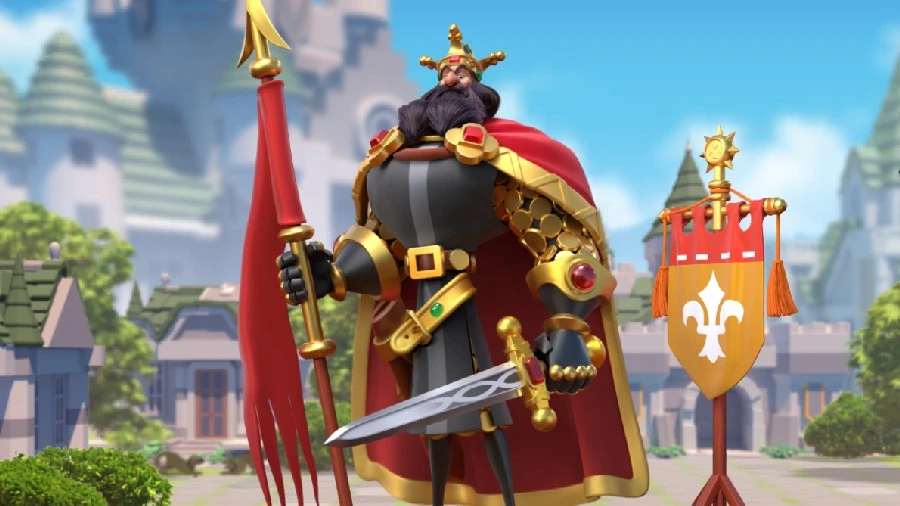
William I, also known as William the Conqueror, is a Legendary Cavalry commander in Rise of Kingdoms with Cavalry, Versatility, and Attack talent trees. His kit combines rectangular AOE damage, March Speed reduction, Cavalry Attack, extra damage against surrounded targets, and useful Defense and Rage support for nearby allies.
William is no longer a first-priority Cavalry investment for most developed accounts. However, he remains one of the more useful older commanders because several of his effects still work well from the secondary commander slot.
A developed William I can therefore add depth to a second or third Cavalry march without forcing you to rebuild an entire lineup around him.
William I is usable at 5-5-1-1, while 5-5-5-1 remains the stronger value build for players who already use him regularly. Expertise improves his damage further, but starting a new expertise project is usually less efficient than completing newer priority commanders first.
Is William I Still Good in Rise of Kingdoms?
Yes, William I is still useful, particularly as a secondary Cavalry commander in open-field combat.
Hidden Bloodline can damage up to three enemy troops in a forward rectangle. It also reduces their March Speed and interferes with additional skill-damage bonuses from buffs.
Meanwhile, Scourge of the North rewards good AOE positioning. When Hidden Bloodline hits at least two enemies, William’s troop and nearby allied troops receive Defense and additional Rage for three seconds.
That combination gives William something many older damage commanders lack: team utility.
However, newer Cavalry commanders provide stronger overall damage, troop capacity, debuffs, survivability, and updated mechanics. Therefore, William should generally be developed after your highest-priority Cavalry commanders rather than before them.
| Game Mode | Current Value | Practical Assessment |
| Open field | Strong secondary | AOE, slows, Defense support, and Rage support remain useful in grouped fights. |
| Rally | Situational | Can contribute in older or secondary rally setups but is not a leading modern rally investment. |
| Sunset Canyon | Useful | Multi-target damage and team support benefit clustered formations. |
| Garrison | Not recommended | He lacks a Garrison tree and dedicated structure-defense skills. |
| City attacking | Low priority | His strongest mechanics are better suited to map fighting and surrounded targets. |
Who Should Still Use William I?
- Cavalry-focused players who already have him at 5-5-1-1 or better
- Accounts needing another secondary Cavalry commander
- Players running multiple open-field Cavalry marches
- Governors who already own strong Cavalry equipment
- Players who regularly fight in large murder balls
Who Should Delay William I?
- New Season of Conquest accounts building their first main march
- F2P players with limited Universal Legendary Sculptures
- Players with stronger modern Cavalry commanders still unfinished
- Infantry or Archer-focused accounts
- Governors looking specifically for a rally or garrison specialist
William I Quick Overview
| Attribute | William I |
| Rarity | Legendary |
| Civilization | Britain |
| Talent Trees | Cavalry, Versatility, Attack |
| Recommended Troop Type | Cavalry |
| Main Role | Open-field secondary commander |
| Active Skill | Hidden Bloodline |
| Maximum Active Damage | 1,500 damage factor |
| Maximum Targets | 3 |
| Minimum Efficient Build | 5-5-1-1 |
| Recommended Legacy Value Build | 5-5-5-1 |
| Best Formation When Primary | Wedge |
How to Get William I
William I belongs to an older generation of Season of Conquest Cavalry commanders.
Historically, he has been available through older commander rotations and events such as Wheel of Fortune and Card King, while Universal Legendary Commander Sculptures can also upgrade him after unlocking.
However, commander-access systems can change over time. Check the current commander selection available in your kingdom rather than relying exclusively on old fixed-day schedules.
More importantly, do not spend Universal Sculptures simply because William becomes available. His current value comes mainly from being an efficient older secondary commander.
Best William I Skill Order
Hidden Bloodline should always be maxed first. It contains his main AOE damage, March Speed reduction, and anti-skill-buff effect.
Charge of Hastings is the next priority because it provides permanent Cavalry Attack and March Speed while also adding extra damage inside alliance territory.
| Skill Setup | Best Use | Assessment |
| 5-1-1-1 | Temporary unlock | Maximum active skill but lacks most Cavalry utility. |
| 5-5-1-1 | Budget secondary | Already provides active AOE plus maximum Cavalry Attack and March Speed from skill two. |
| 5-5-5-1 | Recommended developed build | Maximizes Norman Conquest without paying the expertise cost. |
| 5-5-5-5 | Completed legacy commander | Adds the strongest Norman Conquest values but requires a large additional sculpture investment. |
Why 5-5-1-1 Is Already Usable
At 5-5-1-1, William already has his maximum active skill and maximum Charge of Hastings.
That means the march receives:
- 1,500 active-skill damage factor
- 30% maximum March Speed reduction on affected enemies
- 20% Cavalry Attack from Charge of Hastings
- 15% Cavalry March Speed
- 10% additional damage while fighting inside alliance territory
For a secondary commander that will eventually be replaced, this can be enough.
Why 5-5-5-1 Is Better
Maxing Norman Conquest improves several effects at the same time.
The Cavalry Attack bonus rises from 10% to 20%. The normal-attack proc increases from 600 to 800 damage factor, while the surrounded-target bonus increases from 40 to 80 damage factor for each surrounding troop counted.
Therefore, 5-5-5-1 remains a strong stopping point for an account that intends to use William regularly.
Does William I Need Expertise?
No.
Expertise improves Norman Conquest considerably, but William already provides most of his defining utility before expertise.
For most accounts, the sculptures required to move from 5-5-5-1 to 5-5-5-5 are better spent on a higher-priority modern commander.
William I Skills Explained
Hidden Bloodline

Skill type: Active
Rage requirement: 1,000
Hidden Bloodline deals direct damage to as many as three targets in a forward-facing rectangle.
Damage is reduced by 15% for every additional target after the first. Affected troops also have their March Speed reduced for three seconds, and additional skill-damage bonuses from buffs cannot take effect while the debuff applies.
| Skill Level | Direct Damage Factor | March Speed Reduction |
| 1 | 900 | 10% |
| 2 | 1,000 | 15% |
| 3 | 1,100 | 20% |
| 4 | 1,300 | 25% |
| 5 | 1,500 | 30% |
The rectangular shape makes positioning important. William creates much more value when the primary commander faces a cluster of enemies rather than one isolated march.
Charge of Hastings

Charge of Hastings increases Cavalry Attack and March Speed. While William’s troop is fighting inside alliance territory, it also deals additional damage.
| Skill Level | Cavalry Attack | Cavalry March Speed | Alliance Territory Damage |
| 1 | 10% | 3% | 2% |
| 2 | 12% | 6% | 4% |
| 3 | 14% | 9% | 6% |
| 4 | 16% | 12% | 8% |
| 5 | 20% | 15% | 10% |
The territory bonus is particularly useful during pass fights, flag battles, and defensive fighting around alliance-controlled objectives.
Norman Conquest

While William is on the map, Norman Conquest increases Cavalry Attack.
Normal attacks also have a 10% chance to deal additional direct damage. If the target is surrounded, the proc gains additional damage based on the number of troops surrounding that target.
Up to five surrounding troops are counted.
| Skill Level | Cavalry Attack | Proc Damage Factor | Damage per Surrounding Troop |
| 1 | 10% | 600 | 40 |
| 2 | 12% | 650 | 50 |
| 3 | 14% | 700 | 60 |
| 4 | 16% | 750 | 70 |
| 5 | 20% | 800 | 80 |
At level five, a target surrounded by five qualifying marches can add up to another 400 damage factor to the proc.
This makes William particularly useful when several allied marches collapse onto the same target.
Scourge of the North

Scourge of the North gives William additional survivability and group utility.
When Hidden Bloodline hits a target, William’s troop receives increased Defense for a short period.
| Skill Level | William’s Defense Bonus |
| 1 | 10% |
| 2 | 12% |
| 3 | 14% |
| 4 | 16% |
| 5 | 20% |
The more important effect activates when Hidden Bloodline hits at least two enemy troops.
William’s troop and nearby allied troops then gain:
- 10% increased Defense
- 50 Rage per second
- The effect lasts for three seconds
That equals 150 Rage over the full duration when the effect runs uninterrupted.
Importantly, this multi-target group effect already has fixed values. Increasing the fourth skill mainly improves William’s own Defense bonus.
This is another reason 5-5-5-1 can perform so well for the sculpture cost.
Judgement Day
Judgement Day enhances Norman Conquest.
After expertise:
- Cavalry Attack increases from 20% to 30%.
- The 10% normal-attack proc increases from 800 to 1,000 damage factor.
- Surrounded bonus damage increases from 80 to 100 per surrounding troop.
- Up to five surrounding troops continue to count.
At maximum surround count, the expertise can therefore add up to another 500 damage factor to the normal-attack proc.
These are useful improvements. However, Judgement Day does not fundamentally change William’s role, which is why expertise is optional for most modern accounts.
Best William I Talent Tree
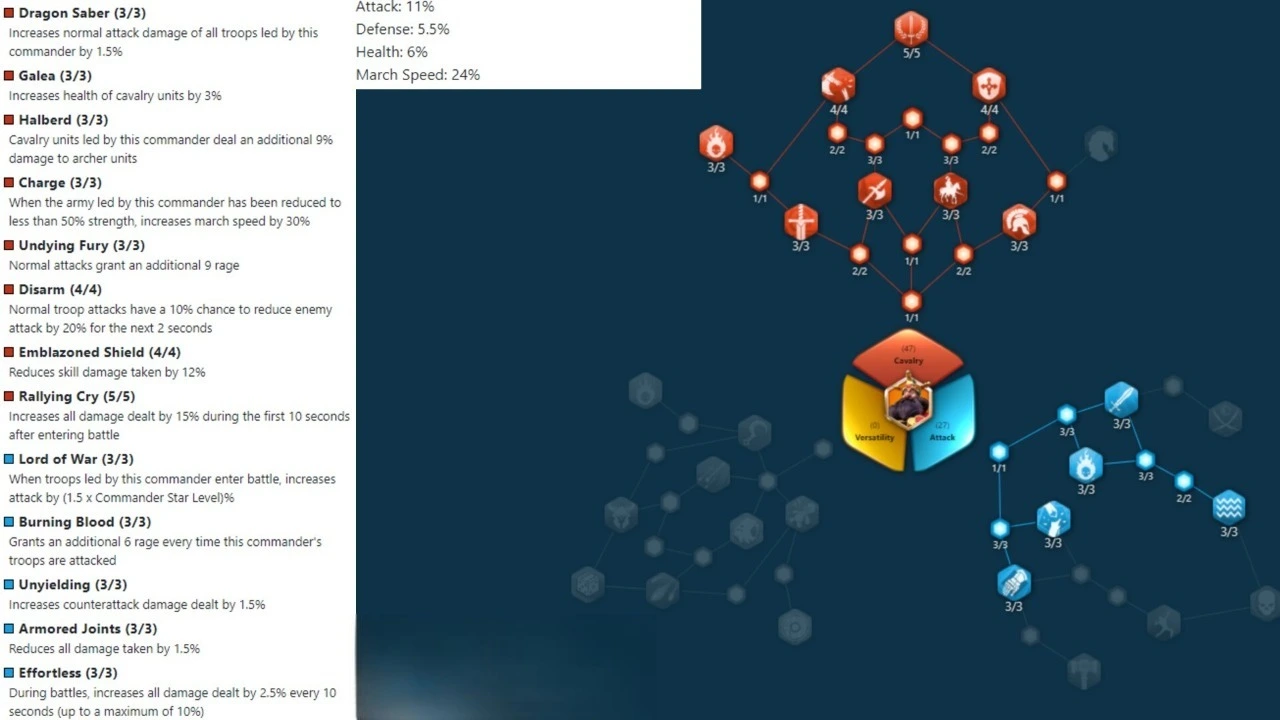
William I is most commonly used as a secondary commander, so his talent tree often does not matter.
However, if William serves as the primary commander, combine the Attack and Cavalry trees.
Attack Tree Priorities
The Attack tree provides general damage and Rage-related value that fits William’s aggressive field role.
Useful targets include:
- Effortless
- Fight to the Death
- Armored Joints
- Rage-generating nodes along the route
Fight to the Death increases damage but also makes the march take more damage. Therefore, pair it with defensive talents rather than building only for offense.
Cavalry Tree Priorities
After securing the core Attack talents, move into Cavalry for survivability and additional Rage.
Useful priorities include:
- Emblazoned Shield
- Undying Fury
- Disarm
- Cavalry Health
- Additional March Speed where efficient
Health is particularly important because William’s skills already supply substantial Cavalry Attack.
Should You Use the Versatility Tree?
Generally, no.
The Versatility tree has situational uses, but Attack and Cavalry provide more consistent value for a normal open-field William build.
Should William I Be Primary or Secondary?
William I is usually more valuable as a secondary commander.
His strongest benefits come from his skills, not from access to a uniquely powerful talent tree. A stronger Cavalry commander can therefore lead the march while William contributes AOE damage, slows, surrounded-target damage, Defense, and Rage support.
| Situation | Recommended Position |
| Paired with a stronger modern Cavalry commander | Secondary |
| William is your best developed Cavalry commander | Primary |
| You specifically need his Attack/Cavalry talent build | Primary |
| Multi-march Season of Conquest roster | Usually secondary |
Best William I Pairings
William works best behind a Cavalry primary that already provides strong damage or survivability.
Huo Qubing and William I
Recommended: Huo Qubing primary, William I secondary
Huo provides strong focused Cavalry pressure, while William adds AOE coverage and additional Rage support when Hidden Bloodline connects with multiple enemies.
The combination is particularly useful for players running several Cavalry marches and looking for a secondary commander without breaking apart another completed pairing.
Alexander Nevsky and William I
Recommended: Nevsky primary, William I secondary
Nevsky provides strong single-target Skill Damage and Cavalry pressure. William complements him with AOE, March Speed reduction, and additional utility in swarms.
This is no longer the newest Cavalry setup, but it remains practical when both commanders are already developed.
Genghis Khan and William I
Best for: Legacy burst setup
An already-developed Genghis Khan can pair with William for concentrated single-target damage plus AOE support.
Khan supplies fast Rage cycles and heavy focused damage. William then adds multi-target pressure and slows.
However, the pairing is relatively fragile and should be treated as a legacy option rather than a new investment goal.
Saladin and William I
Recommended: Saladin primary, William I secondary
Saladin provides more durability than most classic Cavalry partners. This allows William to stay active longer and potentially trigger more Hidden Bloodline and Norman Conquest effects.
The combination is useful for accounts that already own both commanders but should not be built from zero in a mature Season of Conquest kingdom.
Takeda Shingen and William I
Takeda can improve sustained fighting and help an older Cavalry roster survive longer.
However, this pairing lacks the modern mechanics and burst of newer combinations. Use it when the account already has both commanders developed.
Attila and William I
Attila and William have limited synergy because Attila emphasizes normal attacks while William still gains much of his value from Hidden Bloodline and group support.
The pairing can function as a roster fallback, but it should not be considered a priority combination.
Comparing developed Cavalry rosters? William I can still add value as a secondary commander, but account strength also depends on newer commanders, equipment, armaments, formations, technology, resources, and troop reserves. Players evaluating a ROK account for sale should compare the complete Cavalry lineup rather than focusing on one older Legendary commander.
Best Troops for William I
Use a full Cavalry march whenever practical.
William technically has effects that do not require every troop to be Cavalry. However, both Charge of Hastings and Norman Conquest provide Cavalry-specific bonuses.
A full Cavalry march also provides better synergy with:
- Cavalry equipment
- Cavalry talents
- Armament attributes
- Cavalry-focused primary commanders
- March Speed bonuses
Therefore, there is little reason to run mixed troops in normal open-field combat.
Best Formation for William I
Wedge Formation
Wedge is the most natural starting formation when William is being used with a Skill Damage-oriented Cavalry primary.
Hidden Bloodline contributes a substantial amount of active-skill damage, while common William pairings such as Nevsky or Huo also benefit from offensive Skill-related effects.
However, the primary commander should determine the final formation. William is frequently secondary, so do not select a formation based only on his kit.
Useful Armament Attributes
- Cavalry Health
- Cavalry Defense
- Cavalry Attack
- Skill Damage
- All Damage
- Damage Reduction
- March Speed
Excellent armaments can be more valuable than forcing a theoretically ideal formation with poor statistics.
Best Equipment for William I
William should use equipment appropriate for the primary Cavalry commander in the march.
Because his own skills already provide large amounts of Cavalry Attack, Health and Defense usually improve overall trades more efficiently than stacking Attack on every slot.
Equipment Stat Priority
- Cavalry Health
- Cavalry Defense
- All-damage reduction
- Skill Damage when appropriate for the pairing
- Cavalry Attack
- March Speed
Equipment Development Strategy
- Build equipment for the entire Cavalry roster rather than William alone.
- Prioritize permanent Legendary pieces.
- Do not replace strong talented Epic gear too quickly.
- Use special talents matching the primary commander where possible.
- Apply Iconic upgrades only to long-term pieces.
- Transfer the set to a newer Cavalry commander if William leaves the march.
How to Use William I in Open Field
Position the Rectangle Correctly
Hidden Bloodline uses a forward-facing rectangle rather than a circular AOE.
Therefore, the march should face into groups of enemies whenever possible. Poor positioning can turn a three-target skill into a single-target hit.
Fight Near Allied Marches
Scourge of the North becomes much more valuable when nearby allies can receive the Defense and Rage effect.
William performs best inside an organized murder ball rather than roaming alone.
Collapse on Surrounded Targets
Norman Conquest becomes stronger as more allied troops surround the enemy target, up to five troops counted.
Therefore, attack the same target your alliance is already collapsing on instead of spreading damage across random enemies.
Use the Slow to Secure Kills
Hidden Bloodline can reduce March Speed by 30% at maximum skill level.
This helps Cavalry marches keep contact with escaping targets and gives nearby allies more time to finish them.
Do Not Frontline William
His fourth skill provides temporary Defense, but William lacks healing, shielding, and major permanent damage reduction.
Use tankier allied marches to establish the fight before pushing William’s Cavalry march too deep into enemy focus.
Fight on Alliance Territory When Possible
Charge of Hastings adds up to 10% extra damage while the march is fighting on alliance territory.
This provides additional value during flag fights, pass battles, and defensive engagements around controlled structures.
William I Strengths and Weaknesses
| Strengths | Weaknesses |
| Hits up to three targets | Rectangle AOE requires positioning |
| Up to 30% March Speed reduction | No healing or shield |
| Strong Cavalry Attack bonuses | Not a top new investment |
| Adds extra damage against surrounded targets | Surround mechanic needs allied coordination |
| Provides nearby allies Defense and Rage | Team effect requires hitting at least two targets |
| Works effectively as secondary | Talent tree often provides little value from secondary slot |
| Useful at 5-5-1-1 or 5-5-5-1 | Expertise has weaker investment efficiency today |
Common William I Mistakes
- Expertising him automatically: 5-5-5-1 already captures most of his practical value.
- Ignoring 5-5-1-1: A budget William can already function as a useful secondary.
- Using him as primary when a better leader is available: His skills generally matter more than his talents.
- Positioning the AOE poorly: Hidden Bloodline uses a forward rectangle.
- Fighting alone: Scourge of the North and Norman Conquest gain value from nearby allies.
- Attacking isolated tanks: William performs better against clustered or surrounded targets.
- Ignoring alliance territory: Charge of Hastings provides extra damage there.
- Building only Cavalry Attack: Health and Defense can improve real battlefield performance more.
- Using him as a garrison: He lacks the talents and mechanics for serious structure defense.
- Building equipment specifically for William: Create a transferable Cavalry set.
- Assuming old pairings are still top meta: Use them mainly when the commanders are already developed.
- Spending Universal Sculptures before completing modern priorities: William is valuable, but no longer first priority.
FAQ
Is William I good in Rise of Kingdoms?
Yes. William I remains a useful open-field Cavalry commander, particularly as a secondary because his AOE, March Speed reduction, surrounded-target damage, Defense, and Rage support still provide battlefield value.
What is the best William I skill order?
Max Hidden Bloodline first, followed by Charge of Hastings. A 5-5-1-1 build is usable, while 5-5-5-1 is the stronger stopping point for players who plan to use William regularly.
Does William I need expertise?
No. Expertise improves Norman Conquest, but William already provides most of his important AOE and support mechanics at 5-5-5-1.
What is the best William I talent tree?
When William is primary, use an Attack and Cavalry hybrid focused on damage, Rage generation, Cavalry Health, and survivability. His talents do not apply when he is secondary.
Should William I be primary or secondary?
William is usually better as secondary behind a stronger Cavalry primary. Use him as primary only when his own talent tree is the best available option.
Who pairs well with William I?
Huo Qubing and Alexander Nevsky remain useful primaries for an already-developed William. Genghis Khan, Saladin, and Takeda Shingen are older or legacy options.
What formation is best for William I?
Wedge is a strong starting choice for Skill-oriented Cavalry marches. However, William is commonly secondary, so the primary commander and quality of your armaments should determine the final formation.
Is William I worth investing in for F2P players?
He can be worthwhile when already partially developed, especially at 5-5-1-1 or 5-5-5-1. Starting a new expertise project with Universal Legendary Sculptures is generally lower priority for F2P players.
Conclusion
William I remains one of the more useful older Cavalry commanders in Rise of Kingdoms because his value extends beyond raw damage.
Hidden Bloodline provides three-target AOE, March Speed reduction, and an important debuff. Charge of Hastings improves Cavalry Attack and mobility, while Norman Conquest punishes targets that are already surrounded.
Scourge of the North adds another layer of value by providing Defense and Rage to William and nearby allies when Hidden Bloodline hits multiple enemies.
A 5-5-1-1 William is already usable as a budget secondary, while 5-5-5-1 remains the better stopping point for players who use him regularly. Expertise improves his third skill, but the additional sculpture cost is difficult to prioritize over newer commanders.
Use William behind a strong Cavalry primary, position the march so Hidden Bloodline hits several enemies, and focus the same targets your alliance is already surrounding. That approach extracts far more value from his kit than using him as a solo damage dealer.
Explore more commander builds, Cavalry strategies, equipment advice, and KvK guides in the Rise of Kingdoms guide collection.