
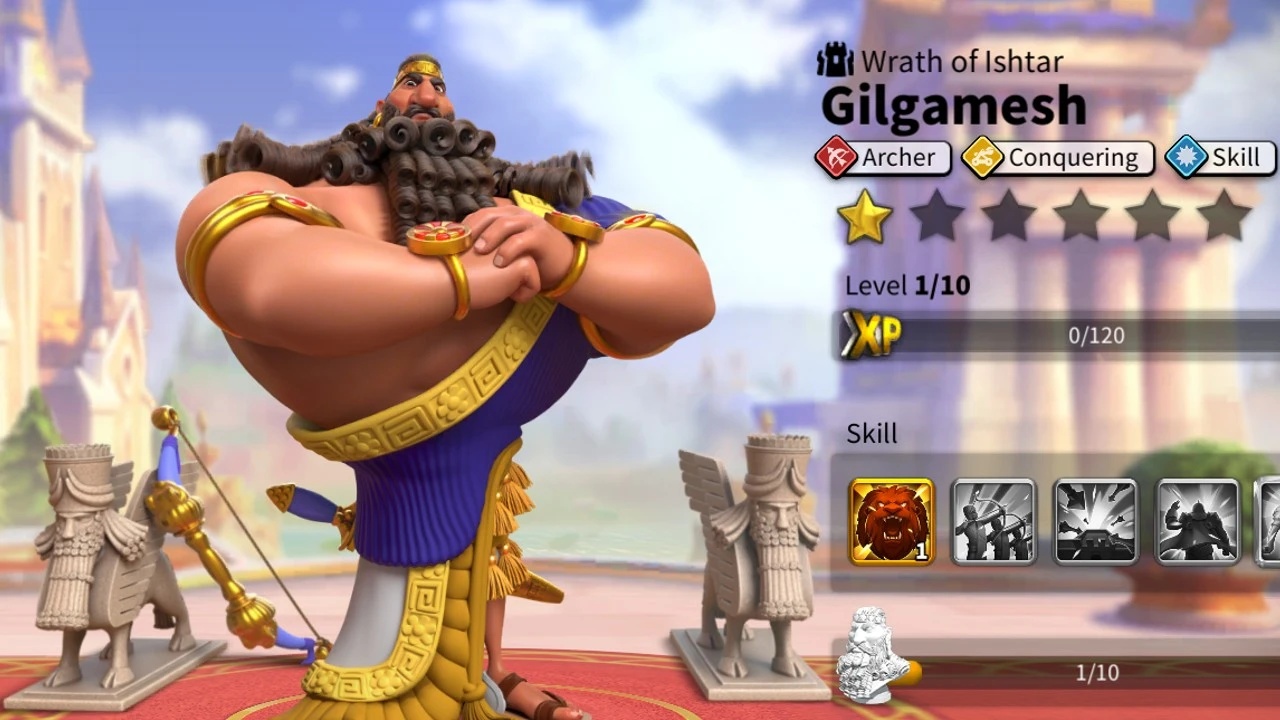
Gilgamesh is a Legendary Archer commander in Rise of Kingdoms with Archer, Conquering, and Skill talent trees. His kit combines high single-target skill damage, Archer Health, bonuses against weakened troops, city and stronghold rally effects, and the unique Blood Craving debuff.
Gilgamesh was once one of the most important Archer rally commanders in the game. However, newer Archer generations now provide stronger overall investment value for most accounts. That makes Gilgamesh primarily useful for governors who already have him developed, need another Archer march, or still use one of his specialist rally combinations.
This guide explains Roar of the Tiger, Bowman of Uruk, A King’s Right, Enkidu’s Path, Blood Craving, the best Gilgamesh talent trees, skill order, pairings, equipment, and whether he is still worth investing in.
Gilgamesh is no longer a priority new Legendary investment for most players. However, an existing 5-5-1-5 or expertised Gilgamesh can still provide useful Archer damage, anti-healing pressure, and rally utility.
For open field, use him primarily when stronger Archer commanders are already assigned elsewhere. For rallies, expertise provides much better value because Demigod significantly improves Blood Craving.
Is Gilgamesh Still Good in 2026?
Gilgamesh remains capable of dealing strong focused damage. Roar of the Tiger has a maximum damage factor of 1,500 and reduces the target’s Health by up to 30% for three seconds.
In addition, Bowman of Uruk provides up to 30% Archer Health. Once an enemy falls below 50% troop strength, Gilgamesh’s Archers can also deal up to 20% additional damage to that target.
His main limitation is age. Modern Archer commanders can offer stronger AOE, better debuffs, newer combat mechanics, or more complete survivability. Therefore, Gilgamesh should generally be viewed as a specialist or roster-depth commander rather than the centerpiece of a new Archer account.
| Game Mode | Current Value | Practical Assessment |
| Open field | Usable when already developed | Good single-target pressure and Blood Craving, but newer Archers provide stronger overall value. |
| Archer rally | Specialist | A King’s Right and Blood Craving remain useful, particularly against healing-heavy defenses. |
| City rally | Legacy option | Usable when the kingdom lacks stronger modern rally leaders. |
| Ark of Osiris | Situational | Healing punishment can pressure defensive objectives. |
| Sunset Canyon | Moderate | Strong focused damage but limited AOE compared with dedicated Canyon commanders. |
| Garrison | Not recommended | He has no Garrison talent tree or structure-defense skill. |
Who Should Still Use Gilgamesh?
- Players who already have him at 5-5-1-5 or expertise
- Archer-focused accounts needing an additional march
- Rally leaders with a developed legacy Archer setup
- Governors who already own strong Archer equipment
- Players whose newer Archer commanders are assigned to other marches
Who Should Skip Gilgamesh?
- New players choosing their first Season of Conquest commander
- F2P players with a limited Universal Legendary Sculpture supply
- Governors building only one Archer march
- Players who already own stronger modern Archer pairings
- Accounts without competitive Archer equipment
Gilgamesh Quick Overview
| Attribute | Gilgamesh |
| Rarity | Legendary |
| Origin | Uruk |
| Talent trees | Archer, Conquering, Skill |
| Best troop type | Archers |
| Primary historical role | Archer rally leader |
| Secondary role | Open-field single-target pressure |
| Maximum active damage factor | 1,500 |
| Maximum Archer Health | 30% |
| Useful partial build | 5-5-1-5 |
| Best rally build | 5-5-5-5 |
| Signature mechanic | Blood Craving |
How to Get Gilgamesh
Gilgamesh was introduced as a Wheel of Fortune Archer commander. In mature kingdoms, his availability can depend on the current Wheel selection system and other commander-access events.
Potential sources include:
- Wheel of Fortune
- Later commander-selection events
- Card King when available
- Universal Legendary Commander Sculptures
Do not spend heavily on a Gilgamesh Wheel simply because he appears. First, compare him with the newer Archer commanders currently available to your kingdom.
Should You Use Universal Sculptures?
For most accounts, starting a new Gilgamesh investment is difficult to justify. Modern Archer commanders usually provide better long-term performance.
Finishing Gilgamesh can still make sense when:
- He is already close to 5-5-1-5 or expertise.
- Your preferred modern Archer commanders are completed.
- You lead an Archer rally that specifically benefits from Blood Craving.
- Your account runs several Archer marches.
- You already own equipment designed for his role.
Best Gilgamesh Skill Order
Gilgamesh has a workable partial build because his third skill is primarily designed for attacking cities and strongholds. An open-field player can therefore prioritize skills one, two, and four.
| Skill Target | Best Use | Assessment |
| 5-1-1-1 | Temporary unlock | Maximum Roar of the Tiger but limited supporting value. |
| 5-5-1-1 | Early partial build | Adds maximum Archer Health and execute-style damage. |
| 5-5-1-5 | Open-field sweet spot | Adds maximum Enkidu’s Path while minimizing investment in the rally-specific third skill. |
| 5-5-5-5 | Rally specialist | Unlocks Demigod and maximum A King’s Right value. |
Recommended Progression
- Keep Gilgamesh at one star until Roar of the Tiger reaches level five.
- Unlock Bowman of Uruk and raise it to level five.
- Use skill locking when targeting 5-5-1-5.
- Stop at 5-5-1-5 for a secondary or open-field role.
- Continue toward expertise when Gilgamesh will lead important Archer rallies.
- Avoid chasing expertise when newer Archer investments remain unfinished.
Important: A 5-5-1-5 Gilgamesh is useful because A King’s Right is primarily a city and stronghold skill. However, this is not a complete rally build. Rally leaders should develop the third skill and Demigod as well.
Gilgamesh Skills Explained
Roar of the Tiger

Skill type: Active
Rage requirement: 1,000
Roar of the Tiger deals direct damage to one target. At maximum level, it has a damage factor of 1,500 and reduces the target’s Health by 30% for three seconds.
| Skill Level | Damage Factor | Enemy Health Reduction |
| 1 | 900 | 10% |
| 2 | 1,000 | 15% |
| 3 | 1,100 | 20% |
| 4 | 1,300 | 25% |
| 5 | 1,500 | 30% |
The Health reduction makes the enemy less durable during the debuff window. It should not be confused with healing reduction. Gilgamesh’s anti-healing mechanic comes from Blood Craving instead.
Bowman of Uruk
Bowman of Uruk increases Archer Health. It also increases all damage dealt by Archers when the enemy troop has less than 50% of its units remaining.
| Skill Level | Archer Health | Damage vs. Target Below 50% |
| 1 | 10% | 10% |
| 2 | 15% | 12% |
| 3 | 20% | 14% |
| 4 | 25% | 17% |
| 5 | 30% | 20% |
This is one of Gilgamesh’s most useful general-purpose skills. The 30% Archer Health applies throughout the fight, while the extra damage helps finish weakened enemies.
A King’s Right

A King’s Right is Gilgamesh’s city and stronghold skill. Archers gain additional Attack while attacking these targets.
Furthermore, the march gains another Archer Attack stack every six seconds. Each stack lasts ten seconds and can accumulate up to six times.
| Skill Level | Archer Attack | Attack per Stack |
| 1 | 10% | 1% |
| 2 | 12% | 2% |
| 3 | 14% | 3% |
| 4 | 17% | 4% |
| 5 | 20% | 5% |
Because this skill requires city or stronghold combat, it contributes little during ordinary open-field fighting. That is why 5-5-1-5 became a practical partial build for field-oriented players.
Enkidu’s Path

Enkidu’s Path reduces normal attack damage received by Gilgamesh’s troop. In addition, his attacks have a 30% chance to apply Blood Craving.
When an affected troop receives healing, Blood Craving deals direct damage. The debuff has a five-second trigger cooldown.
| Skill Level | Normal Attack Damage Reduction | Blood Craving Damage Factor |
| 1 | 2% | 300 |
| 2 | 4% | 350 |
| 3 | 6% | 400 |
| 4 | 8% | 450 |
| 5 | 10% | 500 |
At maximum level before expertise, Blood Craving lasts three seconds. This mechanic makes Gilgamesh particularly annoying for healing-heavy marches and defensive pairings.
Demigod

Demigod is Gilgamesh’s expertise. It enhances Enkidu’s Path rather than functioning as a separate fourth passive skill.
After expertise:
- Normal attack damage taken is reduced by 15% instead of 10%.
- Blood Craving still has a 30% application chance.
- Healing triggers a damage factor of 700 instead of 500.
- The affected enemy takes 15% additional skill damage.
- Blood Craving lasts four seconds instead of three.
- The effect retains a five-second trigger cooldown.
The 15% increased skill damage taken is particularly important in a rally. Gilgamesh can apply Blood Craving while the primary commander and other skill effects take advantage of the vulnerability window.
How Blood Craving Works
Blood Craving should not be confused with a simple healing-reduction effect. Instead of reducing the amount healed, it punishes the enemy when healing occurs.
Before expertise, an affected troop takes direct damage when it receives healing. After Demigod, the damage factor increases to 700 and the target also takes 15% more skill damage for the duration.
Blood Craving Is Strong Against:
- Healing-heavy garrisons
- Commanders with frequent healing skills
- Long sustained battles
- Targets supported by healing effects
- Pairings that rely on surviving through repeated recovery
However, Blood Craving is less impressive against a target with little or no healing. Gilgamesh still contributes his other statistics and skill damage, but one of his defining mechanics loses value.
Best Gilgamesh Talent Trees
Only the primary commander’s talents apply. Therefore, these talent builds matter when Gilgamesh leads the march.
If Zhuge Liang, Nebuchadnezzar, Boudica Prime, or another commander serves as primary, Gilgamesh contributes his skills but not his talent tree.
Gilgamesh Open-Field Talent Tree

The open-field build should combine Skill talents with Archer durability and mobility. Gilgamesh is single-target focused, so remaining close enough to repeatedly attack important enemies matters more than Conquering bonuses.
Open-Field Priorities
- Reach Rejuvenate for additional Rage after active-skill use.
- Take Tactical Mastery and useful Skill damage nodes.
- Add Archer Health and Defense.
- Take March Speed where efficient.
- Use Venomous Sting when the secondary commander provides useful active-skill damage.
- Spend remaining points on general Archer combat statistics.
Avoid investing heavily into Conquering talents for normal PvP. Those points provide much less value when the enemy is another field march rather than a city or stronghold.
Gilgamesh Skill and Rage Talent Tree

This build moves farther into the Skill tree and prioritizes faster active-skill cycles. More Roar of the Tiger activations create additional Health-reduction windows and improve overall skill pressure.
Rage Build Priorities
- Reach Rejuvenate first.
- Continue through the Skill tree toward Feral Nature.
- Add Tactical Mastery for active-skill damage.
- Take essential Archer Health and Defense nodes.
- Add March Speed only after the main Rage path is complete.
The build works best in longer fights where Gilgamesh can remain on target. However, it sacrifices some mobility and general Archer statistics compared with the more balanced open-field route.
Gilgamesh Rally Talent Tree
For a dedicated rally leader, invest more heavily in Conquering talents. A King’s Right activates against cities and strongholds, so a rally build should support the same role.
Prioritize:
- Conquering damage bonuses
- Counterattack-damage reduction
- Damage against garrisons and strongholds
- Rage generation
- Archer Health
- Archer Defense
Do not use the rally route for normal open-field combat. Several talent points and one full skill would provide limited value.
Best Gilgamesh Pairings
Gilgamesh needs a partner that adds AOE, additional skill damage, Rage generation, or another strong Archer combat effect.
Most of his classic pairings are now legacy combinations. They remain useful when already developed, but they should not automatically receive new Universal Sculpture investment.
| Pairing | Suggested Primary | Best Use | Assessment |
| Nebuchadnezzar II and Gilgamesh | Nebuchadnezzar II | Legacy Archer rally | Strong classic combination of AOE, Blood Craving, Archer stats, and rally pressure. |
| Zhuge Liang and Gilgamesh | Zhuge Liang | Secondary rally or roster-depth setup | Zhuge provides stronger modern skill pressure while Gilgamesh adds Health and Blood Craving. |
| Boudica Prime and Gilgamesh | Boudica Prime | Open-field fallback | Works when stronger modern Archer deputies are already occupied. |
| Gilgamesh and Cyrus | Gilgamesh | Legacy skill-damage march | Cyrus provides strong skill pressure and useful Archer synergy. |
| Gilgamesh and YSG | Gilgamesh | Legacy open field | YSG adds AOE damage, but the pairing is vulnerable to modern focused damage. |
| Ramesses II and Gilgamesh | Situational | Legacy field or rally | Adds Archer statistics and another form of anti-healing pressure. |
Nebuchadnezzar II and Gilgamesh
The classic Gilgamesh rally pairs him with Nebuchadnezzar II. Nebuchadnezzar contributes AOE damage, Archer Defense, March Speed, and Rage disruption. Meanwhile, Gilgamesh adds Archer Health, target Health reduction, and Blood Craving.
This combination can still function for an already-developed Archer rally account. Nevertheless, kingdoms with newer rally commanders should compare current battle reports before committing troops.
Zhuge Liang and Gilgamesh
Zhuge Liang should generally lead because his modern skill-oriented kit and talent options provide stronger overall pressure. Gilgamesh can serve as a secondary source of Archer Health and Blood Craving.
This is primarily a roster-depth setup. Stronger pairings should remain together whenever possible.
Boudica Prime and Gilgamesh
Boudica Prime can use Gilgamesh as a fallback secondary when Zhuge Liang, Hermann Prime, or another preferred Archer partner is unavailable.
Gilgamesh contributes single-target damage and Archer durability. However, this should not be interpreted as a reason to build Gilgamesh specifically for Boudica.
Gilgamesh and Cyrus the Great
Cyrus adds skill damage, additional proc damage, and Archer utility. Combined with Gilgamesh, the march can produce strong focused pressure against one target.
Both commanders now belong to older generations, so the pairing is best suited to accounts that already own the investment.
Best Troops, Formation and Equipment
Best Troop Type
Use a full Archer march. Bowman of Uruk and A King’s Right specifically improve Archers, while Gilgamesh’s best talent paths and equipment also favor the same troop type.
Mixed troops sacrifice too much Health, Attack, equipment synergy, and talent value.
Best Formation
Wedge Formation is a practical choice when Gilgamesh is used for skill-oriented open-field combat. It supports active-skill damage and fits well with Roar of the Tiger and Blood Craving pressure.
However, formation choice should follow the primary commander and available armament inscriptions. A Zhuge-led setup may use different armaments from a Gilgamesh-led rally.
Equipment Priorities
Gilgamesh already receives a substantial Archer Health bonus. Even so, Health remains a useful equipment statistic because survivability determines how many skill cycles the march can complete.
- Archer Health
- Archer Defense
- Skill damage
- All-damage reduction
- Archer Attack
- March Speed
Open-field players should not focus exclusively on Attack. A fragile Archer march may produce one strong Roar of the Tiger before being focused out of the fight.
Equipment Development Strategy
- Build equipment for the overall Archer roster, not only Gilgamesh.
- Prioritize permanent Legendary pieces.
- Use special talents that match the primary commander.
- Improve Health and Defense before excessive Attack stacking.
- Use Iconic Crystals only on long-term equipment.
- Move the equipment to a newer Archer commander if Gilgamesh leaves the lineup.
How to Use Gilgamesh Effectively
Focus Healing-Heavy Targets
Blood Craving provides the most value when the enemy relies on healing. Therefore, prioritize marches or garrisons that repeatedly restore troops.
Against a non-healing target, Gilgamesh still provides Health reduction and Archer damage, but the signature debuff becomes less valuable.
Time Damage Around Roar of the Tiger
Roar of the Tiger reduces the enemy’s Health for three seconds. Other high-damage skills can take advantage of that window.
For this reason, pairing Gilgamesh with a strong skill-damage commander can produce better results than combining him with another purely defensive Archer.
Finish Weakened Marches
Bowman of Uruk increases damage against targets below 50% troop strength. Instead of constantly changing targets, Gilgamesh can benefit from finishing a weakened enemy before switching to another march.
However, do not chase an escaping target deep into an enemy group. Archers remain vulnerable when separated from allied support.
Do Not Frontline Gilgamesh
Gilgamesh has solid Archer Health and reduced normal-attack damage, but he lacks healing and shielding. Therefore, allow tankier allied marches to establish contact before moving him into range.
Positioning is especially important in large KvK field fights where enemy players quickly focus recognizable Archer marches.
Use A King’s Right Only Where It Applies
A King’s Right is designed for cities and strongholds. It should not influence the decision to use Gilgamesh in an ordinary field march.
Likewise, Conquering talents provide limited value when attacking another player’s march on the map.
Comparing developed Archer rosters? Gilgamesh can still add specialist rally or secondary-march value, but overall account strength depends on modern commanders, equipment, Iconic levels, armaments, formations, technology, resources, and kingdom status. Players reviewing a ROK account for sale should compare the full Archer roster rather than focusing on a single older Legendary commander.
Gilgamesh Strengths and Weaknesses
| Strengths | Weaknesses |
| 1,500 active-skill damage factor | Single-target active skill |
| Reduces target Health by up to 30% | No healing or shield |
| Provides 30% Archer Health | One skill is mostly rally-specific |
| Deals more damage to weakened enemies | Limited mobility compared with newer options |
| Blood Craving punishes healing | Blood Craving loses value against non-healing targets |
| Expertise increases skill damage received by the target | Expertise requires heavy investment |
| Still usable in specialist Archer rallies | No longer a priority F2P or low-spender investment |
Common Gilgamesh Mistakes
- Calling Roar of the Tiger healing reduction: It reduces the target’s Health stat.
- Forgetting Bowman of Uruk: It is Gilgamesh’s second skill and provides Archer Health.
- Confusing A King’s Right with Bowman of Uruk: A King’s Right is the city and stronghold skill.
- Calling Demigod the fourth passive skill: It is the expertise that improves Enkidu’s Path.
- Assuming Blood Craving simply reduces healing: It deals damage when healing occurs.
- Using mixed troops: Gilgamesh is designed around Archers.
- Using Conquering talents in open field: Several bonuses apply only to cities and strongholds.
- Calling him a must-have in 2026: Newer Archer commanders usually provide better investment priority.
- Building him because he is Wheel-exclusive: Availability does not automatically equal investment value.
- Frontlining the march: He lacks healing and shields.
- Ignoring targets below 50%: Bowman of Uruk increases damage against weakened enemies.
- Using 5-5-1-5 for rallies: Rally leaders benefit substantially from maxing A King’s Right and expertise.
- Building equipment only for Gilgamesh: Create a transferable Archer set.
- Assuming every healing commander is automatically countered: Equipment, troop type, pairing, technology, and battlefield conditions still matter.
FAQ
What does Roar of the Tiger do?
Roar of the Tiger deals up to 1,500 direct damage factor and reduces the target’s Health by up to 30% for three seconds.
What is A King’s Right?
A King’s Right increases Archer Attack when Gilgamesh attacks cities or strongholds. It also creates additional Archer Attack stacks during sustained combat.
What does Enkidu’s Path do?
Enkidu’s Path reduces normal attack damage received and gives Gilgamesh’s attacks a chance to apply Blood Craving, which damages the enemy when healing occurs.
How does Blood Craving work?
Blood Craving damages an affected troop when it receives healing. After Gilgamesh is expertised, the debuff deals up to 700 damage factor and also increases skill damage taken by 15%.
What is the best Gilgamesh skill order?
Max Roar of the Tiger first, followed by Bowman of Uruk. A 5-5-1-5 build is a practical open-field stopping point, while dedicated rally leaders should continue toward expertise.
Is Gilgamesh worth investing in during 2026?
Usually not as a new priority investment. However, an already developed 5-5-1-5 or expertised Gilgamesh can still provide useful Archer depth.
Who pairs best with Gilgamesh?
Nebuchadnezzar II remains his classic rally partner. Zhuge Liang can also use Gilgamesh in selected rally setups, while Boudica Prime, Cyrus, YSG, and Ramesses are situational or legacy options.
Which troops should Gilgamesh use?
Use a full Archer march. Bowman of Uruk, A King’s Right, Archer talents, and Archer equipment all provide more value when the march contains one troop type.
Conclusion
Gilgamesh remains an interesting Archer specialist because his skills attack several different parts of an enemy march. Roar of the Tiger reduces Health, Bowman of Uruk improves Archer durability and finishing damage, while Enkidu’s Path applies Blood Craving.
After expertise, Demigod makes Blood Craving considerably stronger by increasing its healing-triggered damage and causing the target to take 15% additional skill damage.
However, Gilgamesh is no longer a must-build Archer commander. Newer options should generally receive priority when starting a fresh investment.
Use 5-5-1-5 as a practical stopping point when Gilgamesh serves in open field or as a secondary commander. For a dedicated rally build, expertise provides much more complete value because A King’s Right and Demigod directly support sustained structure attacks.
Most importantly, match him with full Archers, permanent equipment, and a partner that benefits from his Health reduction and Blood Craving windows. When already developed, he can still provide useful depth without requiring the entire Archer roster to be built around him.
Explore more commander builds, Archer strategies, equipment advice, and KvK content in the Rise of Kingdoms guide collection.