
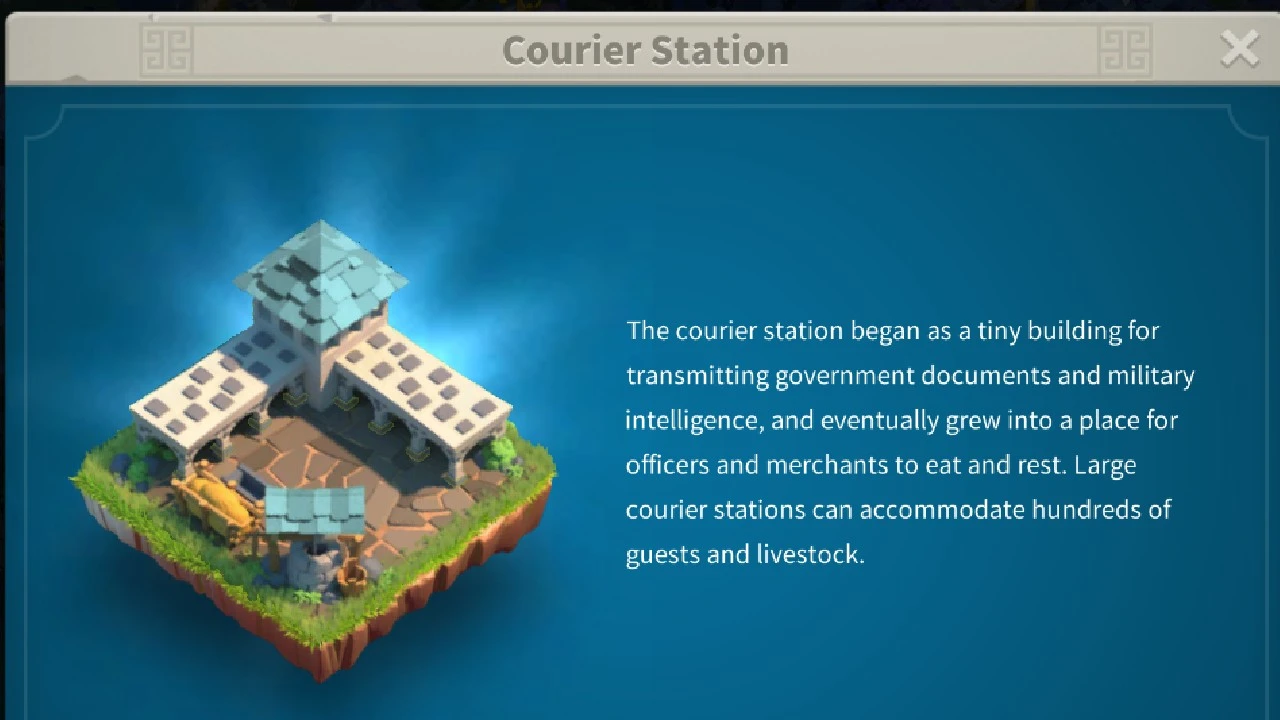
The Courier Station is a city building in Rise of Kingdoms that houses the Mysterious Merchant. During each visit, the merchant offers discounted resources, speedups, boosts, commander items, teleports, and other progression materials.
However, a discount does not automatically make an offer valuable. Some deals allow you to exchange farmable Food or Wood for useful speedups. By contrast, other offers require gems that may provide better long-term value through VIP progression, commander events, or Castle upgrades.
This guide explains how the Courier Station works, when the Mysterious Merchant appears, which items are usually worth buying, and when a paid refresh makes sense.
Buy useful speedups and resource items whenever they cost Food or Wood. Next, use the free refresh during each merchant visit. Most F2P players should stop there and avoid spending gems unless an offer is unusually valuable and supports an immediate account goal.
Meanwhile, low spenders and active KvK players can consider deeply discounted speedups. Even then, every purchase should fit a specific upgrade, training event, research goal, or war-preparation plan.
What Is the Courier Station?
The Courier Station is unlocked after reaching City Hall level 6. Once constructed, it becomes the location where the Mysterious Merchant appears for limited shopping periods.
Each merchant inventory normally contains 16 offers:
- Four resource offers
- Four speedup offers
- Four temporary boosts
- Four other progression items
Some offers require gems and receive a randomly displayed discount. Others cost Food or Wood, allowing you to convert normal resources into speedups, boosts, resource items, Commander EXP, or Starlight Sculptures.
Why the Courier Station Is Valuable
Resources can be gathered repeatedly, produced inside the city, or transferred from farm accounts. Speedups, on the other hand, are limited by events, activity, purchases, and time.
Therefore, exchanging excess Food or Wood for useful speedups usually improves the account’s long-term efficiency. The Courier Station can also convert open resources into resource items stored safely inside the inventory.
As a result, regular merchant visits can provide value without requiring gems or real-money purchases.
How the Mysterious Merchant Works
The Mysterious Merchant normally visits at 00:00 UTC. Additional visits may also occur after completing common activities, such as troop training, building upgrades, or Barbarian battles.
These activities create opportunities for another appearance, but they should not be treated as a guaranteed trigger after every completion. When the merchant arrives, an icon appears above the Courier Station.
Activities That May Trigger Another Visit
| Activity | Practical Strategy |
| Daily reset | Check the Courier Station shortly after 00:00 UTC. |
| Completing troop training | Use several shorter training queues during active farming periods. |
| Finishing a building upgrade | Check the building after collecting completed construction. |
| Defeating Barbarians | Review the Courier Station after extended Barbarian farming. |
| Regular account activity | Watch for the merchant icon while managing the city. |
Active players generally receive more opportunities to shop because they complete more qualifying activities. Nevertheless, repeatedly training unnecessary troops or spending Action Points only to force a merchant visit is rarely efficient.
Courier Station Discounts Explained
Gem-priced offers can appear with discounts ranging from 30% to 90%. A larger discount usually provides better comparative value, although the usefulness of the item still matters.
Offers purchased with Food or Wood typically use smaller discounts. Even so, these deals can be more attractive because they preserve gems and exchange renewable resources for limited progression items.
| Payment Type | Typical Discount Range | General Recommendation |
| Food or Wood | Approximately 10% to 40% | Frequently valuable for speedups and useful inventory resources |
| Gems | Approximately 30% to 90% | Buy selectively according to discount and account goals |
For example, a resource-priced speedup can be worthwhile even at a modest discount. Conversely, a heavily discounted item may still be a poor gem purchase when it provides no immediate or long-term benefit.
Best Items to Buy From the Mysterious Merchant
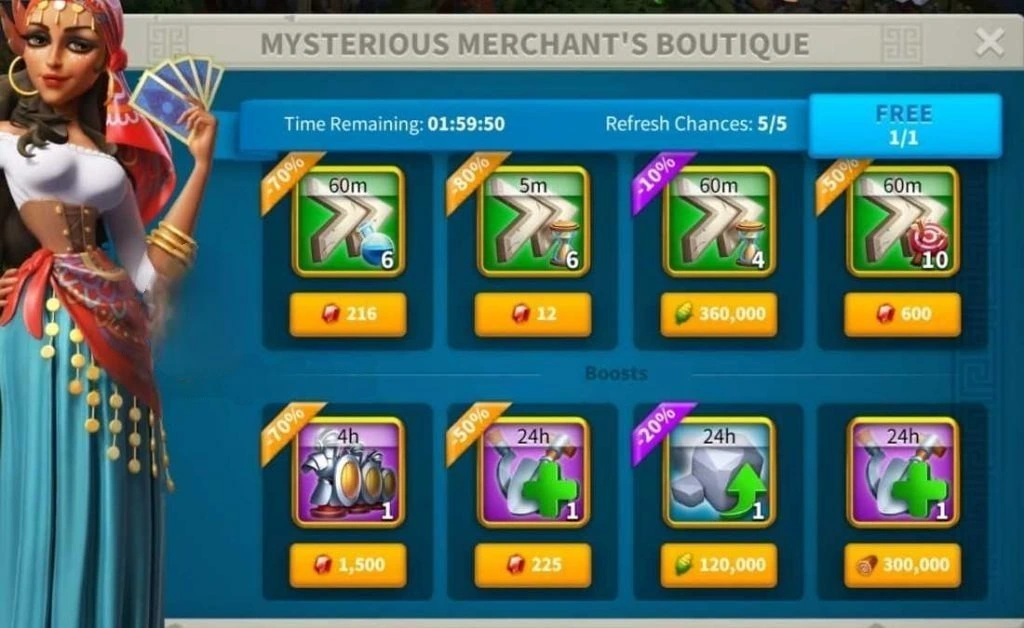
The strongest offers usually convert Food or Wood into speedups or protected resource items. After those purchases, value depends on the account’s current development stage.
1. Speedups Purchased With Resources
Speedups priced in Food or Wood are usually the best Courier Station purchases. These offers turn renewable resources into time, which remains valuable throughout the account’s life.
| Speedup Type | Priority | Best Use |
| Universal Speedups | Very high | Flexible use for research, training, buildings, or healing |
| Research Speedups | Very high | Long Academy upgrades and military technology |
| Training Speedups | High | Training events, troop recovery, and KvK preparation |
| Healing Speedups | High during war | Returning troops to combat during KvK |
| Building Speedups | High early, lower later | City Hall progression and building prerequisites |
Early accounts benefit heavily from Building and Research Speedups. Later, Training and Healing Speedups become more important because troop production and war consume increasing amounts of time.
2. Resource Items Purchased With Resources
The merchant may allow you to exchange one open resource for a packaged resource item. This transaction can help balance Food, Wood, Stone, and Gold shortages.
Furthermore, packaged resource items remain inside your inventory until opened. Enemies cannot plunder them directly from the city’s open-resource balance.
Resource exchanges are especially useful when:
- You hold excess Food or Wood.
- A building or research upgrade requires Stone or Gold.
- You want to reduce vulnerable open resources.
- You are preparing for migration.
- A farm account needs to store value more safely.
However, converting resources unnecessarily can slow a current upgrade. Check upcoming costs before purchasing every available pack.
3. Gathering and Production Boosts
Enhanced Gathering and city-production boosts are useful when they cost resources and will be activated soon. For instance, an eight-hour gathering boost can support a scheduled farming session or an alliance resource deposit.
On the other hand, buying boosts that remain unused provides no practical value. Purchase them when they support a clear resource plan rather than simply because they are inexpensive.
4. Discounted Gem Speedups
Gem-priced speedups require more caution. A low spender preparing for a major training or research event may benefit from a 70% or 90% discount. Meanwhile, an F2P player often receives better long-term value from VIP progression or selected commander events.
Before purchasing, ask three questions:
- Will I use this speedup during a planned event or upgrade?
- Is the displayed discount unusually high?
- Would spending these gems delay a more important goal?
When the third answer is yes, skip the offer even if its discount appears attractive.
5. Starlight Sculptures and Commander EXP
Starlight Sculptures and Tomes of Knowledge can help a new account. Nevertheless, both items become easier to obtain through normal gameplay as the account matures.
Buy them with resources when they solve an immediate progression problem. Gem purchases are rarely necessary unless a heavily discounted offer completes a specific commander upgrade.
Courier Station Purchase Priority
| Offer | Resource Price | Gem Price | Overall Priority |
| Universal Speedups | Buy | Consider only at a strong discount | Very high |
| Research Speedups | Buy | Situational | Very high |
| Training Speedups | Buy | Useful before training events | High |
| Healing Speedups | Buy | Useful during active war | High during KvK |
| Building Speedups | Buy early | Usually skip | Stage dependent |
| Resource Items | Buy when useful | Usually skip | Medium to high |
| Gathering Boosts | Buy when needed | Usually skip | Medium |
| Commander EXP | Early-game option | Skip | Low to medium |
| Starlight Sculptures | Situational | Usually skip | Low to medium |
| Unneeded Teleports or Boosts | Skip unless required | Skip | Low |
Items You Should Usually Avoid
The merchant’s discount label can create a sense of urgency. Yet unused items still represent wasted resources or gems.
Low-Value or Situational Purchases
- Small Commander EXP offers purchased with gems
- Starlight Sculptures when commander stars are not blocking progress
- Teleports already available through the Alliance Shop
- Production boosts without an immediate plan
- Resource packs purchased with gems
- Building Speedups after major construction is complete
- Repeated paid refreshes without a specific target
Instead of asking whether an item is discounted, ask whether it advances the account’s current objective. This approach prevents small purchases from consuming a large amount of gems over time.
Should F2P Players Spend Gems at the Courier Station?
Most F2P players should use the Courier Station primarily as a resource exchange. Speedups, boosts, and resource packs purchased with Food or Wood can provide excellent value without interfering with gem-saving goals.
Meanwhile, gems may be required for VIP progression, Castle development, Wheel of Fortune participation, or other account priorities. Spending them repeatedly on merchant offers can delay those larger milestones.
Recommended F2P Rules
- Buy useful speedups that cost Food or Wood.
- Purchase resource packs when the exchange supports current needs.
- Use every free merchant refresh.
- Skip most gem-priced EXP, boosts, and resources.
- Consider a gem offer only at a very high discount.
- Do not use paid refreshes without a specific reason.
Although an individual gem purchase may appear small, daily spending accumulates quickly. Consistent discipline produces more value than chasing every discounted offer.
Courier Station Strategy for Spenders
Low spenders and larger spenders can use the merchant more aggressively. Discounted speedups may reduce the cost of reaching event milestones, finishing important research, or rebuilding troops before KvK.
However, spender status does not make every offer efficient. Before using gems, compare the merchant’s price with bundle value, event timing, and the account’s existing inventory.
Good Reasons to Spend Gems
- A deeply discounted Universal Speedup supports a planned event.
- Healing Speedups are needed during active KvK fighting.
- Research Speedups complete an important technology upgrade.
- Training Speedups help reach a valuable milestone.
- The purchase aligns with an active gem-spending event.
By contrast, paying for several refreshes merely to browse additional offers usually creates poor value.
Courier Station Refresh Costs
Each merchant visit includes one free inventory refresh. Afterward, four additional refreshes are available for progressively higher gem costs.
| Refresh | Cost | Recommendation |
| First refresh | Free | Always use |
| Second refresh | 100 gems | Occasionally reasonable with a clear target |
| Third refresh | 200 gems | Usually for spenders or event preparation |
| Fourth refresh | 300 gems | Low general value |
| Fifth refresh | 400 gems | Rarely justified |
Using every paid refresh costs 1,000 gems during one visit. Therefore, a player should not refresh repeatedly unless the expected purchases are worth more than the refresh cost.
When a Paid Refresh May Be Worth It
- You are preparing for a high-value training event.
- A critical research upgrade needs more speedups.
- Active KvK fighting has reduced healing inventory.
- You are spending gems as part of a planned event.
- A spender is deliberately searching for discounted time value.
When to Avoid Paid Refreshes
- Your gem balance is low.
- No major upgrade or event is planned.
- You are searching only for basic resources.
- Several paid refreshes have already been used.
- VIP or Castle progress remains a higher priority.
Best Items by Account Stage
Early Game
Building and Research Speedups provide the most immediate value during early progression. They help unlock additional march queues, stronger troop tiers, new buildings, and economic technology.
Universal Speedups are also useful because they can solve whichever timer is currently blocking progress. However, gems should remain protected for larger account goals.
Mid Game
Research becomes a larger time gate as the Academy advances. Consequently, Research and Universal Speedups should receive higher priority.
Training Speedups also become more valuable when the account starts planning around power events. At this stage, avoid purchasing EXP and low-impact boosts unless they solve a specific shortage.
Late Game and KvK
Healing, Training, and Universal Speedups become the main priorities during war. A large hospital can consume substantial resources and time after only a few major fights.
During peaceful periods, gathering and production boosts may provide better immediate value. Once combat begins, however, Healing Speedups can become the most important merchant offer.
Comparing progression from different account stages? Courier Station savings are useful, but established accounts also depend on VIP level, commanders, technology, speedup inventory, equipment, resources, and kingdom eligibility. Players reviewing an ROK account for sale should evaluate the full progression profile rather than focusing only on displayed power.
Best Daily Courier Station Routine
A simple routine captures most of the Courier Station’s value without creating unnecessary gem spending.
- Check the merchant after 00:00 UTC.
- Buy useful speedups priced in Food or Wood.
- Review resource exchanges according to current shortages.
- Purchase boosts only when they will be activated soon.
- Use the free inventory refresh.
- Review the second set of 16 offers.
- Stop unless a paid refresh supports a defined goal.
- Check again when the merchant icon reappears.
Additionally, review your resource and speedup inventory before shopping. A clear understanding of current shortages prevents impulse purchases.
Common Courier Station Mistakes
- Buying every discounted offer: A discount has no value when the item is unnecessary.
- Ignoring resource-priced speedups: These are usually the merchant’s strongest deals.
- Forgetting the free refresh: It provides another 16 offers without a gem cost.
- Using all paid refreshes automatically: One visit can consume 1,000 gems.
- Spending gems on resource packs: Normal resources can be gathered or produced.
- Buying EXP late in the game: Barbarians and events provide Commander EXP.
- Purchasing unneeded teleports: Alliance Shop options may already cover demand.
- Forcing merchant appearances: Do not waste Action Points or training resources solely for another visit.
- Ignoring event timing: Speedups gain more value when used during suitable reward events.
- Using open resources carelessly: Resource-item exchanges can protect part of the city’s value.
- Buying boosts without activating them: Unused inventory does not improve progression.
- Following one rule at every account stage: Purchase priorities change as the account develops.
FAQ
How do you unlock the Courier Station?
The Courier Station becomes available at City Hall level 6. After construction, the Mysterious Merchant can begin visiting the building.
When does the Mysterious Merchant appear?
The merchant normally appears at 00:00 UTC. Additional visits may occur after troop training, building upgrades, Barbarian battles, and other regular account activity.
How many items does the merchant offer?
Each inventory normally contains 16 offers: four resources, four speedups, four boosts, and four other progression items.
What is the best Courier Station purchase?
Speedups purchased with Food or Wood usually provide the best overall value. Universal, Research, Training, and Healing Speedups are particularly useful.
Should F2P players spend gems at the Courier Station?
Usually not. F2P players should prioritize resource-priced offers and the free refresh. A deeply discounted gem offer may be considered when it supports an immediate, high-value goal.
How much do Courier Station refreshes cost?
The first refresh is free. Additional refreshes cost 100, 200, 300, and 400 gems, for a total of 1,000 gems when every paid refresh is used.
Are resource packs from the merchant protected?
Resource items remain in inventory until opened and cannot be directly plundered as open city resources. Therefore, resource exchanges can provide safer storage.
Is the Courier Station worth using every day?
Yes. Resource-priced speedups, useful exchanges, and the free refresh can provide consistent value. However, repeated gem spending is unnecessary for most players.
Conclusion
The Courier Station is one of the easiest ways to exchange renewable resources for limited progression items. Speedups priced in Food or Wood are usually the best purchases, while packaged resource items can balance shortages and protect value inside the inventory.
For consistent results, check the Mysterious Merchant after reset and whenever the icon reappears. After buying useful resource-priced offers, use the free refresh and review the next inventory.
F2P players should generally protect their gems. Meanwhile, spenders and active KvK players can consider deeply discounted speedups when those purchases support a planned event, upgrade, or war objective.
Ultimately, the Courier Station rewards disciplined shopping. Buy items that solve current needs, skip unnecessary discounts, and avoid paying for refreshes without a clear purchasing target.
Explore more building guides, commander advice, event strategies, and progression content in the Rise of Kingdoms guide collection.