
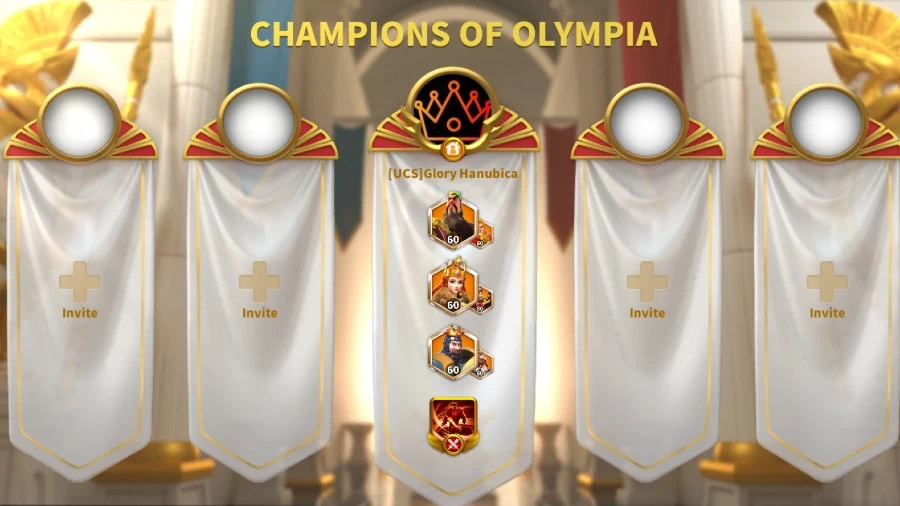
Champions of Olympia is a five-versus-five Rise of Kingdoms battle mode in which each player controls three marches. Instead of manually filling those marches with troops, you select a commander or commander preset, and the event assigns the appropriate troop composition.
Changing the selected commander can also change the assigned troop type. Therefore, review the Infantry, Cavalry, Archer, mixed, Leadership, or specialized troop assignment shown on the preparation screen before joining matchmaking.
- Team size: Five players
- Marches per player: Three
- Main objective: Capture and hold flags to earn points
- Troop assignment: Automatically determined by the selected commander or preset
- Best general strategy: Control three flags, rotate together, and avoid unnecessary fights
- Important preparation step: Save all three march presets before joining the queue
What Is Champions of Olympia in ROK?
Champions of Olympia is a short objective-based match built around flag control, movement, morale, and team coordination. Each team contains five governors, while every governor controls three event marches.
The battlefield normally contains five flags:
- One flag near each team’s starting area
- One flag on the left side
- One flag on the right side
- One central flag
Holding flags generates points over time. As a result, a team that controls objectives efficiently can defeat an opponent with more individual kills.
Champions of Olympia vs Normal Open-Field Combat
| Champions of Olympia | Normal Open Field |
| Five-player teams | Kingdom or alliance-scale combat |
| Three event marches per player | Standard city dispatches |
| Mode assigns troop compositions | Player manually selects troop type and count |
| Five capture flags | Open map objectives and structures |
| Morale and replenishment mechanics | Standard troop health and hospital systems |
| Selectable battlefield skills | Normal commander and account abilities |
Ranked and Unranked Modes
Champions of Olympia has used both Unranked and Team Ranked formats. Team Ranked requires a coordinated five-player team, while matchmaking criteria and league systems have been adjusted through multiple updates.
Consequently, do not rely on an old statement that the mode has no ranking or power-based matchmaking. Review the active queue, division, league, and matching rules inside the current event interface.
How to Assign Troops in Champions of Olympia
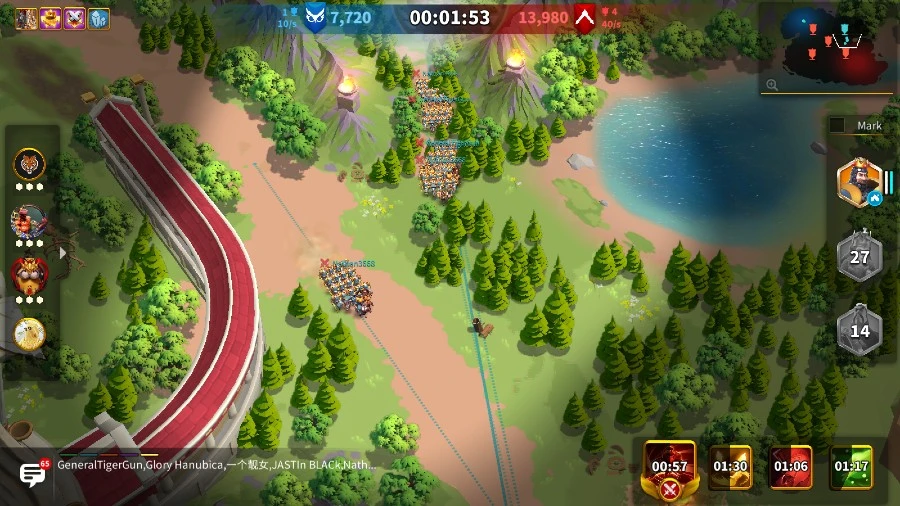
You do not assign normal city troops to a Champions of Olympia march. Instead, the event creates the army after you select its commander or commander preset.
Troop Assignment Steps
- Open the Champions of Olympia event.
- Enter the lineup or march preparation screen.
- Select the first march slot.
- Choose an available commander or preset.
- Check the troop type automatically displayed for that commander.
- Review troop capacity and applicable statistics.
- Select the battlefield skills for the lineup.
- Repeat the process for the second and third marches.
- Save the complete lineup.
- Review all three marches before entering matchmaking.
Important: Changing a commander may also change the assigned troop type. Always check the displayed composition again after editing a march.
Why Troops Are Assigned Automatically
The system reduces the advantage of simply owning more trained troops. Recent versions generally supply event troops, commonly described as Tier 5 units, while commander choice, battlefield skills, movement, flag control, and team coordination determine performance.
Even so, not every normal account effect is guaranteed to work in every division. For example, formation and armament effects have been specifically enabled in the Odyssey Division. Check the active division rules for equipment, city themes, VIP effects, technologies, armaments, and formations.
How Commander Choice Determines Troop Type
Troop-specific commanders generally receive their matching units. Meanwhile, Integration, Leadership, Engineering, or other flexible commanders may receive a mixed or mode-specific assignment.
| Commander Category | Typical Assignment | Best Role |
| Infantry specialist | Infantry | Flag holding, center fighting and frontline pressure |
| Cavalry specialist | Cavalry | Fast rotations, pursuit and back-captures |
| Archer specialist | Archers | Damage, ranged pressure and tower setups |
| Leadership | Mixed or mode-specific troops | Flexible support and battlefield-skill synergy |
| Integration | Mixed or specialized assignment | Utility, tower control and flexible movement |
| Engineering or Siege-focused | Verify the current preparation screen | Specialized builds only |
Do not select a commander based only on normal open-field strength. The assigned troop type and the interaction with your chosen Olympia skills may change the commander’s value inside this mode.
Best Champions of Olympia Commanders by Role
There is no permanent universal ranking because commander availability differs by kingdom season. Instead, choose commanders according to the job each march must perform.
Flag Defender
A defender should survive while standing inside or near a capture circle. Therefore, prioritize:
- Health and Defense
- Shields and damage reduction
- Healing or morale recovery
- Control effects
- Infantry or Leadership synergy
Useful examples by account age include Richard I, Charles Martel, Alexander the Great, Scipio Africanus Prime, Liu Che, or another developed defensive commander available in the current season.
Roaming and Rotation March
The roamer moves between side flags, reinforces weak lanes, pursues damaged enemies, and threatens unguarded objectives.
Look for:
- March Speed
- Target control
- Strong single-target pressure
- Fast disengagement
- Cavalry synergy
Examples include Cao Cao, Minamoto, Saladin, Alexander Nevsky, Joan of Arc Prime, or another current Cavalry option.
Damage and Center-Fight March
Center fights often contain several enemy marches. Consequently, area damage and fast skill cycles become valuable.
Possible examples include Sun Tzu, Yi Seong-Gye, Aethelflaed, Zhuge Liang, Hermann Prime, Boudica Prime, or other developed area-damage commanders.
Support March
A support commander should improve several allied marches rather than chase personal kills. Prioritize:
- Team buffs
- Enemy debuffs
- Healing
- Morale support
- Movement or control
Joan of Arc, Aethelflaed, Constantine, Trajan, and other Leadership or support-oriented commanders can fill this role when their assigned troops and skills match the plan.
Tower or Ranged-Control March
The All Out skill creates the tower form. It is not an automatic Archer commander ability.
Integration commanders can gain a multi-target interaction in tower form, while Archer or Leadership commanders may gain additional damage effects. As a result, commander category and the selected All Out skill must be considered together.
Best Champions of Olympia Lineups by Kingdom Season
The following lineups are flexible starting points. Choose only commanders that are available and properly developed in your kingdom.
Season 1 and KvK 1 Lineup
| March Role | Commander Options | Main Purpose |
| Defender | Richard I, Charles Martel or Sun Tzu | Hold side flags and absorb pressure |
| Roamer | Cao Cao, Minamoto or Belisarius | Rotate quickly and threaten back-flags |
| Damage or support | Yi Seong-Gye, Aethelflaed or Joan of Arc | Center pressure, area damage or team utility |
F2P Season 1 Alternative
- Sun Tzu for holding and area damage
- Belisarius for fast rotations
- Aethelflaed, Joan of Arc, Hermann or Kusunoki for support and pressure
KvK 2 and KvK 3 Lineup
| March Role | Commander Options | Main Purpose |
| Defender | Alexander the Great, Charles Martel or Richard I | Contest flags and survive focused attacks |
| Roamer | Saladin, Cao Cao or Minamoto | Move between lanes and finish damaged marches |
| Damage | Yi Seong-Gye, Edward of Woodstock or Tomyris | Apply burst or area pressure |
Season of Conquest Lineup
| March Role | Commander Options | Main Purpose |
| Defender or center fighter | Scipio Africanus Prime, Liu Che or another durable Infantry commander | Hold contested flags and pressure grouped enemies |
| Roamer | Alexander Nevsky, Joan of Arc Prime or another fast Cavalry commander | Rotate, chase and back-cap |
| Damage | Zhuge Liang, Hermann Prime, Boudica Prime or another developed Archer commander | Deliver area damage and ranged pressure |
These are role examples rather than mandatory lineups. A fully developed older commander may perform better than a newer commander with incomplete skills or unsuitable equipment.
Best Champions of Olympia Skills
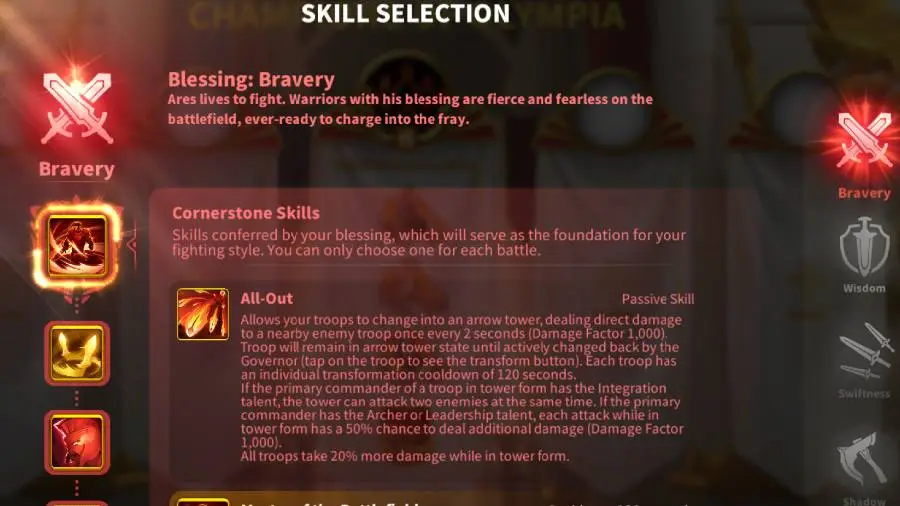
Each lineup selects four battlefield skills from separate categories. Skill effects have changed through past updates, so use the live tooltip as the final authority.
Recommended Skill Sets by Role
| Role | Cornerstone | First Secondary | Second Secondary | Common |
| Flag defender | Bloodlust | Vengeful Strike | Lead the Charge | Field Surgery |
| Roamer | Master of Battlefield | Relentless Strikes | Fearless Roar | Swift March |
| Area-damage march | Master of Battlefield | Slice and Dice | Marching Tune | Field Surgery |
| Tower control | All Out | Slice and Dice or Vengeful Strike | Lead the Charge or Marching Tune | Field Surgery |
Cornerstone Skills

All Out: Transforms marches into ranged towers. Integration, Archer and Leadership commanders receive different interactions. However, tower-form marches also become more vulnerable.

Master of Battlefield: Builds Mastery through normal attacks and supports sustained damage. It works well for marches that remain active in long fights.

Bloodlust: Provides repeated healing after normal-attack damage. Infantry and Leadership commanders may also receive morale-related benefits.
First Secondary Skills

Slice and Dice: Adds nearby damage after repeated skill-damage activations. It is useful during grouped center fights.

Relentless Strikes: Improves normal-attack output for a limited period. It fits sustained-damage and Mastery builds.

Vengeful Strike: Rewards a march for absorbing losses by producing area pressure and temporary damage reduction.
Second Secondary Skills
Marching Tune: Targets a visible area with skill damage. Save it for grouped enemies or a decisive flag contest.

Fearless Roar: Adds movement and Mastery, making it useful for rotations, pursuit and fast reinforcement.
Lead the Charge: Forces nearby enemies to attack a chosen march while that march gains defensive and morale support. Use it on a prepared Tank, not a fragile damage march.
Common Skills

Field Surgery: Heals all three marches. Use it before several marches become critically low rather than waiting until one is already defeated.

Swift March: Improves the movement of all your marches. It is especially useful for roaming players and final-minute rotations.
Champions of Olympia Map and Flag Strategy
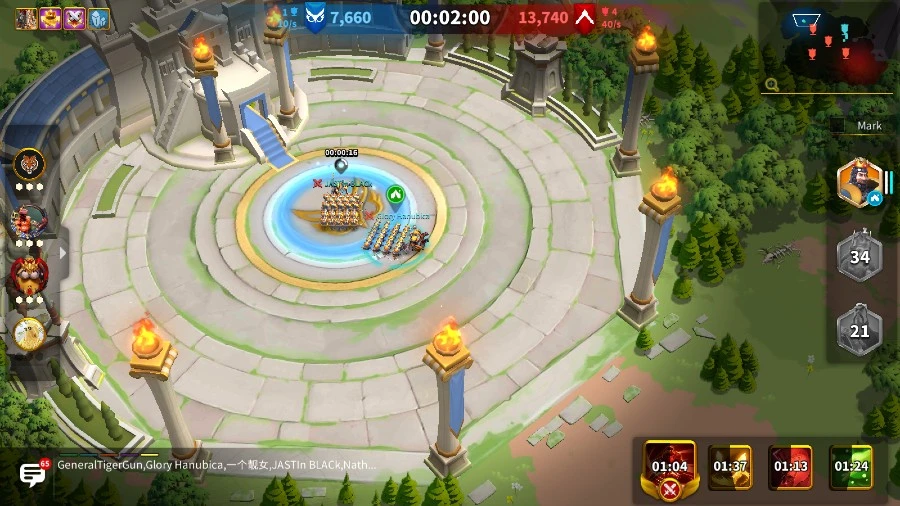
Flags are captured by placing marches inside the capture circle. Recent references describe a five-second capture process, while additional allied marches can improve control during a contested capture.
Starting Flag
Secure the nearby starting flag quickly, but do not send all five players to it. One assigned player can usually handle the opening capture while the rest establish side-lane and center positions.
Side Flags
Side flags are easier to defend and provide useful rotation points. A durable player should hold each side while a roamer moves between them.
Center Flag
The center attracts the largest battles. Nevertheless, winning the center is not useful when both side flags are left unguarded.
Commit additional marches to the center only when:
- Your side flags are secure
- The team can arrive together
- A major battlefield skill is available
- The opponent has overcommitted elsewhere
- Capturing the center changes the score advantage
Visibility and Scouting
Enemy marches may not remain visible across the entire map. Therefore, use allied positions, the minimap, score changes, and flag status to infer where the opponent is rotating.
Best Five-Player Team Roles
| Player Role | Main Responsibility | Preferred March Style |
| Left-side defender | Capture and protect the left flag | Durable Infantry and sustain |
| Right-side defender | Capture and protect the right flag | Durable Infantry or flexible Leadership |
| Center fighter | Contest grouped enemies and apply area pressure | AOE, control and healing |
| Roaming support | Rotate to weak flags and chase damaged marches | Fast Cavalry and movement skills |
| Flexible damage or back-cap | Exploit open flags and reinforce decisive fights | Damage, speed and adaptable skills |
These roles are not permanent. For example, a side defender can rotate after the opponent abandons that lane, while the flexible player can temporarily hold an exposed flag.
Opening Strategy
- Assign players to the starting, left, right and center routes before the match begins.
- Send only enough marches to secure the starting flag.
- Place durable marches on the side objectives.
- Use fast marches to scout the opponent’s opening.
- Avoid committing all fifteen team marches to the center.
- Call the first rotation as soon as the enemy’s plan becomes visible.
A balanced opening aims to control three flags. Although capturing four or five flags creates a large advantage, overextending too early can expose every lane.
Mid-Match Strategy
During the middle phase, watch flag ownership, morale, march health, enemy respawns, and skill cooldowns.
- Retreat damaged marches before they are defeated.
- Recover near a controlled replenishment point when available.
- Send the roamer toward the weakest contested flag.
- Use major skills when they can influence an objective.
- Leave a losing fight when another flag can be captured instead.
- Do not chase one damaged march across the map.
Morale and Replenishment
Morale decreases when marches take unfavorable fights or suffer losses. Low-morale troops become less effective, so retreating can be better than continuing an unwinnable engagement.
Recent references describe a longer normal respawn after defeat and faster recovery near controlled flags or replenishment areas. Exact timers may change, so follow the live countdown shown during the match.
Final-Minute Strategy
When Your Team Is Ahead
- Protect the three flags already generating points.
- Avoid unnecessary center fights.
- Use movement skills to answer back-capture attempts.
- Keep at least one healthy march near each vulnerable lane.
- Force the opponent to split rather than grouping in one location.
When Your Team Is Behind
- Identify the flag that changes the score fastest.
- Group major damage and movement skills for one coordinated capture.
- Send one fast player toward an unguarded side flag.
- Stop fighting enemies that are far from an objective.
- Split marches only when the opponent cannot punish the rotation.
Common Champions of Olympia Mistakes
- Not saving the lineup: The intended commanders or skills may not appear in the match.
- Trying to assign normal city troops: The mode supplies troops based on commander selection.
- Ignoring the displayed troop type: Changing commanders can alter the assignment.
- Using one lineup in every season: Commander availability changes as kingdoms develop.
- Chasing kills: Flags generate the points required to win.
- Sending all three marches together permanently: The team loses map coverage.
- Ignoring morale: Low-morale marches take increasingly poor fights.
- Dying beside a safe retreat path: Replenishing can be faster than respawning.
- Using All Out as if it were an Archer passive: Tower form comes from the selected battlefield skill.
- Using a major skill away from an objective: The cooldown may not return before the decisive fight.
- Overcrowding the center: Side flags become free captures.
- Copying Ark of Osiris strategy: The two modes have different maps, team sizes and scoring.
- Assuming old matchmaking rules still apply: Check the current ranked and unranked interface.
FAQ
How do you assign troops to a champion in Rise of Kingdoms?
Open the Champions of Olympia preparation screen, select a commander or preset for each march, and check the troop type assigned automatically by the event. Save all three marches before queueing.
What determines troop type in Champions of Olympia?
The selected commander and that commander’s troop specialization determine or influence the troop composition shown by the mode.
What are the best Champions of Olympia commanders?
Use durable Infantry commanders for flags, fast Cavalry commanders for rotations, area-damage commanders for center fights, and Leadership or support commanders for team utility.
What is the best Season 1 lineup?
A practical starting lineup combines a durable commander such as Richard or Charles, a fast commander such as Cao Cao or Minamoto, and an area-damage or support option such as Yi Seong-Gye, Sun Tzu, Aethelflaed or Joan of Arc.
How many marches does each player control?
Each player controls three Champions of Olympia marches.
How do you capture flags?
Move marches into the capture circle and maintain control until the capture completes. Additional allied marches help during contested captures.
Do equipment and city skins work?
Normal account effects are not identical across every division or version. Formation and armament bonuses have been enabled in the Odyssey Division, while other effects should be confirmed through the current event-rules screen.
Is Champions of Olympia the same as Champions of Olympus?
No. The official Rise of Kingdoms event name is Champions of Olympia. “Champions of Olympus” is a common search variation.
Comparing more flexible commander rosters? Champions of Olympia standardizes several battlefield elements, but commander availability and lineup flexibility still affect the roles an account can perform. Players comparing available ROK accounts should also review commander skills, equipment, formations, armaments, troop development, VIP level, migration eligibility and kingdom status.
Conclusion
Champions of Olympia is won through flag control, preparation and coordinated rotations. Before joining, select all three commanders, check their assigned troop types, choose role-appropriate skills and save the complete lineup.
During the match, aim to control three flags instead of chasing every enemy march. Meanwhile, use fast marches to reinforce weak lanes and durable marches to hold contested objectives.
Finally, adapt the lineup to the kingdom season. Season 1 accounts should use accessible early commanders, while Season of Conquest players can build more specialized Infantry, Cavalry and Archer roles.
Explore more commander, event, alliance and progression content in the Rise of Kingdoms guide collection.