
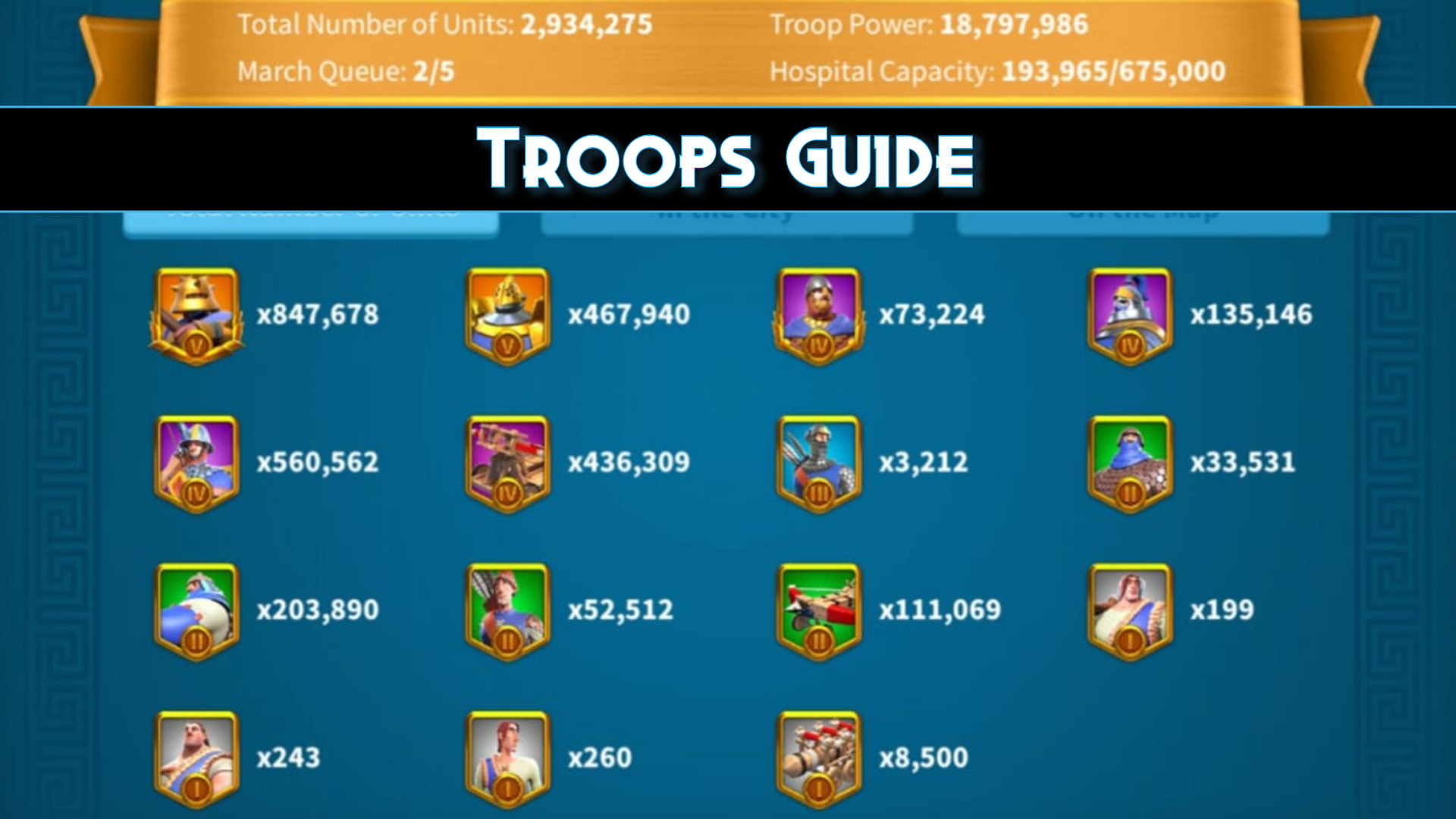
There is no single best troop type in Rise of Kingdoms. Infantry counters Cavalry, Cavalry counters Archers, and Archers counter Infantry, while Siege units are mainly valuable for gathering and city-related utility. Your strongest combat troop should match the commanders, equipment, technology, and civilization you are actually developing.
For troop training, keep all available military buildings working instead of training only one unit type. Normally, train your highest unlocked combat tier. Once you have Tier 5 unlocked, however, keeping a reserve of Tier 4 troops can be useful for cheaper field fighting and efficient T4-to-T5 upgrades during troop-training events.
Rise of Kingdoms Troop Types and Counters
Rise of Kingdoms has four basic troop categories: Infantry, Cavalry, Archers, and Siege. The three combat troop types follow a counter system:
- Infantry counters Cavalry.
- Cavalry counters Archers.
- Archers counter Infantry.
- Infantry, Cavalry, and Archers all have an advantage over Siege in normal troop combat.
These counters matter, but they do not override everything else. A well-developed march with stronger commanders, equipment, technology, Armaments, troop tier, and buffs can still beat a nominal counter with much weaker account development.
Scroll sideways to view the full table.
| Troop Type | Counters | Countered By | Main Strength | Typical Role |
|---|---|---|---|---|
| Infantry | Cavalry | Archers | Durability | Open field, frontline, garrison or rally roles depending on commanders |
| Cavalry | Archers | Infantry | March speed and mobility | Open field, chasing, rallies, fast-response marches |
| Archers | Infantry | Cavalry | Strong damage-oriented commander options | Open field, rallies, garrisons depending on account and season |
| Siege | Watchtowers | Infantry, Cavalry, Archers | High troop load | Gathering and specialized city-related uses |
How to Train Troops Efficiently
Keep Every Training Building Active

Your Barracks, Archery Range, Stable, and Siege Workshop have separate training queues. That means choosing Infantry as your main PvP troop type does not mean your Stable and Archery Range should sit idle.
Continuous natural training is one of the cheapest ways to grow your army. Before logging off, start a batch long enough to keep each useful training building occupied until you return.
For newer accounts, troop preservation matters just as much as troop production. Avoid unnecessary city attacks and wars that permanently remove troops faster than your economy can replace them.
Train the Highest Combat Tier You Have Unlocked
During normal account progression, training the highest available combat tier directly is generally more efficient than deliberately producing large numbers of weak troops and upgrading them through several tiers later.
Existing troops can be upgraded after a new tier is unlocked, but repeated tier upgrades add extra resource requirements compared with training the higher tier directly in the first place.
There are two important exceptions:
- Event preparation: T5 accounts may deliberately build T4 reserves for later T4-to-T5 upgrades.
- Siege gathering: Low-tier Siege can remain useful because gathering does not require high combat stats.
Do Not Upgrade Every Low-Tier Troop Immediately
When you unlock T3 or T4, there is no need to stop all normal training until every older troop has been upgraded. Your first priority is usually building enough troops to fill gathering and combat marches while continuing account development.
Upgrading becomes more attractive when:
- You need stronger troops for an upcoming KvK or war.
- You can combine the upgrade with a troop-training or Power event.
- You have strong training-speed buffs active.
- You need to reduce the number of weak combat units in your roster.
Best Training Speed Buffs to Stack
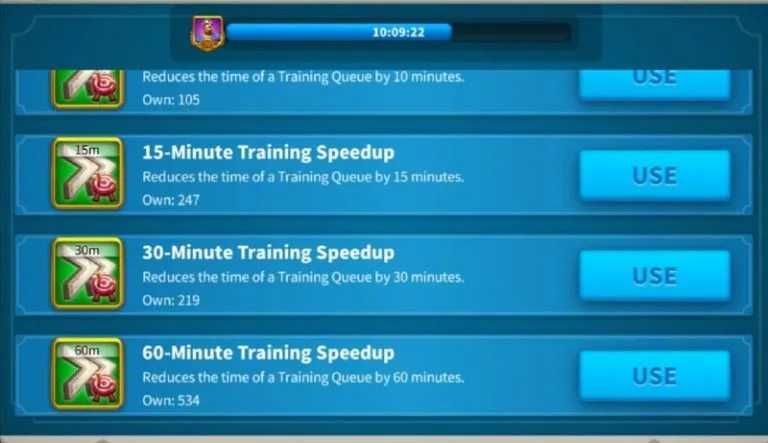
Natural troop training should continue every day, but large speedup pushes are much more efficient when you stack temporary and permanent training-speed bonuses first.
Useful bonuses can include:
- Duke kingdom title: +10% troop training speed.
- Training kingdom buff: +10% training speed when activated by the King.
- Training rune: Can provide a significant temporary training-speed increase; high-level runes can reach 15%.
- Shrine of War: Provides a training-speed bonus when controlled by your alliance.
- VIP: Higher VIP levels provide permanent troop-training bonuses; VIP 10 provides 15% training speed.
- Civilization bonus: Civilizations such as Germany and Britain provide 5% troop training speed.
- Alliance technology and account research: Additional permanent bonuses may further improve training efficiency.
Check the active bonuses on your own account before beginning a large batch because not every kingdom will have the same rune, title availability, Holy Sites, or kingdom buff active at the same moment.
When Should You Use Training Speedups?
The best use of training speedups is usually a planned event push that also creates troops you genuinely need.
Good opportunities can include:
- Mightiest Governor troop-training stages
- Power-growth events
- Pre-KvK preparation
- Zenith-style Power events when you are intentionally competing
- Urgent troop replacement before an important kingdom objective
Do not force a leaderboard push simply because you have speedups. Check the rewards, your likely ranking, kingdom rules, required resources, and how much of your reserve you would need to consume.
F2P players should be especially selective. Spending months of speedups for a rank you cannot realistically hold can leave your account underprepared for KvK.
How MGE Troop Training Points Work
The standard Mightiest Governor troop-training stage awards more points for higher-tier troops.
Scroll sideways to view the full table.
| Troop Tier | Standard MGE Training Points per Unit |
|---|---|
| Tier 1 | 5 |
| Tier 2 | 10 |
| Tier 3 | 20 |
| Tier 4 | 40 |
| Tier 5 | 100 |
When upgrading existing troops, MGE awards the difference between the two tiers rather than giving the full higher-tier score on top of the old score.
Under the standard table, upgrading one T4 troop to T5 therefore gives 60 training-stage points: 100 for T5 minus the 40 points represented by T4.
T4 vs T5: Which Troops Should You Train?
Tier 5 troops are the strongest standard troop tier, but stronger does not mean cheaper or automatically better for every activity.
Why T5 Is Stronger
T5 troops have substantially higher combat stats than T4 troops and are important when maximum march strength matters, including serious rallies, garrisons, Ark of Osiris, and high-value PvP situations.
Unlocking T5 is also a major account milestone because it requires extensive city and military-technology development.
Why T4 Still Matters After Unlocking T5
T5 troops are significantly more expensive to train and heal. For F2P players and accounts with limited Gold and healing resources, using nothing but T5 in every large open-field battle can create an unsustainable hospital bill.
T4 remains useful for:
- Large open-field engagements when resource efficiency matters.
- Building a reserve for later T4-to-T5 event upgrades.
- Lower-priority marches where maximum T5 strength is unnecessary.
- Accounts that have unlocked T5 but cannot yet maintain T5 healing costs comfortably.
Your strongest march can still use T5 when the situation warrants it. The goal is not to avoid T5, but to choose where the additional strength is worth the additional cost.
Which Troop Type Is Best?
There is no universally correct choice. Select a primary combat type based on your commander roster, equipment, military technology, civilization, and expected role.
For F2P and low-spending accounts, concentrating premium combat investment into one main troop type is usually easier than trying to maintain equally strong Infantry, Cavalry, and Archer commander lineups at the same time.
Infantry
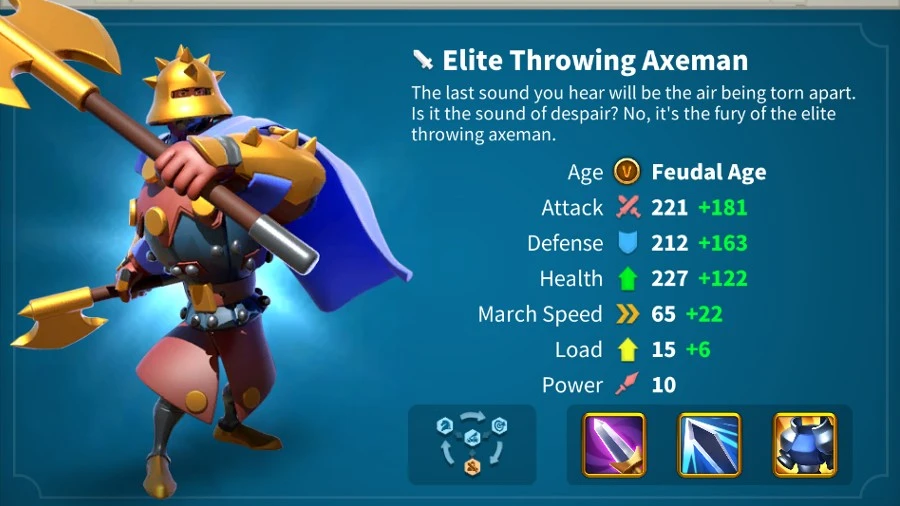
Infantry counters Cavalry and is commonly associated with durable field marches. Base Infantry is slower than Cavalry, so positioning and march-speed bonuses become important in large fights.
Choose Infantry if:
- Your best developed commanders are Infantry commanders.
- Your strongest equipment is Infantry-focused.
- You prefer durable frontline marches.
- Your military technology has already developed heavily toward Infantry.
The old idea that Infantry should be avoided by beginners because there are too few early commanders is too broad. Sun Tzu and Björn Ironside, for example, can form an inexpensive early Infantry-oriented combination.
Cavalry
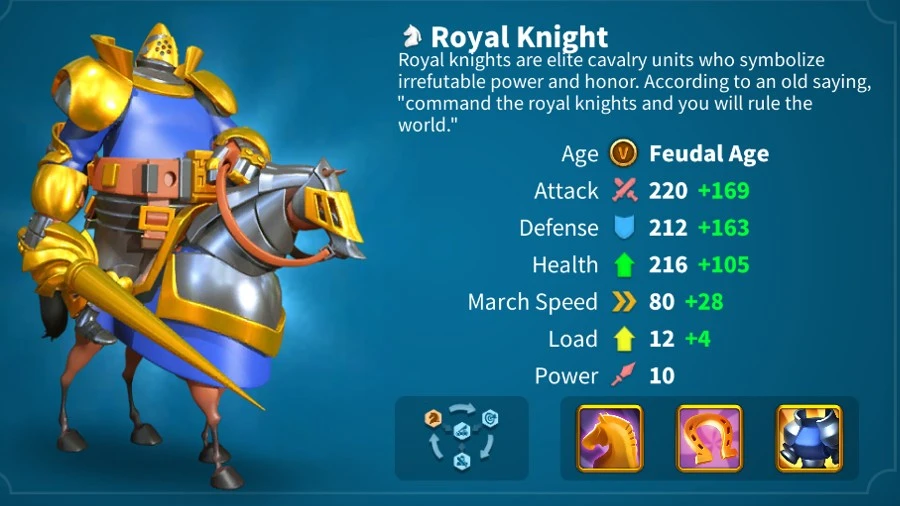
Cavalry counters Archers and has the highest base march speed among the three standard combat troop classes. That mobility is valuable for chasing damaged marches, disengaging, reinforcing, collecting runes, and moving between battlefield positions.
Choose Cavalry if:
- You value mobility and fast field movement.
- Your commander investments are Cavalry-focused.
- You already have strong Cavalry equipment.
- Your preferred civilization and research support Cavalry.
Cavalry is a strong option, but it is not automatically the best beginner troop simply because it moves faster.
Archers
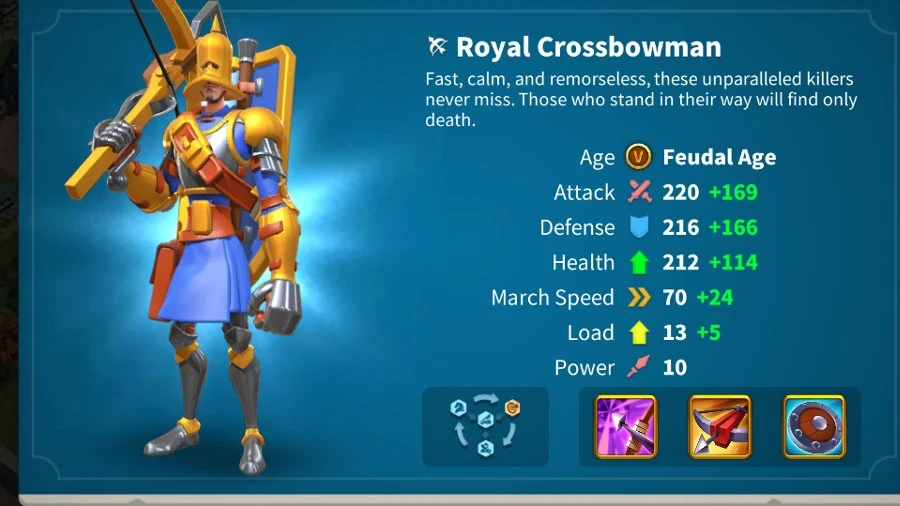
Archers counter Infantry and are no longer accurately described as simply “weak in field battles.” Their real performance depends on the commanders, season, equipment, formations, and technology behind the march.
Choose Archers if:
- Your strongest long-term commanders are Archer commanders.
- You have developed Archer equipment and technology.
- Your kingdom role requires an Archer-focused field, rally, or garrison setup.
- You understand that Cavalry is the direct troop counter and position accordingly.
For a brand-new F2P account, the main limitation is often commander and equipment investment rather than a fundamental weakness of Archer troops themselves.
Siege
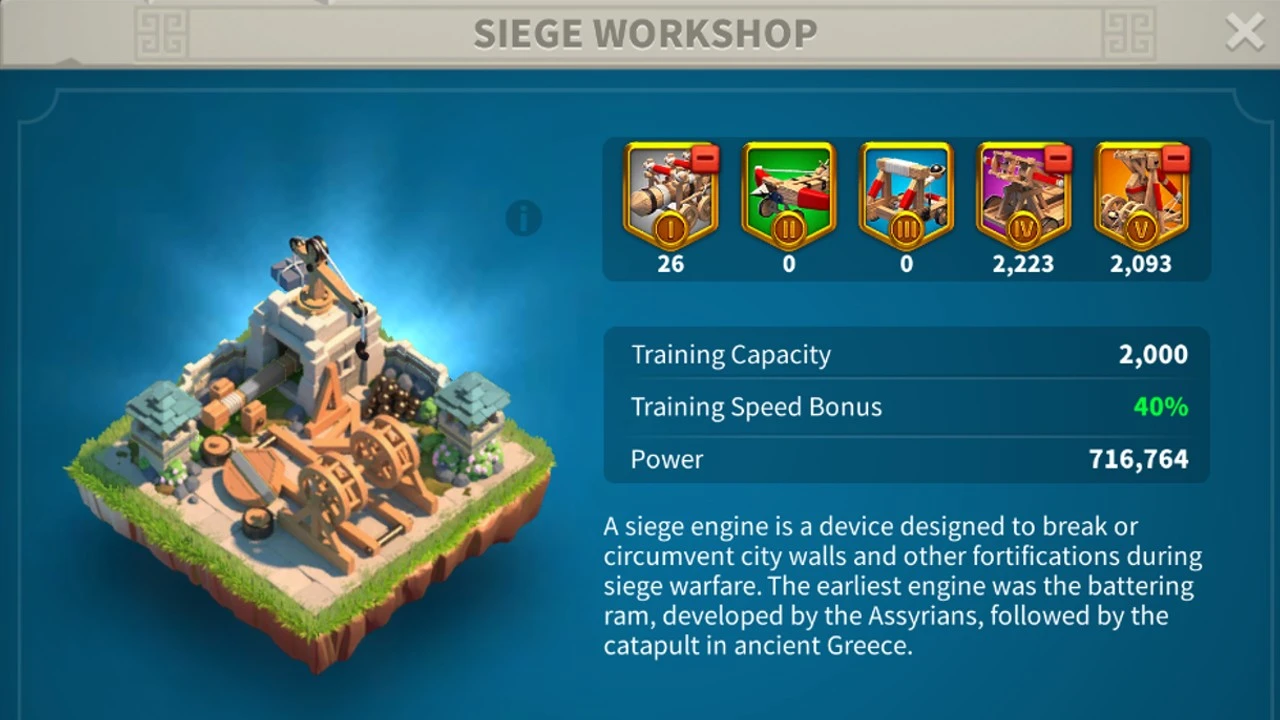
Siege units have much higher load than Infantry, Cavalry, or Archers and are therefore the standard choice for resource gathering. They also counter Watchtowers but are countered by all three normal combat troop types.
For most players, Siege should not receive the same training-speedup investment as a primary combat type.
However, the advice to never train low-tier Siege is also incorrect. T1 Siege remains useful for routine gathering because it is inexpensive and has enough load to support economical farming marches when paired with gathering commanders.
Should F2P Players Specialize in One Troop Type?
Yes for premium combat investment, but no for basic troop production.
A practical F2P setup is:
- Keep Infantry, Archer, and Cavalry queues training naturally.
- Maintain enough Siege for your gathering marches.
- Choose one primary PvP troop type for your best commanders.
- Craft your strongest equipment around those primary marches.
- Prioritize advanced military research that supports the troops you actually fight with.
- Use large training-speedup reserves where they produce the greatest event and combat value.
This approach gives you a broad troop reserve without forcing your scarce Legendary Sculptures, materials, and advanced technology into three completely different commander ecosystems.
How Commanders Affect Your Troop Choice
Troop type should follow commander development rather than the other way around. Many commander skills only activate when a march contains a specific troop type.
Before committing heavily to Infantry, Cavalry, or Archers, check:
- Which commanders you already have developed.
- Which future commanders fit your account plan.
- Whether their skills require a single troop type.
- Whether the primary commander’s talents support that troop type.
- What equipment and Armaments you can actually field.
- Whether your civilization provides relevant combat bonuses.
A technically stronger troop tier performs poorly when led by an unfinished commander pair with mismatched skills and weak equipment.
When Should You Upgrade Old Troops?
Upgrading old troops is most valuable when it serves a specific goal.
Upgrade when:
- You have just unlocked an important new tier and need a full combat march quickly.
- A troop-training event rewards the upgrade.
- You have strong training buffs active.
- Your army contains far more low-tier combat troops than you need.
Wait when:
- No useful event is active.
- You are missing a good training rune or title and the upgrade is not urgent.
- The resources would leave you unable to research, heal, or develop your city.
- You want to preserve T4 as an affordable field-fighting reserve after unlocking T5.
Players considering a more developed starting point can also compare a Rise of Kingdoms account for sale as an optional progression route. When evaluating one, look beyond total troop count and check troop tiers, technology, commanders, equipment, VIP, resources, and the account’s ability to sustain healing.
How Troop Wounds and Deaths Work
Not every troop removed from a march is permanently dead. Rise of Kingdoms distinguishes between slightly wounded, severely wounded, and dead troops.
- Slightly wounded: Recover automatically when the march returns to the city.
- Severely wounded: Usually enter the Hospital in normal open-field combat, provided there is capacity.
- Dead: Permanently removed from the account.
Battle type matters. For example, open-field PvP normally sends severely wounded troops to the Hospital, while attacking enemy cities or alliance structures can cause severe wounds to become permanent deaths. Some structure battles also have special casualty rules.
If the Hospital is already full, additional severely wounded troops that cannot enter it can die. Check hospital capacity before large battles instead of assuming every wounded troop can be recovered.
Common Troop Training Mistakes
- Leaving training queues idle: Natural training should run almost continuously.
- Training only one troop type: Specialize premium combat investments while still using the other training queues.
- Using every speedup immediately: Save large pushes for useful events and stacked training buffs.
- Training low tiers only to upgrade them later: Direct higher-tier training is usually more resource-efficient outside event planning.
- Upgrading all T4 after unlocking T5: Keeping T4 can reduce the cost of prolonged open-field fighting and create an MGE upgrade reserve.
- Assuming Cavalry is always best for beginners: Your developed commanders and equipment matter more.
- Assuming Archers are inherently bad: Modern Archer performance depends on the complete march setup.
- Using combat speedups on unnecessary Siege: Siege is primarily an economic troop type for most accounts.
- Ignoring troop counters: Avoid taking unnecessary Infantry-versus-Archer, Archer-versus-Cavalry, or Cavalry-versus-Infantry trades.
- Ignoring healing economics: T5 strength comes with a much larger resource burden during sustained fighting.
FAQs
What is the best troop type in Rise of Kingdoms?
There is no universal best troop type. Infantry counters Cavalry, Cavalry counters Archers, and Archers counter Infantry. Your best choice depends on commanders, equipment, technology, civilization, and battlefield role.
Should I train T4 or T5 troops?
Use T5 when maximum combat strength matters, but keep T4 if T5 healing costs are difficult to sustain. T5 accounts can also pre-train T4 naturally and upgrade it to T5 during suitable troop-training events.
How many MGE points does upgrading T4 to T5 give?
Under the standard MGE training table, T4 is worth 40 points and T5 is worth 100. Troop upgrades receive the difference, so a T4-to-T5 upgrade gives 60 training-stage points per unit. Check the active event rules before a major push.
Should beginners train Tier 1 troops?
For combat, normally progress toward the highest tier you have unlocked rather than deliberately mass-producing T1. T1 Siege is an exception because it remains inexpensive and useful for resource gathering.
What is the fastest way to train troops?
Stack training bonuses before large batches. Useful sources include a training rune, Duke title, kingdom training buff, VIP bonuses, civilization bonuses, alliance technology, and controlled Holy Sites. Then use training speedups during an event that rewards the same troop production.
Are dead troops permanently lost in Rise of Kingdoms?
Yes, but not every casualty is a death. Slightly wounded troops recover automatically and severely wounded troops can enter the Hospital in many battle types. Permanent death rates depend on where and how the battle occurs, and Hospital overflow can also kill troops that cannot be admitted.
Conclusion
The best Rise of Kingdoms troop strategy is to keep every useful training queue active while concentrating your premium combat investment around the marches you actually use. Train your highest tier during normal progression, preserve T4 strategically after unlocking T5, stack training-speed bonuses before major pushes, and use troop counters instead of assuming one unit type dominates every matchup.
For more commander builds, KvK strategies, civilization advice, and account progression guides, browse the Heaven Guardian Rise of Kingdoms guides.