
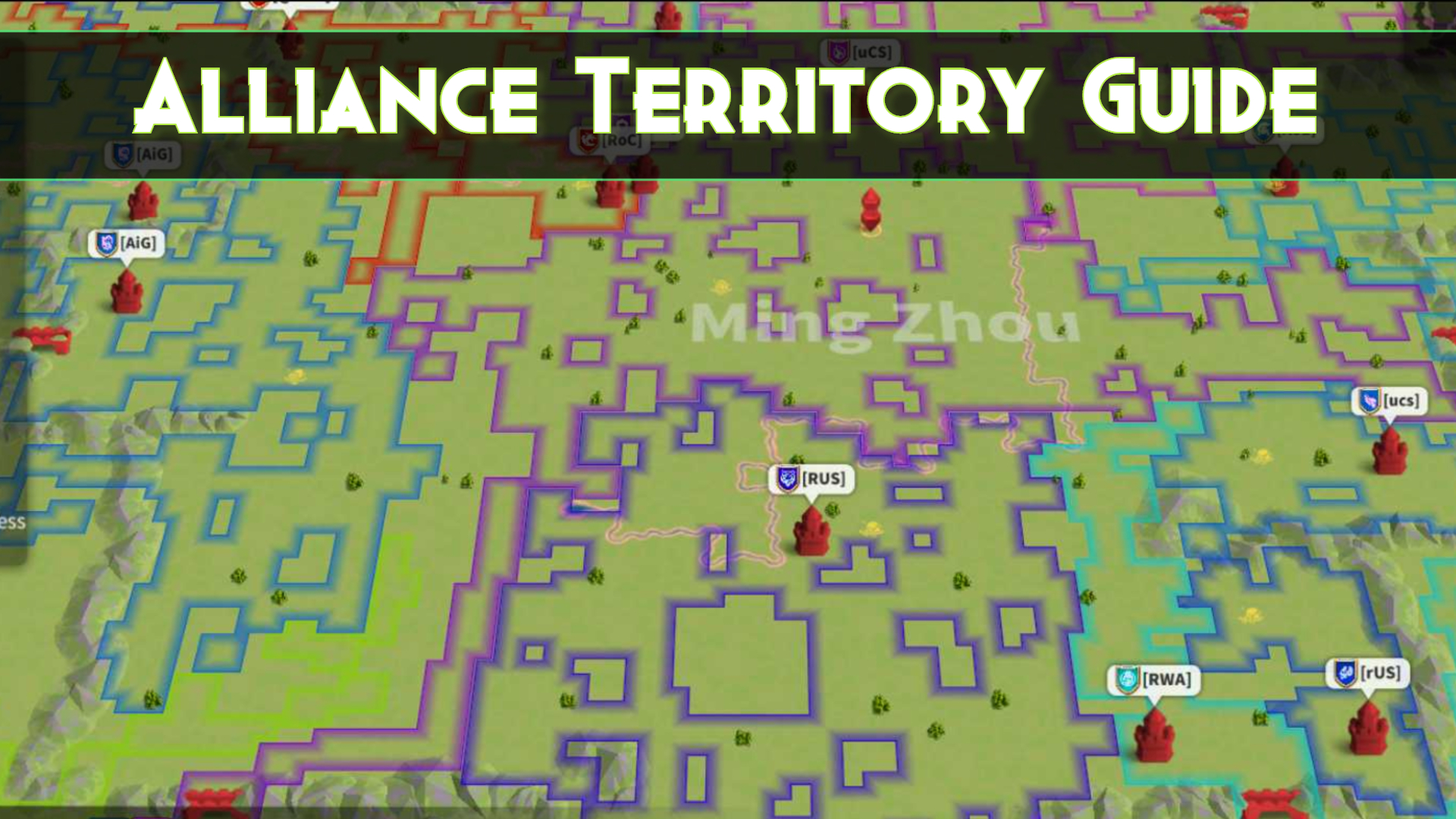
Alliance territory in Rise of Kingdoms begins with a Center Fortress and expands through connected Alliance Flags, additional Alliance Fortresses, and controlled map objectives. Effective territory gives members better access to resources, teleport locations, Holy Sites, strategic routes, and alliance-wide bonuses.
A strong territory plan is not simply about building the largest number of flags. Alliance leadership must balance construction costs, Alliance Resources, technology, member activity, map objectives, and the ability to defend every route.
Build the Center Fortress first, then expand with connected flags toward valuable Resource Points, passes, Holy Sites, and defensible positions. Check the live flag cost before every placement, keep territory connected, research Flag Quantity and Architecture technologies, and repair burning structures before their durability reaches zero.
How Alliance Territory Works
Alliance territory is the controlled area created by fortresses, connected flags, and applicable Holy Sites.
Effective territory allows an alliance to:
- Expand toward passes and Holy Sites
- Connect to Alliance Resource Points
- Generate Alliance Resources
- Provide gathering bonuses on owned normal nodes
- Create valid teleport locations
- Build additional territory structures
- Attack adjoining enemy structures
- Receive territorial combat and movement bonuses
Territory must remain connected to a fortress or another effective territorial anchor. A narrow branch that depends on one exposed flag can become inactive when that connection is destroyed.
| Question | Quick Answer |
| What begins alliance territory? | The Center Fortress |
| How does an alliance expand? | Through connected Alliance Flags and additional fortresses |
| Who places territory structures? | The alliance leader and authorized officers |
| Commonly documented first flag cost | 50,000 Alliance Credits |
| What does Territory Guardian increase? | Troop Attack while fighting on effective alliance territory |
| How many Resource Center types are normally active? | One selected Resource Center type at a time |
| Gathering bonus on owned normal nodes | 25% faster gathering |
| Can burning structures be repaired? | Yes, before they are fully destroyed |
Alliance Center, Center Fortress and Resource Center Explained
Several alliance systems have similar names but perform completely different functions.
| Term | Location | Main Function |
| Alliance Center | Inside an individual Governor’s city | Alliance Help and reinforcement capacity |
| Center Fortress | Kingdom map | Creates the alliance’s first territory area |
| Alliance Fortress | Kingdom map | Creates an additional territorial anchor |
| Alliance Flag | Kingdom map | Extends connected alliance territory |
| Alliance Resource Center | Constructed inside valid alliance territory | Provides a large protected gathering location |
| Alliance Resource Point | Pre-existing map object | Generates Alliance Resources when its center is enclosed by territory |
| Alliance Storehouse | Alliance-level system | Stores alliance-owned Food, Wood, Stone, Gold, and applicable seasonal resources |
Alliance Center
The Alliance Center is a personal city building. It determines how much Alliance Help a Governor can receive and how many reinforcing troops can enter the city.
It does not create alliance territory and should not be confused with the Center Fortress.
For the role of the Alliance Center and other city structures, read the Rise of Kingdoms buildings guide.
Center Fortress
The Center Fortress is the alliance’s first territorial anchor. Once construction is complete, officers can begin placing connected Alliance Flags around it.
Alliance Resource Center
An Alliance Resource Center is a large gathering structure selected and placed by alliance leadership. The available types are the Granary, Wood Lot, Stone Pit, and Mother Lode.
How to Build the Center Fortress
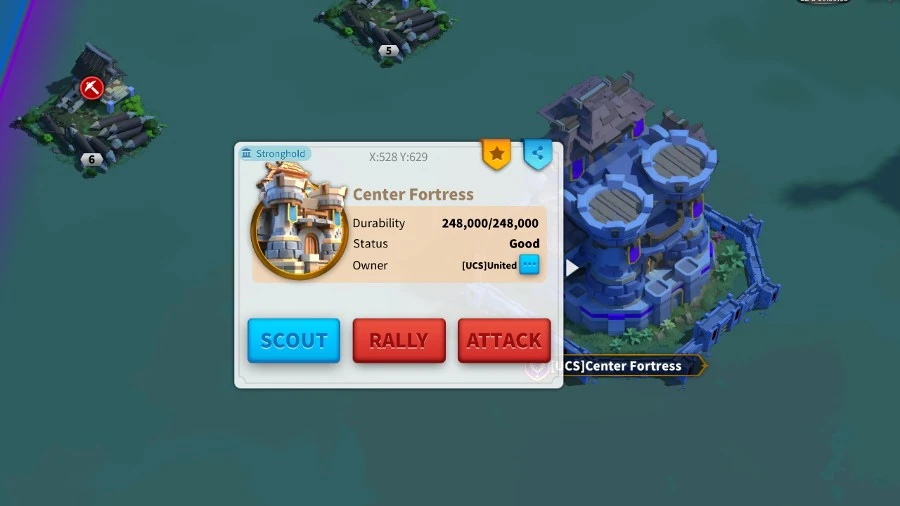
Community references commonly document the following Center Fortress requirements:
- At least 20 alliance members
- At least 500,000 combined alliance power
- 1,000,000 Alliance Credits
Check the current construction screen before committing resources because requirements can change between versions or scenarios.
Center Fortress Placement Checklist
Before placing the Center Fortress, alliance leadership should evaluate:
- Nearby Alliance Resource Points
- High-level normal resource nodes
- Distance from passes
- Holy Sites and Lost Temple routes
- Space for member cities
- Neighboring alliance territory
- Choke points and terrain
- Future zone progression
- Defensive reinforcement time
- Whether the location creates several useful expansion routes
The nearest empty location is not always the best choice. A poorly placed fortress can force the alliance to spend dozens of unnecessary flags to reach important objectives.
Is a Center Fortress a Safe Zone?
No. It is a territorial anchor, not an immunity zone.
Alliance territory improves coordination, access, and defensive positioning, but cities and structures can still be attacked when war conditions allow it. Frontline Governors should continue using shields, safe positioning, and leadership instructions.
How Alliance Flags Work
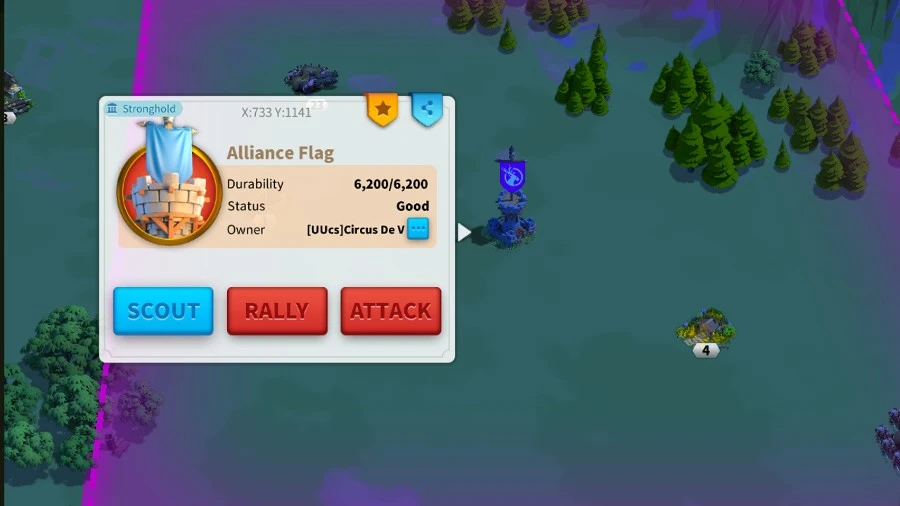
Alliance Flags extend territory from the Center Fortress, an additional Alliance Fortress, another effective flag, or an applicable controlled objective.
A new flag normally needs to touch the border of existing effective territory. Once construction finishes, its area becomes part of the alliance’s connected territory.
How to Build an Alliance Flag
- Build the Center Fortress or another valid territorial anchor.
- Accumulate the required Alliance Credits and Alliance Resources.
- Give placement responsibility to an authorized R4 or R5.
- Select an open map location.
- Confirm that the new border touches effective alliance territory.
- Check nearby Resource Points, passes, Holy Sites, and enemy routes.
- Review the displayed flag cost.
- Place the flag.
- Send member troops to construct it.
- Protect the construction if the area is contested.
- Confirm that the territory becomes effective after completion.
Flag Placement Checklist
Officers should answer these questions before placing each flag:
- Does the flag connect to a valuable objective?
- Will it enclose an Alliance Resource Point?
- Is the route shorter than the alternatives?
- Can the position be reinforced quickly?
- Would one destroyed flag disconnect the whole branch?
- Can a second connection be added later?
- Is the alliance overextending?
- Does another alliance claim the same area?
- Will a nearby pass or Holy Site open soon?
- Is the current cost worth the territory gained?
ROK Alliance Flag Costs
The first Alliance Flag is commonly documented as costing 50,000 Alliance Credits.
Flag costs rise in stages as the alliance builds more of them. Alliance technologies such as Architecture can reduce the resource cost displayed in the placement interface.
Important: Always use the cost shown in the live placement screen. Alliance technology, current progression, and scenario rules can change the actual amount.
Late-Expansion Flag Cost Example
After an alliance has built more than 400 flags, commonly documented reference costs include:
| Resource | Reference Cost |
| Alliance Credits | 375,000 |
| Food | 1,500,000 |
| Wood | 1,500,000 |
| Stone | Approximately 1,100,000 |
| Gold | 750,000 |
These are reference values rather than guaranteed permanent costs. Record the current technology level and in-game amount when updating the article.
How Flags Affect Member Capacity
Community references commonly document an increase of one alliance member slot for every ten completed flags.
This means territory development can support alliance growth, but building flags only for member capacity is rarely efficient. Every route should still support a useful map, resource, or defensive objective.
What Is the Maximum Number of Flags?
The available cap depends on the alliance’s current Flag Quantity technologies and development.
Do not assume every alliance immediately has access to a 500-flag limit. Open the alliance technology tree and current flag counter before planning large-scale expansion.
Fast Versus Slow Flag Construction
Alliance leaders can choose between completing a structure quickly or allowing more members to participate over a longer period.
| Method | Advantages | Disadvantages |
| Fast construction | Finishes quickly and secures contested territory | Fewer members may have time to earn contribution rewards |
| Slow construction | Allows more members to contribute and earn Individual Credits | Leaves the structure exposed for longer |
Use Fast Construction When
- The flag is in contested territory.
- A pass or Holy Site is opening soon.
- An enemy alliance is building toward the same objective.
- The structure must become effective before a scheduled battle.
- The route protects a vulnerable territory branch.
Use Slow Construction When
- The location is safe.
- Members need Individual Credits.
- The alliance is rebuilding routine territory.
- No enemy can contest the area.
- Leadership wants more members to contribute.
Skillful Craftsman increases Alliance Flag construction speed, while other alliance technologies can improve construction more broadly. Use the live technology description to confirm current values.
For earning and spending construction currencies, read the Alliance and Individual Credits guide.
Alliance Fortresses Explained
Additional Alliance Fortresses create new territorial anchors away from the Center Fortress. They can help an alliance reach another region, create a defensive fallback, or establish a new expansion route.
When to Build an Additional Fortress
- The current flag route would be excessively long.
- The alliance needs another strategic base.
- A new region contains important Resource Points.
- The alliance needs a secondary defensive area.
- Existing territory cannot reach a pass efficiently.
- The alliance is reorganizing after a territorial loss.
Reference Fortress Costs
The following values appeared in earlier community documentation and should be checked against the live construction screen before publication:
| Fortress | Alliance Credits | Food | Wood | Stone | Gold |
| Center Fortress | 1,000,000 | 0 | 0 | 0 | 0 |
| Alliance Fortress 1 | 4,500,000 | 1,800,000 | 1,800,000 | 1,400,000 | 900,000 |
| Alliance Fortress 2 | 8,900,000 | 4,500,000 | 4,500,000 | 2,700,000 | 1,800,000 |
Do not mix normal home-kingdom Alliance Fortresses with Crusader Fortresses or other scenario-specific Lost Kingdom structures.
What Are Alliance Resources?
Alliance Resources are alliance-owned Food, Wood, Stone, Gold, and applicable scenario resources stored at alliance level.
They are different from the resources held by individual Governors.
| Resource or Currency | Owner | Main Use |
| Personal Food, Wood, Stone and Gold | Individual Governor | Buildings, research, troops and healing |
| Alliance Resources | Entire alliance | Flags, fortresses, technology and territory development |
| Individual Credits | Individual Governor | Alliance Shop purchases |
| Alliance Credits | Entire alliance | Construction, technology and Alliance Shop stocking |
How to Get More Alliance Resources
- Enclose Alliance Resource Points with effective territory.
- Encourage members to gather from normal nodes inside owned territory.
- Keep the selected Alliance Resource Center active.
- Improve Storehouse capacity.
- Maintain active gathering membership.
- Research cost-reduction and territory technologies.
- Avoid wasting resources on unnecessary flag branches.
- Protect connections to important Resource Points.
Alliance Resource Points
Alliance Resource Points are pre-existing map objects that generate alliance-level resources when their center falls inside effective alliance territory.
Examples include:
- Alliance Cropland
- Alliance Logging Camps
- Alliance Stone Deposits
- Alliance Gold Deposits
- Crystal Fields in applicable Lost Kingdom scenarios
Normal Resource Nodes Inside Territory
Normal resource nodes inside effective alliance territory provide members with a 25% Gathering Speed bonus.
When alliance members gather from those owned nodes, the alliance also receives additional resources in its Storehouse without removing the player’s normal gathered amount.
For commanders, Siege troops, runes, and gathering priorities, read the complete ROK gathering guide.
Alliance Resource Centers
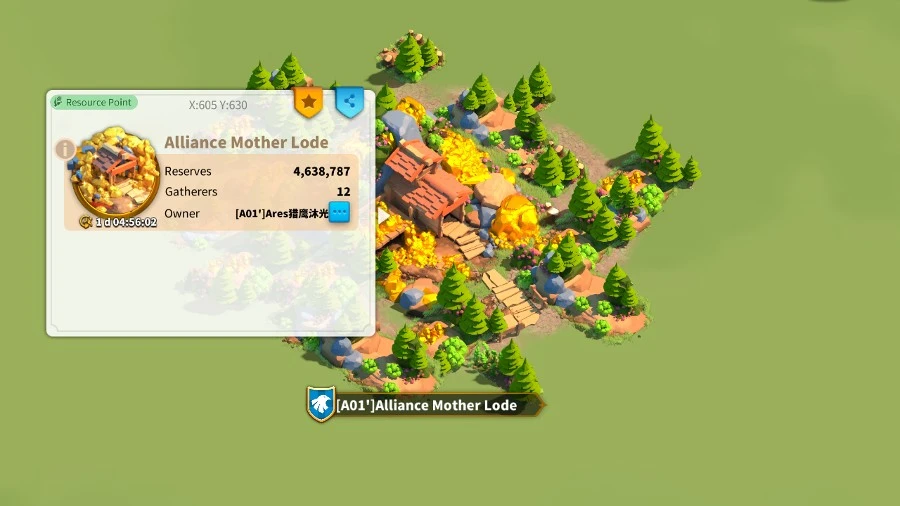
An alliance normally selects one Resource Center type to operate at a time. Officers should choose the resource that best supports the alliance’s current development, healing, training, research, or event needs.
| Resource Center | Resource | Best Time to Use It |
| Alliance Granary | Food | Troop training, healing and Food shortages |
| Alliance Wood Lot | Wood | Building, research, training and healing |
| Alliance Stone Pit | Stone | City and alliance development |
| Alliance Mother Lode | Gold | Late research, healing, T5 costs and Gold-gathering events |
Alliance Mother Lode
The Mother Lode provides a large Gold-gathering location.
It does not permanently generate event points by itself. Gathering from it provides event points only when the current event awards points for Gold or gathering activity.
Resource Center Safety
Alliance Resource Centers are designed as protected gathering locations for eligible alliance members under their normal structure rules.
Confirm the current tooltip for:
- Duration
- Total capacity
- Minimum City Hall requirement
- Number of marches allowed per member
- Placement restrictions
- Home kingdom and Lost Kingdom differences
Resource Center Versus Resource Point
| Feature | Alliance Resource Center | Alliance Resource Point | Normal Resource Node |
| Created by alliance | Yes | No | No |
| Main benefit | Large member gathering location | Passive Alliance Resource production | Personal resources and territory gathering bonus |
| Needs territorial placement | Yes | Its center must be enclosed | Must fall inside territory for ownership bonuses |
| Resource choice | Selected by officers | Fixed by map object | Fixed by node type |
Normal resource node
Personal gathering plus alliance-territory bonus
Alliance Resource Point
Passive Alliance Resource production
Alliance Resource Center
Large alliance-built gathering location
What Does Territory Guardian Increase?
Territory Guardian is an Alliance Technology that increases troop Attack while fighting on effective alliance territory.
Territory Guardian II further increases the territorial Attack bonus.
Territory Guardian answer: Territory Guardian increases troop Attack during battles that take place on effective alliance territory. It does not provide a universal Attack bonus for every battle on the kingdom map.
Best Territory Technologies
| Technology | Main Effect |
| Territory Guardian I | Increases troop Attack while fighting on alliance territory |
| Territory Guardian II | Further increases troop Attack on alliance territory |
| Rapid March I and II | Improve March Speed when moving toward targets on alliance territory |
| Architecture I and II | Reduce Alliance Building resource costs |
| Flag Quantity I and II | Increase the maximum number of Alliance Flags |
| Artisan’s Spirit | Improves alliance construction speed |
| Skillful Craftsman | Greatly improves Alliance Flag construction speed |
| Storehouse Expansion | Increases Alliance Resource capacity |
Technology Priority by Situation
| Alliance Situation | Recommended Priority |
| Flag cap blocks expansion | Flag Quantity |
| Construction costs are too high | Architecture |
| Contested territory expansion | Skillful Craftsman and construction speed |
| Territory warfare | Territory Guardian and Rapid March |
| Alliance Resources are reaching capacity | Storehouse Expansion |
| Peaceful development phase | Resource, construction and cost-reduction technologies |
What Is Tactical Expansion II?
Technology names may differ by language, scenario, or game version.
If the current client displays Tactical Expansion II, open its tooltip and check whether it affects:
- Flag quantity
- Territory size
- Alliance construction
- Banner effects
- A scenario-specific territory mechanic
Do not map it to another technology only because the names appear similar.
Alliance Territory Map and Flag Routes
A useful territory map should show more than the total number of flags. It should reveal how objectives are connected and which routes are vulnerable.
Efficient Territory Route
- Uses a short flag chain
- Connects several Resource Points
- Provides access to a pass or Holy Site
- Has room for member teleports
- Can be reinforced quickly
- Includes an alternative connection where practical
Weak Territory Route
- Uses a long, narrow chain
- Connects only one low-value objective
- Depends on one exposed flag
- Is difficult to reinforce
- Consumes excessive Alliance Resources
- Places cities near an indefensible frontline
Disconnected Territory Example
|
Flag A
|
Flag B ← destroyed
|
Flag C
|
Holy Site
If Flag B is destroyed:
- The territory beyond it may become ineffective.
- Flag C may lose its active connection.
- Resource Points on that branch may stop producing.
- Teleport and structure access may be affected.
- The alliance must rebuild Flag B or create another route.
For passes, regions, Holy Sites, and map progression, read the Rise of Kingdoms zones guide.
Attacking, Defending and Repairing Alliance Structures
Enemy flags, fortresses, and applicable Holy Sites normally require adjoining territory before an alliance can attack them.
Structure Battle Stages
| Status | Meaning | Recommended Response |
| Under rally | Enemy is attacking the structure’s garrison | Reinforce, swarm or counter-rally according to leadership |
| Burning | The structure is losing durability | Begin repairs and protect the location |
| Repaired | The burn has been stopped | Restore the garrison and prepare for another attack |
| Destroyed | Durability reached zero | Rebuild or create a different route |
| Disconnected | No effective link remains to the territorial anchor | Restore the connection before continuing expansion |
Can Burning Flags Be Repaired?
Yes. Authorized R4 and R5 leadership can repair a burning Alliance Flag or Fortress while it remains recoverable.
Repairing does not automatically make the position safe. The alliance must also stop repeated enemy attacks and protect the territory connection.
Flag Defense Checklist
- Use an approved garrison commander.
- Send only the requested troop type.
- Keep reinforcements moving before the garrison empties.
- Watch hospital capacity.
- Prepare counter-rallies where appropriate.
- Clear enemy open-field marches around the structure.
- Repair burning structures quickly.
- Protect neighboring flags that maintain the connection.
Flag Attack Checklist
- Confirm adjoining territory.
- Use an approved rally captain.
- Scout the surrounding area.
- Review the enemy garrison.
- Use the requested troop type.
- Coordinate open-field support.
- Prepare for counter-rallies.
- Continue pressure while the structure burns.
- Do not waste troops on an objective the kingdom cannot hold.
Casualty distribution can differ between rally attackers, garrison defenders, swarming marches, the home kingdom, and Lost Kingdom scenarios. Check current battle reports rather than applying one universal percentage to every structure battle.
For rallies, garrisons, and structure attacks, read the ROK city and flag attack guide.
Teleporting to Alliance Territory
A Territorial Teleport is the standard item for moving directly onto effective alliance territory.
A Targeted Teleport may also work when:
- The selected destination is valid.
- The city footprint fits completely.
- Regional and pass requirements are satisfied.
- The map or scenario permits the move.
Lost Kingdom scenarios can apply stricter rules than the home kingdom.
Teleport answer: A Territorial Teleport is not always the only possible option. A Targeted Teleport can also work when the destination and regional-access rules allow it.
Use the Rise of Kingdoms Teleport guide for Territorial, Targeted, Random, and Beginner Teleport requirements.
Officer and Member Responsibilities
R4 and R5 Responsibilities
- Place fortresses and flags.
- Plan routes toward passes and Holy Sites.
- Prioritize Alliance Technologies.
- Monitor Storehouse resources.
- Select the Resource Center type.
- Mark construction and teleport positions.
- Repair burning structures.
- Coordinate rallies and garrisons.
- Avoid territorial overextension.
- Communicate construction and war schedules.
Normal Member Responsibilities
- Donate to the selected Alliance Technology.
- Send troops to approved construction projects.
- Gather inside alliance territory.
- Use Resource Centers efficiently.
- Avoid blocking strategic teleport spaces.
- Follow territory and war markers.
- Reinforce only when requested.
- Report enemy movement.
- Help generate Alliance Credits and Resources.
- Move away from exposed territory before going offline.
Alliance Territory Strategy in KvK
Lost Kingdom territory can use special structures, currencies, passes, and construction rules. Do not assume every home-kingdom value applies unchanged in KvK.
Before Entering KvK
- Confirm alliance assignments.
- Review fortress-building teams.
- Save Alliance Credits and applicable resources.
- Prepare teleports.
- Publish flag-route plans.
- Assign rally and garrison leaders.
- Prepare construction marches.
- Identify safe city locations.
During KvK Expansion
- Follow Chronicle and pass-opening schedules.
- Build only approved routes.
- Protect vulnerable single-flag connections.
- Prioritize strategic objectives over decorative territory.
- Keep fallback territory available.
- Repair burning structures before durability reaches zero.
- Avoid leaving frontline cities unshielded while offline.
The specific fortress names, Resource Center rules, and construction currencies can vary by scenario. Use the current Lost Kingdom interface as the final authority.
Common Alliance Territory Mistakes
- Confusing the Alliance Center with the Center Fortress: One is a city building, while the other creates map territory.
- Assuming all four Resource Centers operate simultaneously: Alliances normally select one active type.
- Building flags without a route plan: Every flag should support a strategic objective.
- Publishing one permanent flag cost: Costs rise and technology can reduce them.
- Using a long single-flag connection: One destroyed flag can disable the entire branch.
- Ignoring Alliance Resource Points: They provide long-term alliance-level production.
- Overextending toward low-value territory: Large territory is not automatically useful territory.
- Failing to repair burning structures: A recoverable position can become fully destroyed.
- Assuming territory makes cities safe: Frontline cities can still be attacked.
- Using the wrong teleport: Check the destination, pass, and scenario requirements.
- Building too quickly in peaceful areas: Members may lose contribution opportunities.
- Building too slowly in contested areas: The enemy may reach the objective first.
- Leaving the Resource Center inactive: Select the resource members currently need.
- Allowing Storehouse resources to cap: Spend or expand capacity before production is wasted.
- Researching combat bonuses while the flag cap blocks expansion: Match technology to the alliance’s current bottleneck.
Comparing accounts in established kingdoms? Strong alliance territory can improve resources and account development, but territory access alone does not determine account value. Players comparing available ROK accounts should also review the current alliance and kingdom, migration eligibility, troop technology, commanders, equipment, armaments, VIP level, resources, Passport Pages, and KvK status.
FAQ
What is an Alliance Resource Center in Rise of Kingdoms?
An Alliance Resource Center is a large gathering structure placed by authorized alliance leadership. The alliance selects a Granary, Wood Lot, Stone Pit, or Mother Lode based on the resource members currently need.
How many Alliance Resource Centers can an alliance build?
An alliance normally operates one selected Resource Center type at a time. Check the current construction screen for scenario-specific rules.
What does Territory Guardian increase in ROK?
Territory Guardian increases troop Attack while fighting on effective alliance territory. Territory Guardian II further increases that bonus.
How much does an Alliance Flag cost?
The first flag is commonly documented at 50,000 Alliance Credits. Later costs rise as more flags are built, while Architecture technology can reduce the displayed resource cost.
What are the Center Fortress requirements?
Community references commonly list 20 alliance members, 500,000 combined power, and 1,000,000 Alliance Credits. Confirm the current requirements before building.
How do you get Alliance Resources?
Enclose Alliance Resource Points, gather from normal nodes inside owned territory, maintain an active Resource Center, and improve Storehouse and territory technologies.
Can burning Alliance Flags and Fortresses be repaired?
Yes. Authorized R4 and R5 leadership can repair burning structures before their durability reaches zero.
Can you teleport to alliance territory without a Territorial Teleport?
A Targeted Teleport may also work when the destination and regional-access rules are valid. Lost Kingdom scenarios may apply stricter restrictions.
Conclusion
Effective alliance territory begins with a well-positioned Center Fortress and expands through short, connected, and defensible flag routes. Officers should prioritize valuable Resource Points, passes, Holy Sites, and member access instead of building territory only to increase its visible size.
Check the live cost before placing every flag. Architecture can reduce building costs, Flag Quantity increases the available cap, Territory Guardian strengthens combat on owned land, and construction technologies help secure contested routes faster.
Alliance Resource Centers, Alliance Resource Points, and normal resource nodes perform different roles. Understanding those differences helps leadership choose the right Resource Center, maintain Storehouse production, and prevent Alliance Resources from being wasted.
Looking for more Rise of Kingdoms strategy guides? Explore more Rise of Kingdoms guides for alliance systems, gathering, teleports, zones, commanders, KvK preparation, and account development.