
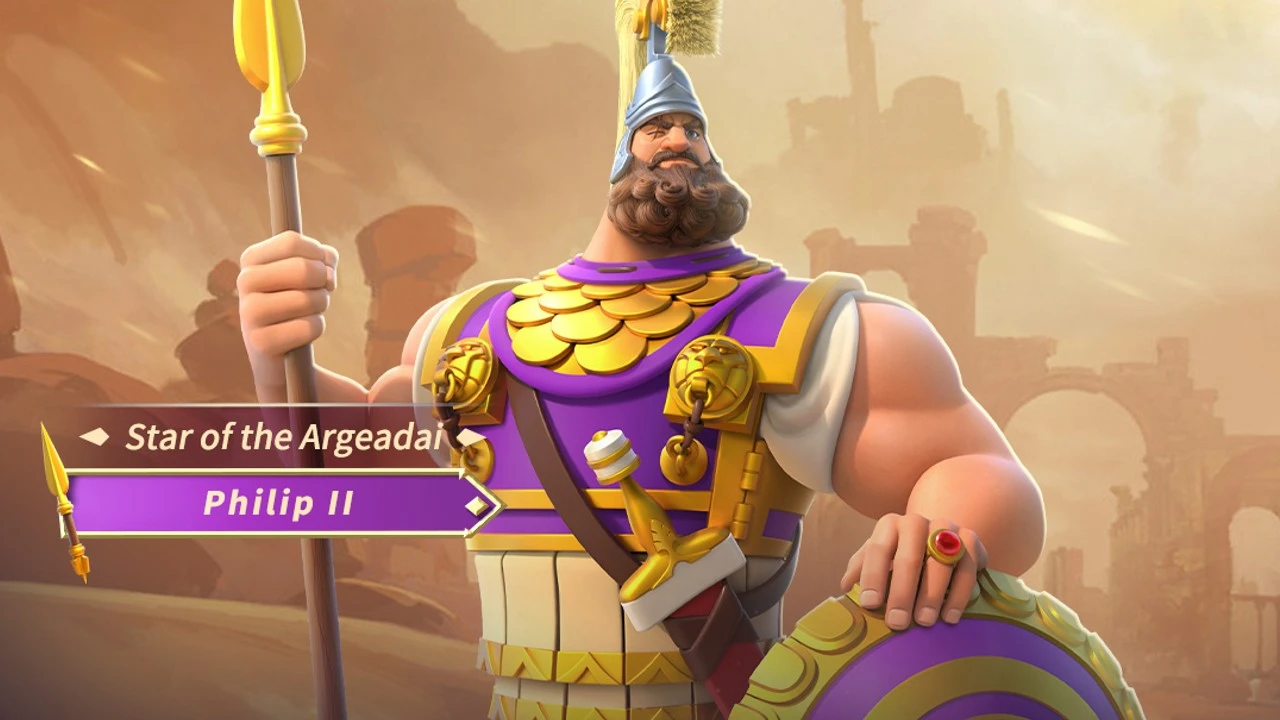
Philip II is a Legendary Leadership commander in Rise of Kingdoms who supports his own march and nearby allied armies through damage bonuses, damage reduction, March Speed, Rage disruption, and repeated active-skill effects.
His build has one important decision. A march containing only one troop type receives a large damage bonus, while a mixed march gains additional March Speed and damage reduction. Therefore, Philip II should not automatically use mixed troops in every situation.
Philip II is primarily an open-field support commander. New players and accounts with limited Legendary Sculptures should usually skip him. Consider investing when you already have a strong expertised damage commander, suitable equipment, and enough developed marches to benefit from his nearby buffs. Expertise is highly important because it unlocks his active-skill duplication mechanic.Use one troop type for maximum personal damage. Use at least two troop types when you prefer additional mobility and damage reduction. Equipment must match the chosen setup.
Is Philip II Worth Investing In?
Philip II is valuable when his buffs improve an already strong open-field march. However, he is not a beginner commander, a universal rally captain, or an automatic garrison investment.
His strongest advantage is not raw personal damage. Instead, he improves nearby allies while creating opportunities to repeat his own active skill and the active skill of his secondary commander.
| Player Type | Recommendation | Reason |
| New player | Skip | Early accounts need more accessible and specialized commanders |
| F2P with limited sculptures | Compare carefully | His defining duplication effect requires expertise |
| Player building an unfinished fifth march | Skip | Philip does not fix weak equipment, technology, or secondary commanders |
| Player with an expertised damage commander | Consider | His expertise can repeat a valuable secondary active skill |
| Open-field support player | Consider | Nearby allied marches benefit from his active skill |
| Rally leader | Usually choose a specialist | Philip is not automatically a leading rally commander |
| Garrison captain | Usually choose a specialist | His kit is better suited to coordinated field combat |
Reasons to Build Philip II
- He buffs up to five nearby allied marches.
- His own march receives double the active-skill effects.
- He can work with Infantry, Cavalry, Archers, or mixed troops.
- He provides significant March Speed.
- His fourth skill adds area damage and Rage reduction.
- His expertise can repeat two different active skills.
- He fits several troop-specific equipment paths.
Reasons to Skip Philip II
- He needs expertise to unlock his defining mechanic.
- His value depends heavily on the secondary commander.
- He performs best near allied marches rather than alone.
- His broad flexibility can make equipment planning more complicated.
- More specialized commanders may provide better value in smaller rosters.
- His pairings change as newer commander generations enter the game.
Philip II Quick Overview
| Attribute | Philip II |
| Rarity | Legendary |
| Nickname | Star of the Argeadai |
| Talent trees | Leadership, Versatility, and Support |
| Primary role | Open-field support and damage amplification |
| Troop options | Infantry, Cavalry, Archers, or mixed troops |
| Main strength | Nearby buffs and active-skill duplication |
| Main weakness | Expertise and pairing dependence |
| Best general mode | Large open-field battles |
| Default formation | Wedge for active-skill pairings |
Single Troop or Mixed Troops?
Philip II can use either setup, but League of Corinth provides different effects based on the number of troop types in the march.
Single Troop Type
A march containing only one troop type deals up to 30% additional damage. Sarissa then supplies a troop-specific attribute:
- Cavalry: Up to 35% Attack
- Infantry: Up to 35% Defense
- Archers: Up to 35% Health
- Every setup: Up to 20% March Speed
This build is usually easier to equip because the march can use a complete Infantry, Cavalry, or Archer equipment set.
Mixed Troops
A march containing at least two troop types receives up to 15% additional March Speed and 15% damage reduction.
The mixed setup trades the 30% single-type damage bonus for greater durability and movement. It can work well in large fights where Philip’s main responsibility is staying close to allied marches and repeatedly applying buffs.
| Setup | Main Benefit | Best Use | Main Limitation |
| Single troop type | 30% additional damage | Damage-focused open-field march | Loses mixed-troop damage reduction |
| Mixed troops | Speed and damage reduction | Support, mobility, and large fights | Harder equipment optimization |
| Cavalry | Attack and March Speed | Aggressive rotations | Can be focused quickly |
| Infantry | Defense | Durable frontline support | Lower mobility than Cavalry |
| Archers | Health | Sustained ranged pressure | Depends heavily on the partner |
Best Philip II Talent Tree
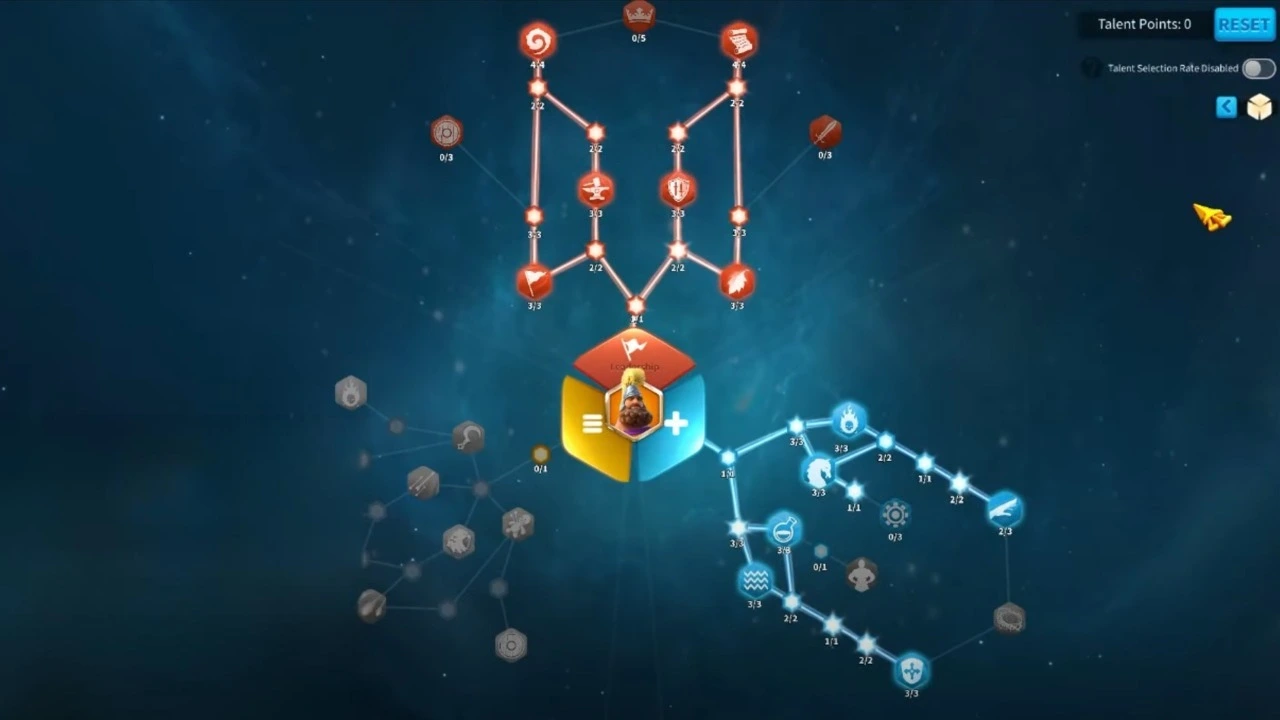
The existing build uses the Leadership and Support trees. Its main goals are faster active-skill cycles, general troop durability, and additional value after Philip activates Macedonian Phalanx.
Recommended Talent Route
- Start through the Support tree. Move toward Rejuvenate so Philip restores Rage after active-skill use.
- Do not overinvest in Rage generation. His build and paired commander may already approach the normal Rage-generation limit.
- Move into Leadership. Take Hidden Wrath for additional Rage when the march is attacked.
- Add Fresh Recruits. The larger march improves both survivability and total damage.
- Take Strategic Prowess. This provides temporary Defense after using an active skill.
- Complete the main Leadership durability route. Follow the displayed build for the remaining points.
- Skip talents that do not support open-field combat. Do not spend points solely because Philip has the Versatility tree.
Why Rejuvenate Matters
Macedonian Phalanx lasts only two seconds. Therefore, more frequent active-skill cycles allow Philip to create additional short damage and defense windows for his own march and nearby allies.
However, excessive Rage generation can become inefficient when the march is already close to the Rage cap. Balance Rejuvenate with durable Leadership talents instead of selecting every available Rage node.
Primary commander rule: Philip II must be primary for this talent tree to apply. When Philip is secondary, his skills still activate, but none of his selected talents affect the march.
Best Philip II Skill Order
Macedonian Phalanx should reach level five before additional skills are unlocked. Afterward, Philip benefits from all four skills, but his defining active-skill duplication remains locked behind expertise.
Recommended Progression
- Keep Philip at one star until Macedonian Phalanx reaches level five.
- Raise him to two stars and improve Sarissa.
- Continue upgrading League of Corinth before judging his preferred troop composition.
- Unlock Conqueror of Chaeronea when you are prepared to continue investing.
- Plan for 5-5-5-5 if Philip will become part of a serious open-field march.
| Skill Target | Practical Use |
| 5-1-1-1 | Maximum allied buff before further investment |
| 5-5-1-1 | Full troop-specific stats and March Speed |
| 5-5-5-1 | Complete single-versus-mixed troop mechanic, when achievable |
| 5-5-5-5 | Recommended target for a committed Philip march |
Do not invest based only on the performance of an unfinished Philip. Vergina Sun changes his pairing value significantly because it can repeat both his own skill and the secondary commander’s skill.
Philip II Skills Explained
Macedonian Phalanx

For two seconds, Macedonian Phalanx affects Philip’s march and as many as five nearby allied or friendly troops.
- Nearby allied marches take up to 10% less damage.
- Nearby allied marches deal up to 20% more damage.
- Both effects are doubled for Philip’s own march.
- At maximum level, Philip’s march can receive 20% damage reduction and 40% additional damage during the window.
The duration is short. Therefore, Philip should remain close to other active marches, and his partner should cycle skills frequently enough to capitalize on the buff window.
Sarissa
While Philip’s troop is on the map, Sarissa gives different bonuses to each troop type.
| Troop Type | Maximum Bonus |
| Cavalry | 35% Attack |
| Infantry | 35% Defense |
| Archers | 35% Health |
| Entire march | 20% March Speed |
League of Corinth
League of Corinth determines whether Philip uses a damage-focused or defensive troop setup.
- At least two troop types: Up to 15% March Speed and 15% damage reduction.
- Only one troop type: Up to 30% additional damage.
The single-type bonus is too large to ignore. Mixed troops are not automatically the best choice, especially when Philip is paired with a powerful troop-specific damage commander.
Conqueror of Chaeronea
Every basic attack has a 10% chance to trigger Conqueror of Chaeronea.
- Deals up to 800 direct damage to three nearby enemy troops.
- Every additional target reduces damage to each target by 15%.
- Reduces affected enemies’ Rage by up to 100.
- Has a three-second cooldown.
This is conditional pressure rather than a guaranteed effect every active-skill cycle. It becomes more valuable during long fights where Philip launches many basic attacks.
Vergina Sun

Vergina Sun is Philip II’s expertise and the main reason partner selection matters.
- Philip has a 40% chance to cast Macedonian Phalanx a second time.
- The secondary commander has a 20% chance to cast its active skill a second time.
- The duplication effect has a seven-second trigger cooldown.
Consequently, Philip should be paired with a commander whose active skill remains valuable when repeated. High damage, area pressure, strong debuffs, control, or team support can all benefit.
Best Philip II Pairings
There is no permanent universal best pairing. The ideal partner depends on troop type, current commander generation, available equipment, and whether Philip is primary or secondary.
| Pairing Type | Primary | Troop Setup | Main Advantage | Main Limitation |
| Liu Che and Philip II | Liu Che | Pure Infantry | Strong Infantry field march with Philip’s support and duplication | Philip’s talent tree does not apply |
| Philip II and Bai Qi | Philip II | Usually pure troop type | Uses Philip’s Leadership and Support talents with a valuable secondary skill | Requires both commanders to be well developed |
| Philip II and modern skill commander | Depends on talents | Single troop type | Potential repeated active-skill damage or debuffs | Expertise required |
| Philip II and support commander | Philip or partner | Mixed or single | Strong team utility in grouped fighting | Lower personal damage |
| Philip II and Scipio Prime | Depends on build | Pure Infantry | Damage, debuffs, and durability | Scipio may be more useful in another march |
Liu Che and Philip II
This is a pure-Infantry setup that allows Liu Che to lead with his own troop-specific talents while Philip contributes Sarissa, League of Corinth, area Rage disruption, and active-skill duplication.
Philip’s own talent tree does not apply in this order. However, using him as secondary can be correct when Liu Che’s primary talents provide more overall value.
Philip II and Bai Qi
Philip can lead when the march needs his Leadership and Support talents. Bai Qi then provides a powerful active skill that may be repeated through Vergina Sun.
This pairing is more relevant to developed accounts with several completed marches. Do not build Bai Qi solely to provide Philip with a partner unless the commander also fits the wider roster.
Philip II and Scipio Prime
Scipio Prime remains a usable Infantry partner because he adds damage, Defense reduction, and survivability. Nevertheless, he may be needed elsewhere, and newer commanders can create stronger complete rosters.
Choosing Another Partner
A good Philip secondary should provide at least one of the following:
- A high-value active skill
- Area damage
- A strong enemy debuff
- Control or Rage reduction
- Team-wide support
- Compatibility with the selected troop type
Do not choose a partner only because the commander is highly ranked individually. The active skill, troop conditions, equipment, and primary talent tree must work together.
Best Equipment and Formation
Equipment by Troop Type
- Pure Cavalry: Use a complete Cavalry set with Health, Defense, Attack, and March Speed.
- Pure Infantry: Prioritize Infantry Health and Defense before additional Attack.
- Pure Archers: Prioritize Archer Health, Defense, and active-skill support.
- Mixed troops: Use broadly applicable attributes that benefit the full march.
There is no separate “Leadership equipment” category that automatically solves every Philip build. Equipment must follow the troops actually placed in the march.
Best Formation
Wedge Formation is the safest general starting point when Philip is paired with a commander that relies on active-skill damage.
Other formations may work when:
- The partner relies more heavily on normal attacks.
- The march is designed mainly to provide buffs.
- A different formation has substantially better armaments.
- A valuable inscription changes the comparison.
Always compare the complete armament attributes and inscriptions. A theoretically ideal formation with weak armaments can perform worse than a less obvious option with excellent stats.
How to Use Philip II in Open Field
- Stay near allied marches. Macedonian Phalanx loses much of its team value when Philip fights alone.
- Avoid leading the engagement. Let more durable frontline marches take initial focus.
- Fight inside allied groups. This improves the chance that the active skill affects several friendly armies.
- Watch the two-second buff window. Frequent Rage cycles increase its practical value.
- Use the correct troop composition. Do not accidentally mix troops and lose the 30% damage bonus.
- Do not chase too far. Philip becomes less valuable when separated from the allied group.
- Protect the secondary commander’s skill cycle. Expertise is strongest when the partner remains alive and continues casting.
- Retreat before being surrounded. Philip supports a group but is not automatically a durable solo Tank.
Where Philip II Performs Poorly
- Normal Barbarian farming
- Early-game progression
- Weak or unfinished marches
- Solo fighting away from allies
- Accounts unable to expertise him
- Rally leadership without current matchup testing
- Garrison defense without a specialist defensive pairing
- Marches with mismatched troops and equipment
Common Philip II Mistakes
- Assuming mixed troops are always best: A pure march gains up to 30% additional damage.
- Ignoring Sarissa: Infantry, Cavalry, and Archers receive different attributes.
- Using Philip as secondary while relying on his talents: Secondary talent trees do not apply.
- Investing without a strong partner: Expertise is only as valuable as the active skill it may repeat.
- Calling him a top garrison commander: His main role is coordinated open-field support.
- Using generic equipment: Build equipment around the chosen troop composition.
- Fighting away from allies: His active skill should affect several nearby marches.
- Evaluating him before expertise: Vergina Sun is central to his full value.
- Copying old pairings automatically: Reassess the complete roster after new commander releases.
- Choosing every Rage talent: Excess Rage generation can become inefficient near the cap.
- Using a weak mixed march for flexibility: Damage reduction cannot compensate for poor equipment and technology.
- Targeting broad historical intent: Keep metadata focused on Philip II ROK.
FAQ
Is Philip II good in ROK?
Philip II is useful as an open-field support commander, especially in developed multi-march rosters. His value is lower for beginners and accounts with only one or two completed marches.
Is Philip II worth Legendary Sculptures?
Consider him when you already have a strong expertised partner, suitable equipment, and enough field marches to benefit from his buffs. Otherwise, save the sculptures for a more essential commander.
What is the best Philip II talent tree?
Use a Leadership and Support build that reaches Rejuvenate, then adds Rage, troop capacity, and post-skill Defense through talents such as Hidden Wrath, Fresh Recruits, and Strategic Prowess.
Should Philip II use mixed troops?
Mixed troops provide up to 15% March Speed and damage reduction. However, a single troop type receives up to 30% additional damage. Choose according to the march’s role.
Who is the best pairing for Philip II?
No single pairing is permanently best. Liu Che, Bai Qi, Scipio Prime, and modern active-skill commanders are possible options depending on troop type and the wider roster.
Should Philip II be primary or secondary?
Use Philip as primary when you need his Leadership and Support talents. Use him as secondary when the troop-specific primary commander has the stronger talent tree.
Does Philip II need expertise?
Expertise is strongly recommended. Vergina Sun unlocks the chance to repeat Philip’s active skill and the secondary commander’s active skill.
Is Philip II good for rallying or garrison defense?
He can function in specialized setups, but his most reliable role is open-field support. Use dedicated rally and garrison commanders unless current battle testing supports a specific Philip pairing.
Comparing developed commander rosters? Philip II is most valuable when the account already has compatible expertised commanders, suitable equipment, and enough open-field marches to benefit from his nearby buffs. Players comparing ROK accounts for sale should also review commander skills, equipment, formations, armaments, troop technology, resources, migration eligibility, and kingdom status.
Conclusion
Philip II is a flexible open-field support commander, but flexibility does not make him an automatic investment for every account. His value depends on the quality of his secondary commander, the chosen troop composition, equipment, and whether the team fights close enough to benefit from Macedonian Phalanx.
Use a single troop type when the march needs maximum damage. Alternatively, use mixed troops when additional March Speed and damage reduction provide more practical value.
For serious use, plan around expertise. Vergina Sun is the mechanic that allows Philip and his partner to repeat active skills, which substantially changes the march’s damage and support potential.
Finally, treat him as an open-field commander first. Rally and garrison use should be based on current matchup testing rather than unsupported universal ratings.
Explore more commander, event, alliance, and progression content in the Rise of Kingdoms guide collection.