 A good Whiteout Survival pack strategy for mid spenders is not simply a larger version of a low-spender plan. Once your budget can cover more than one useful purchase, the difficult question changes from “What should I buy first?” to “How should I divide my spending?”
That makes mid-level spending surprisingly easy to waste. You may have enough budget for permanent upgrades, recurring benefits, hero progression, and occasional event packs, but probably not enough to invest heavily in every system at the same time.
The smarter approach is to give different parts of your budget different jobs. Build a reliable base first, choose one or two progression priorities, and keep enough flexibility to act when an event genuinely supports those goals.
Mid Spenders Should Think in Budget Lanes, Not Individual Packs
Judging every pack independently is one of the easiest ways to lose control of a mid-level budget.
A pack can look reasonable on its own and still be the wrong purchase if it takes money or Gems away from something more important.
Instead, divide your Whiteout Survival spending into clear lanes:
- Permanent value: account upgrades that keep providing utility.
- Recurring value: purchases you are comfortable maintaining over time.
- Progression value: spending dedicated to one important account system or hero plan.
- Event value: flexible budget reserved for unusually useful temporary opportunities.
This structure gives every purchase a reason to exist. More importantly, it makes skipping a mediocre offer much easier because you already know what that money is reserved for.
Build Your Whiteout Survival Spending Strategy on Permanent Value First
Having a larger budget does not make long-term utility less important. In many cases, it makes delaying those upgrades even harder to justify.
If important permanent account improvements are still missing, consider solving those limitations before repeatedly spending on consumable resources.
Construction Queue
An additional permanent Construction Queue can continue helping throughout city progression because it allows another building project to run alongside your primary construction.
Whiteout Survival also provides temporary ways to access additional construction capacity, so the permanent option should still be judged against how often you actually use a second builder. However, an active mid-spender who regularly keeps multiple construction projects moving can extract value from permanent utility for a long time.
March Queue
Additional March Queues improve flexibility across gathering, Intel, rallies, events, and other map activities.
Before paying specifically for another march, check what your account already receives from research, VIP progression, and other unlocks. A mid-spender should solve an actual limitation rather than buying a queue simply because it appears on a priority list.
The principle is simple: finish the permanent utility that meaningfully affects your account, then stop budgeting for problems you have already solved.
Keep a Stable Recurring Base Without Buying Everything Every Week
Once your important permanent upgrades are covered, recurring purchases can form the stable part of a mid-spender budget.
The Ultra Value Monthly Card is a good example of this type of purchase because its benefits are spread across an extended period rather than consumed in one short progression burst.
For an active player, that type of predictable value can make budgeting easier. However, being a mid-spender does not mean every weekly or monthly offer automatically belongs in your base.
Review recurring purchases using three questions:
- Do I use the benefits consistently?
- Would I still maintain this purchase if no major event were running?
- Does keeping it active reduce my ability to fund a more important progression target?
If a recurring purchase fails those tests, move it out of the permanent budget and treat it as optional.
Use Dawn Fund as Progression Value, Not as an Automatic Purchase
The Furnace-linked progression purchase currently commonly referred to as Dawn Fund can be another useful part of a structured spending plan.
Older Whiteout Survival guides may call a similar progression purchase a Growth Fund. Rather than relying on an old name, price, or reward list, check the live progression offer available on your account.
Dawn Fund deserves more attention when:
- you are still progressing through relevant Furnace milestones;
- there are meaningful rewards left for your account to claim;
- you expect to continue developing the same account;
- the purchase fits without taking money from a more important permanent or hero goal.
The key advantage of progression-based value is alignment. You are paying around progress that you already planned to make rather than inventing a new goal because a temporary bundle appeared.
Give Hero Progression Its Own Mid-Spender Budget
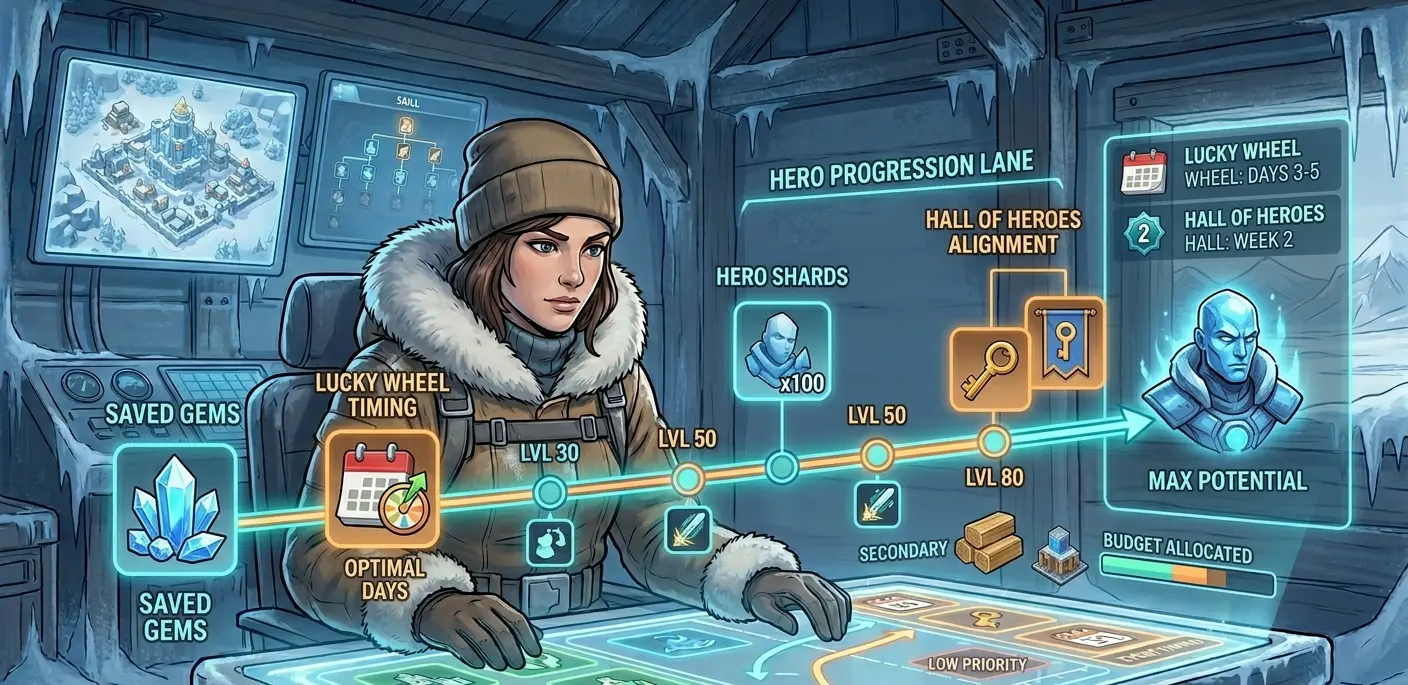 This is where a mid-spender can usually become more ambitious than a very low spender.
Instead of treating hero upgrades as occasional impulse purchases, reserve part of your resources for a defined hero plan.
That does not mean buying every new hero. It means deciding which hero acquisition route deserves your Gems and paid budget before the relevant event arrives.
Plan Gems Around Lucky Wheel
Lucky Wheel remains an important route for obtaining generation-specific Mythic heroes. Its milestone structure makes planning your Gems before the event more useful than spinning randomly whenever you have enough for another attempt.
For a mid-spender, the important decision is not simply whether Lucky Wheel is good. Ask:
- Is the current Wheel hero important to my lineup?
- How far am I realistically planning to develop that hero?
- Do I have enough Gems to reach a useful stopping point?
- Would spending those Gems now interfere with another major account priority?
A hero you do not intend to develop should not consume a large part of your budget simply because the Wheel is available.
Use Hall of Heroes Selectively
Hall of Heroes is another recurring hero-progression route, but it should not automatically compete equally with Lucky Wheel every cycle.
Its value depends on the heroes and rewards relevant to your state progression, the event currency available to you, and whether those rewards support the lineup you are actually building.
A structured mid-spender can therefore treat Hall of Heroes as a secondary hero lane: valuable when the available rewards fit the plan, easy to reduce when they do not.
Do Not Spread Your Hero Budget Across Every Generation
A common mid-spender mistake is buying enough hero materials to start several projects but not enough to finish any of them properly.
Whiteout Survival continues introducing new hero generations as states mature. That makes uncontrolled hero spending especially risky because another attractive hero will eventually appear.
Before committing money or a large Gem reserve, decide:
- which heroes you expect to use in your main combat roles;
- which hero is the current priority;
- what development target you are trying to reach;
- what would cause you to stop investing.
Mid-spender flexibility is useful, but it should not become constant switching.
The Strongest Mid-Spender Move Is Stacking Progress
The main advantage of a moderate budget is the ability to make several systems support the same goal.
For example, suppose you are already saving Gems for a hero-focused event. If an event also rewards progression actions you were going to complete anyway, you can time those resources so one planned investment contributes to several objectives.
The same principle can apply to gear materials, speedups, hero upgrades, and other progression resources.
A useful stack might include:
- a recurring base already active;
- permanent utility already handled;
- Gems reserved for the chosen hero route;
- saved upgrade materials waiting for a relevant scoring window;
- a limited event budget available only if the pack contents support the same target.
This is different from simply buying several things at once. Stacking value means making several parts of your plan point in the same direction.
Classify Events Before You Spend on Them
Mid-spenders usually have enough budget to participate in more events, which is exactly why event discipline becomes important.
A useful system is to classify events before their offers start competing for your money.
Core Events
These support goals you have already decided to prioritize. A hero acquisition event tied directly to your planned lineup might belong here.
Situational Events
These become interesting only when the rewards line up unusually well with a current bottleneck. You do not reserve guaranteed spending for them.
Skip Events
These do not meaningfully support your current account plan. Their banners, timers, and promotional value labels should not change your decision.
This classification matters because mid-spenders often lose efficiency through frequency. Five acceptable purchases made in five different directions can weaken a strategy more than one obviously poor purchase.
Stop Letting Filler Packs Consume a Mid-Level Budget
Once you have enough budget to plan around permanent upgrades, hero development, and event timing, generic filler becomes increasingly difficult to justify.
That includes purchases such as:
- basic resources you can obtain steadily through normal gameplay;
- general speedup packs bought without a specific progression target;
- hero materials for characters outside your development plan;
- random shop offers that solve no meaningful bottleneck;
- event bundles purchased primarily because of a high displayed value percentage.
This does not mean every resource or speedup pack is bad. A bundle can make sense when it solves a specific problem at the right moment.
The important distinction is that a mid-spender should be able to explain exactly why that purchase deserves budget that could otherwise fund a stronger hero, gear, permanent, or event objective.
For a broader look at the different offer categories, read Whiteout Survival packs explained: all major variants and which ones matter most before treating a shop offer as automatically valuable.
A Smart Mid-Spender Budget Needs Three Main Parts
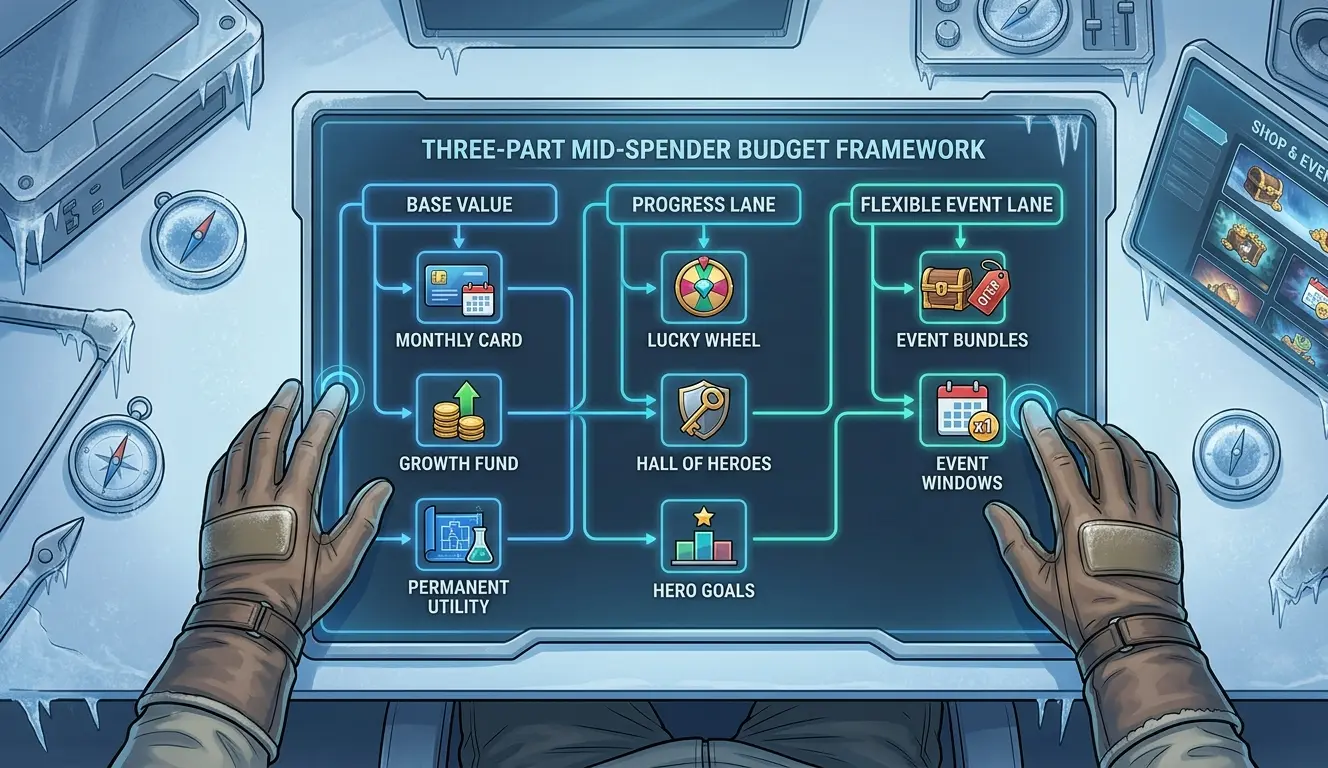 You do not need to assign an exact percentage to every category. What matters is separating money that has different jobs.
| Budget Lane | Purpose | Typical Uses | Main Rule |
|---|---|---|---|
| 1. Base Value | Maintain long-term account efficiency. | Useful permanent upgrades, recurring cards, Dawn Fund when relevant. | Keep only purchases you can justify consistently. |
| 2. Progress Lane | Accelerate one high-priority system. | Lucky Wheel, Hall of Heroes, a chosen hero, Chief Gear, Hero Gear, or another major bottleneck. | Focus instead of funding everything equally. |
| 3. Flexible Event Lane | Take advantage of genuinely useful temporary opportunities. | Selected event packs and event-aligned resources. | Unused budget can stay unused. |
The third rule is especially important. A flexible event budget is permission to spend when the opportunity is strong—not an obligation to empty that budget every month.
Choose One Main Progression Lane at a Time
Mid-spenders can usually support more than one system eventually, but trying to accelerate every system simultaneously creates shallow progress.
Your primary lane might currently be:
- Lucky Wheel and one specific hero;
- Chief Gear;
- Hero Gear;
- Fire Crystal progression;
- VIP development;
- another account-specific bottleneck.
Once that priority reaches a reasonable target, reassess the budget rather than continuing automatically.
This makes your spending strategy adaptive without making it random.
Use a Replacement Test Before Buying Any Whiteout Survival Pack
One of the most useful questions a mid-spender can ask is:
“What does this purchase replace?”
Every optional pack takes budget away from something else. Depending on your account, that may be:
- the next Lucky Wheel cycle you care about;
- a Hall of Heroes target;
- your next recurring purchase;
- a permanent account improvement;
- a Chief Gear or Hero Gear push;
- a better event offer that has not appeared yet.
If the current pack is not more useful than the opportunity it replaces, skipping it is part of the strategy.
Keep the Top-Up Method Secondary to the Spending Plan
Once you know what pack or progression target deserves your budget, you can decide how you want to purchase it. Pack selection should come first; the purchase method should not create the reason to spend.
If you prefer assisted purchasing for selected Whiteout Survival packs or bundles, Heaven Guardian offers a Whiteout Survival-specific game top up service. Heaven Guardian is an independent service rather than the developer or publisher, so compare the current option with your own purchasing preferences before using it.
Regardless of the purchase route, stay focused on the same rule: buy because the pack fits the strategy, not because making the purchase is convenient.
Before using any third-party option, it is also useful to understand common top up scams and how to avoid them, especially when an event timer creates pressure to act quickly.
Common Mid-Spender Mistakes to Avoid
Buying Every “Good Value” Pack
Several offers can be reasonably priced at the same time. That does not mean they all belong in your personal spending plan.
Starting Too Many Hero Projects
A collection of partially developed heroes can consume a large budget without strengthening your primary lineup as efficiently as focused investment.
Using Saved Resources Outside Useful Events
If the same upgrade can also contribute to an event objective later, spending the materials immediately may sacrifice additional value without accelerating anything important.
Letting a Larger Budget Reduce Discipline
More available spending should create more strategic options, not more impulse purchases.
Copying Another Player’s Exact Purchase List
Pack value changes with account age, hero generation, existing permanent unlocks, VIP level, progression bottlenecks, and personal goals. Use other spending lists as frameworks rather than fixed instructions.
FAQ
What is a good Whiteout Survival pack strategy for mid spenders?
Build a stable base from useful permanent and recurring value, choose one main progression lane, and reserve a smaller flexible budget for event opportunities. The goal is to prevent every available pack from competing equally for your money.
Should mid spenders still buy the Monthly Card?
It can remain useful for active players who regularly benefit from its current perks. A bigger budget does not make recurring value irrelevant. However, check the live card benefits and make sure maintaining it still fits your larger progression plan.
Should mid spenders prioritize Dawn Fund?
Dawn Fund can be useful when its Furnace-linked rewards remain relevant to your account. Evaluate the milestones available to you rather than treating it as an automatic purchase for every spender.
Is Growth Fund the same as Dawn Fund in Whiteout Survival?
Current Whiteout Survival spending references generally use Dawn Fund for the Furnace-linked progression purchase. Older guides may use Growth Fund terminology, so check the live offer on your account rather than relying on an older pack name or reward list.
Is Lucky Wheel worth saving Gems for as a mid spender?
It can be one of the more important hero-planning uses of Gems when the featured Mythic hero fits your lineup. Save with a target in mind rather than spending Gems on scattered spins without knowing how far you plan to develop the hero.
Should mid spenders spend on Hall of Heroes?
Hall of Heroes can be useful when its current hero and reward options match your progression plan. It should compete for resources based on what your account actually needs rather than receiving a fixed share of the budget every cycle.
Should mid spenders buy more event packs than low spenders?
Not automatically. A larger budget creates the ability to participate in more events, but the smarter advantage is increased selectivity. Spend when an event overlaps with an existing goal instead of increasing purchase frequency simply because you can.
What should mid spenders avoid buying in Whiteout Survival?
Be cautious with generic resource packs, unfocused speedup offers, hero materials outside your development plan, and temporary bundles that solve no important bottleneck. The biggest danger is often scattered spending rather than one obviously terrible purchase.
Conclusion
A strong Whiteout Survival pack strategy for mid spenders gives each part of the budget a purpose. Finish useful permanent upgrades, maintain recurring value that still earns its place, and select one major progression lane rather than trying to accelerate everything simultaneously.
Hero events such as Lucky Wheel and Hall of Heroes become much easier to manage when you decide your targets before spending. The same principle applies to temporary packs: an event should support a plan you already have, not create a new spending goal simply because its timer is running.
The main advantage of a mid-level budget is flexibility. Use that flexibility to wait for better alignment, stack progress across relevant events, and skip purchases that would take resources away from something more valuable.
For more pack comparisons, spending strategies, and practical recharge advice, explore our latest game top-up guides.