
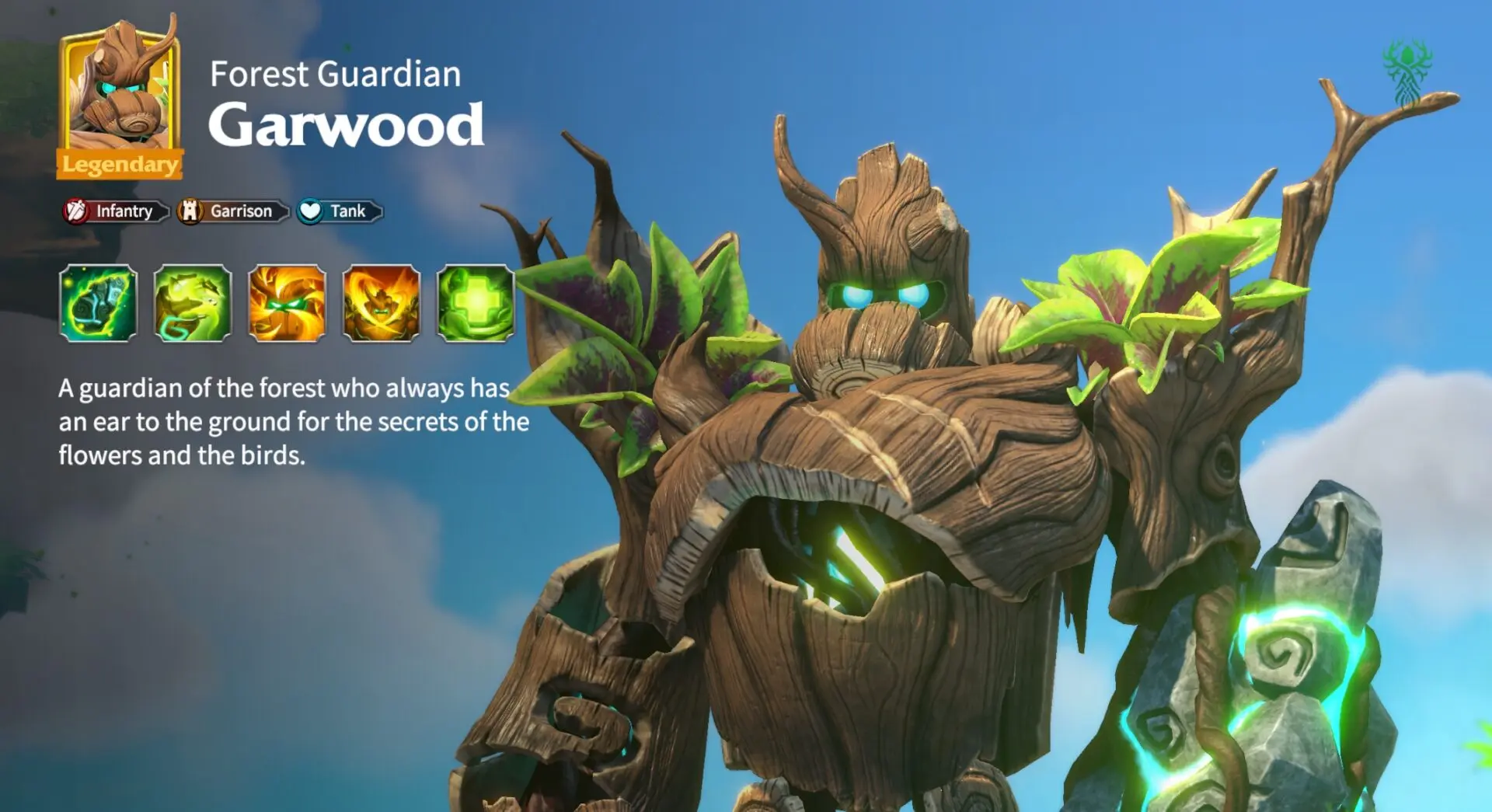
Garwood is a Legendary Infantry Tank hero in Call of Dragons built around healing, damage reduction, Infantry DEF, and sustained frontline combat. His ability to recover lightly wounded units while reducing incoming damage makes him particularly effective when your objective is to survive long engagements rather than chase maximum burst damage.
His real gameplay is very different from older descriptions involving Shield Bash, Earthquake Smash, stun combos, armor sets, or manual Q/W/E abilities. Garwood instead relies on Rage Skills, passive Infantry bonuses, healing interactions, Resistance, and the Call of Dragons talent system.
This guide explains the best Garwood talent tree, his actual skills, recommended skill investment, PvE and open-field builds, garrison setup, hero pairings, Artifacts, War Pets, and practical strategies for using him effectively.
Garwood at a Glance
- Rarity: Legendary
- Faction: Springwardens
- Race: Ironbark Treant
- Unit Specialization: Infantry
- Map Specialization: Garrison
- Team Role: Tank
- Primary Strength: Healing and sustained durability
- Best General Use: PvE/Behemoth tanking and durable Infantry formations
- Secondary Use: Situational open-field and garrison defense
- Recommended Talent Direction: Tank + Infantry
Who Is Garwood in Call of Dragons?
Garwood, the Forest Guardian, is one of the original Legendary Infantry commanders in Call of Dragons.
His kit revolves around an unusually simple but effective loop:
Take Damage → Cast Revitalizing Rune → Heal → Gain Resistance → Trigger Physical Damage Buffs → Continue Tanking
Unlike a burst hero who wants to eliminate an enemy quickly, Garwood gains value by staying alive long enough for this cycle to repeat.
That makes him particularly suitable for:
- Behemoth tanking.
- Long PvE engagements.
- Defensive Infantry formations.
- Situational garrison defense.
- Open-field marches built around sustain.
Garwood’s main limitation is offensive pressure. He can become surprisingly dangerous once his healing triggers Thistles and Thorns, but damage is still secondary to keeping the Legion alive.
Is Garwood Good in Call of Dragons?
Garwood is good when used for the role his kit actually supports: tanking and sustained Infantry combat.
His major strengths include:
- Healing Factor up to 1,200 before Awakening.
- 20% damage reduction after his Rage Skill at maximum level.
- Up to 20% Infantry DEF.
- Up to 30% stronger healing interactions.
- Up to 30% increased Physical damage when his healing-based passive activates.
- Additional Garrisoned Army HP.
- Strong synergy with other tank and healing heroes.
- Excellent endurance in PvE and sustained battles.
His weaknesses are equally important:
- Low burst damage compared with dedicated damage heroes.
- One passive is restricted specifically to garrison defense.
- Infantry mobility is naturally lower than Cavalry.
- Heavy Legendary investment can be difficult to justify for players focused purely on modern open-field PvP.
- Later-generation Infantry heroes can offer stronger specialized PvP performance.
Garwood should therefore be viewed as a specialized sustain hero, not automatically as the best Infantry investment for every account.
Garwood Skills Explained
The old abilities Shield Bash, Fortress Stance, Earthquake Smash, Barrier Up, and similar action-RPG skills are not part of Garwood’s documented Call of Dragons kit.
His actual skills are:
| Skill | Type | Main Effect |
|---|---|---|
| Revitalizing Rune | Rage Skill | Heals lightly wounded units and grants Resistance, reducing all damage taken temporarily. |
| Tempered Bark | Passive / Garrison | Increases the HP of a Garrisoned Army while defending a City or Stronghold. |
| Call of the Ancient Tree | Passive | Increases Infantry DEF and improves healing involving Infantry units in Garwood’s Legion. |
| Thistles and Thorns | Passive | Healing Garwood’s Legion has a chance to temporarily increase Physical damage dealt. |
| Lifestone | Awakening | Enhances Revitalizing Rune with stronger healing and a longer Resistance duration. |
Revitalizing Rune
Revitalizing Rune is the foundation of Garwood’s entire build and should receive your first skill priority.
The Rage Skill heals lightly wounded units in Garwood’s Legion and grants Resistance, temporarily reducing all incoming damage.
Its upgrade progression is:
- Healing Factor: 500 / 650 / 800 / 1,000 / 1,200
- Damage Taken Reduction: 10% / 12% / 14% / 16% / 20%
- Resistance Duration: 4 seconds
At maximum level, Garwood therefore restores a substantial portion of lightly wounded troops while taking 20% less damage for the following four seconds.
This combination is considerably more useful than healing alone.
The healing returns troops to active combat, while Resistance makes it harder for the enemy to immediately remove those recovered units again.
Important: Garwood heals lightly wounded units still associated with the Legion. He cannot magically return severely wounded troops that have already been removed from the active fight.
Tempered Bark
Tempered Bark is Garwood’s dedicated Garrison skill.
When Garwood is part of an Army garrisoned inside a City or Stronghold, the Garrisoned Army receives additional HP.
The bonus increases through:
- 2%
- 4%
- 6%
- 8%
- 10% at maximum level
This is a useful defensive bonus, but the restriction matters enormously.
Tempered Bark provides no direct open-field value when Garwood is marching around the map.
Players who primarily use Garwood for PvE tanking or open-field combat should therefore avoid evaluating his second skill as though it contributes to every battle.
Call of the Ancient Tree
Call of the Ancient Tree is one of Garwood’s most important general-combat passives.
At maximum level, Infantry units in his Legion gain:
- 20% DEF.
- Up to 30% stronger healing interactions.
This explains why Garwood should normally command a full Infantry Legion.
The DEF bonus helps his troops survive incoming pressure, while the healing amplification strengthens the mechanic around which his entire kit is built.
Using random troop types sacrifices part of this passive and weakens the synergy between Revitalizing Rune and the rest of Garwood’s build.
Thistles and Thorns
Garwood is defensive, but healing can also turn into offensive pressure.
Whenever his Legion is healed, Thistles and Thorns has a 75% chance to increase Physical damage dealt for five seconds.
The Physical damage bonus scales through:
- 10%
- 15%
- 20%
- 25%
- 30% at maximum level
This mechanic creates one of Garwood’s most important synergies:
Receive Healing → Trigger Thistles and Thorns → Gain Physical Damage → Continue Fighting
That means additional healing from a partner or other compatible effect can potentially contribute to both survivability and damage.
Lifestone
Lifestone is Garwood’s Awakening and directly enhances Revitalizing Rune.
After Awakening:
- Healing Factor increases to 1,400.
- Resistance remains at 20% damage reduction.
- Resistance duration increases from 4 to 6 seconds.
The longer Resistance duration is particularly important because it extends the amount of time Garwood can continue absorbing pressure after each Rage Skill.
For a dedicated Garwood tank, Awakening is a meaningful improvement rather than a minor numerical bonus.
Best Garwood Skill Order
The first priority is simple:
Max Revitalizing Rune First
Budget Garwood: 5-1-1-1
A 5-1-1-1 Garwood is a useful budget checkpoint because Revitalizing Rune already provides:
- Healing Factor 1,200.
- 20% damage reduction.
- Four seconds of Resistance.
This gives you most of Garwood’s defining active utility without immediately making a massive Legendary investment.
Open-Field / PvE Target: 5-1-5-5
For players who can develop the relevant skills selectively, 5-1-5-5 is an attractive field-oriented target.
The logic is straightforward:
- Skill 1: maximum healing and Resistance.
- Skill 2: remains low because it only affects garrison combat.
- Skill 3: maximum Infantry DEF and healing synergy.
- Skill 4: maximum Physical-damage bonus after healing.
This configuration captures Garwood’s strongest open-field and PvE mechanics while minimizing investment in his most situational skill.
Your actual upgrade path can depend on how skill upgrades are available on your account, so treat 5-1-5-5 as a target configuration rather than assuming every upgrade will land perfectly.
Dedicated Garrison Garwood
If Garwood is genuinely part of your City or Stronghold defense strategy, Tempered Bark becomes relevant and a fully developed build makes more sense.
A committed garrison player can therefore justify:
5-5-5-5 + Lifestone
Players who never garrison should be more cautious about the extra investment.
Best Garwood Talent Tree
Garwood has access to Infantry, Garrison, and Tank talent specializations.
There is no single build that is best for every game mode.
PvE / Behemoth Tank: Tank + Infantry
Open-Field Sustain: Tank + Infantry
City / Stronghold Defense: Garrison + Tank
Garwood Tank Talent Tree
The Tank tree is the best foundation for Garwood’s most natural role.
Prioritize talents that improve:
- Legion HP.
- Damage reduction.
- Normal attack damage reduction.
- Counterattack survivability.
- Healing efficiency.
- General frontline durability.
The goal is not to chase the largest damage number. Your objective is to keep Garwood alive long enough to activate Revitalizing Rune repeatedly.
Garwood Infantry Talent Tree
The Infantry tree complements Garwood’s troop-specific passive.
Prioritize bonuses to:
- Infantry HP.
- Infantry DEF.
- Physical ATK.
- Counterattack performance.
- Normal attack performance.
- Infantry survivability.
Tank + Infantry is therefore the most natural combination for Behemoths, PvE tanking, and general sustain-focused field play.
Garwood Garrison Talent Tree
A Garrison build should only be used if Garwood is actually defending a City or Stronghold.
Prioritize:
- Garrisoned Army HP.
- Garrison damage reduction.
- DEF.
- Healing and sustain.
- Counterattack performance.
- Useful Tank bonuses.
Tempered Bark already rewards garrison use with additional HP, so the Garrison tree reinforces an existing part of the kit.
Talent Tip: Do not use a Garrison talent tree simply because Garwood has the Garrison specialization. If most of your Garwood gameplay is Behemoths or open field, Tank + Infantry provides much more relevant value.
Best Garwood Build for Behemoths and PvE
Garwood’s strongest long-term niche is often tanking PvE damage.
For a Behemoth or extended PvE setup:
- Use Tank + Infantry talents.
- Field a full Infantry Legion.
- Prioritize HP, DEF, and healing.
- Use Revitalizing Rune to keep lightly wounded troops active.
- Choose a secondary hero that adds shields, healing, or additional tank mechanics.
- Avoid sacrificing durability simply to increase theoretical DPS.
The longer the fight lasts, the more opportunities Garwood receives to heal and trigger Thistles and Thorns.
This is exactly the kind of battle where his sustain-oriented design produces value.
Best Hero Pairings for Garwood
Madeline + Garwood
Madeline + Garwood is one of the classic defensive Infantry pairings.
Madeline contributes strong HP, shields, counterattack mechanics, and tanking utility while Garwood provides:
- Healing.
- Resistance.
- Infantry DEF.
- Healing amplification.
- Additional Physical damage after healing.
The pairing is excellent when your priority is survivability rather than burst damage.
For open-field combat, Madeline can make sense as primary when her PvP/Tank talents are the better match. For pure Tank or PvE-oriented setups, Garwood can lead when his Tank + Infantry talent tree provides the desired build.
Skogul + Garwood
Skogul is one of the more interesting later-generation partners for Garwood.
Skogul brings Infantry HP, Physical ATK, counterattack pressure, mobility, and conditional healing. Garwood contributes additional healing and damage reduction.
The two mechanics complement each other particularly well because:
- Garwood helps the Legion remain alive longer.
- Skogul benefits from sustained engagements.
- Healing can help activate Garwood’s Physical-damage passive.
- Both heroes reinforce Infantry durability.
This is a strong option for players who want a sustain-heavy frontline march rather than maximum initial burst.
Garwood is often the better primary for a pure Tank configuration, while Skogul can lead when her Infantry/Mobility talents are more important.
Garwood + Eliana
Eliana is an accessible support partner, particularly for newer accounts.
Her Divine Shield, normal-attack damage reduction, temporary DEF, and Awakening sustain combine naturally with Garwood’s healing.
This pairing offers:
- Shielding.
- Healing.
- Damage reduction.
- DEF bonuses.
- Excellent early PvE durability.
The disadvantage is damage. Garwood + Eliana can survive well but will usually kill targets more slowly than a formation containing a dedicated damage hero.
Garwood + Hosk
Hosk is a premium flexible alternative.
His Overall specialization and Legion-wide buffs can increase Garwood’s HP, ATK, damage, and troop capacity while Garwood provides the sustain.
If Hosk is Deputy, Battle-Scarred can also supply a large normal-attack damage bonus.
This pairing is generally more relevant to established or higher-investment accounts because Hosk himself requires significant Legendary development.
Garwood + Bakhar
Bakhar is a more accessible Infantry alternative when your stronger tank partners are unavailable.
He provides straightforward Infantry combat value and additional damage while Garwood handles much of the sustain.
It can work during early progression, but mature Infantry rosters usually have stronger specialized combinations available.
Best Troops for Garwood
Use Infantry units.
Call of the Ancient Tree specifically improves Infantry DEF and healing interactions, so mixed armies sacrifice a major part of Garwood’s combat value.
A full Infantry formation gives you:
- Maximum DEF from Garwood’s third skill.
- Maximum synergy with Infantry talents.
- Better compatibility with Infantry partners.
- Better compatibility with Infantry Artifacts.
- A natural frontline troop profile.
Garwood’s second skill can buff all units in a Garrisoned Army, but that does not make random mixed troops optimal for his normal Legion.
Best Artifacts for Garwood
Garwood wants an Artifact that reinforces Infantry durability, healing, counter-pressure, or garrison defense.
| Artifact | Best Use |
|---|---|
| Dragonscale Armor | General Infantry Tank and defensive open-field play. |
| Deathless Vines | Modern Infantry PvP / Control-oriented tank setup. |
| Springs of Silence | More aggressive Infantry PvP option. |
| Breath of the Forest | Dedicated Garrison / Support configuration. |
| Butcher’s Blade | Accessible Epic Infantry alternative. |
Dragonscale Armor
Dragonscale Armor is one of the safest general-purpose choices for Garwood.
It fits Infantry/Tank builds and complements the exact thing Garwood wants to do: remain under pressure without collapsing.
It is particularly natural with pairings such as Madeline + Garwood.
Deathless Vines
Deathless Vines is a modern Legendary Infantry PvP/Control option and can work well in durable open-field formations.
It is particularly interesting when you already own a developed version and want Garwood or his Infantry partner to remain active during longer player-versus-player engagements.
Springs of Silence
Springs of Silence is a more aggressive option when your Garwood formation has enough durability and you want the Artifact slot to contribute additional offensive pressure.
Breath of the Forest
If Garwood is being built specifically around garrison defense, Breath of the Forest becomes more relevant because its specialization matches that role.
Do not choose it for general open-field play simply because Garwood himself has a Garrison specialization.
Butcher’s Blade
Butcher’s Blade provides an accessible Infantry alternative for players who do not yet have a suitably developed Legendary Artifact.
A highly upgraded Epic Artifact can be more useful than forcing an undeveloped Legendary option into the build.
Best War Pet for Garwood
Garwood has two particularly logical War Pet directions: punishing enemies for attacking him or reinforcing his healing-based sustain.
Venomous Lizard
Venomous Lizard is one of the strongest practical choices for an open-field Garwood tank.
Its Infection mechanic can punish enemy Legions when Garwood is hit by normal attacks.
This fits his gameplay because Garwood is naturally expected to:
- Receive enemy focus.
- Remain in combat for extended periods.
- Survive repeated normal attacks.
- Use defensive durability to create counter-pressure.
Useful Venomous Lizard builds can also incorporate counterattack, Rage, healing, and tank-oriented pet skills depending on the individual pet you own.
Striped Bear
Striped Bear is the more obvious healing/sustain alternative.
Its Friendship mechanic interacts with Hero Skill healing and can provide additional HP-oriented value, making it thematically and mechanically compatible with Garwood’s healing-heavy style.
Use Striped Bear when your goal is to make the Legion harder to remove rather than generate additional counter-pressure.
Which Garwood War Pet Is Better?
Choose:
- Venomous Lizard: for open-field tanking, reactive damage, and counter-pressure.
- Striped Bear: for healing-oriented sustain and additional durability.
The individual pet’s attributes and acquired skills can matter more than the species name alone.
War Pet Tip: Do not replace a well-developed Venomous Lizard with a poor Striped Bear simply because one guide labels the latter as a healing pet. Compare the actual attributes and acquired skills on your account.
How to Play Garwood Effectively
1. Let Garwood Do What He Is Built to Do: Tank
Garwood’s biggest value comes from surviving pressure.
Do not evaluate him solely by damage reports.
A successful Garwood Legion can:
- Keep enemies occupied.
- Absorb attacks that would otherwise hit fragile allied Legions.
- Recover lightly wounded units.
- Reduce incoming damage.
- Remain active longer than a more offensive formation.
Those benefits can matter significantly during coordinated alliance combat and PvE encounters.
2. Keep a Full Infantry Legion
Call of the Ancient Tree makes Infantry the natural choice.
Using mixed troops reduces the effectiveness of Garwood’s troop-specific DEF and healing bonuses.
3. Fight Near Allied Damage Dealers
A tank that survives forever but accomplishes nothing can still lose the strategic fight.
Keep Garwood close enough to allied Marksman, Magic, Cavalry, or offensive Infantry Legions that they can punish enemies committing attacks into him.
Your goal is to make focusing Garwood an expensive decision for the opponent.
4. Do Not Chase Fast Enemies
Garwood is an Infantry Tank hero, not a Mobility commander.
Chasing Cavalry across the map can pull your Legion away from:
- Allied support.
- Objectives.
- Ranged damage dealers.
- Better defensive positioning.
Hold useful ground instead of turning every retreat into a chase.
5. Use Healing to Create Offensive Windows
Thistles and Thorns means Garwood becomes more dangerous after receiving healing.
When its Physical-damage bonus activates, remain engaged if the situation is favorable instead of automatically retreating simply because you recently took damage.
The hero’s kit is deliberately designed to convert recovery into another window of combat pressure.
6. Avoid Unnecessary Swarms
Garwood is difficult to kill, but no tank is immortal.
If too many enemy Legions surround him, healing and Resistance may no longer compensate for incoming damage.
Retreat before:
- Your troop count collapses.
- You become completely separated from allies.
- Multiple high-damage Legions focus you simultaneously.
- The objective you were protecting is already lost.
Surviving is valuable only when it serves the larger battle.
7. Use Garwood Against Behemoths
Long PvE encounters are one of the situations where Garwood’s healing-heavy design performs particularly well.
A dedicated Tank + Infantry build can repeatedly absorb damage while your alliance’s stronger offensive Legions handle the majority of DPS.
8. Do Not Waste Garrison Talents in Open Field
Tempered Bark and Garrison talents are conditional.
If you spend nearly all your time outside a City or Stronghold, build around Tank and Infantry instead.
Is Garwood Worth Investing In?
Garwood is worth considering when your account specifically needs an Infantry tank or PvE sustain commander.
He becomes more attractive when:
- You regularly tank Behemoths.
- Your alliance needs durable PvE frontlines.
- You already own Madeline or Skogul.
- Your Infantry technology is well developed.
- You own a strong defensive Infantry Artifact.
- You have a useful Venomous Lizard or Striped Bear.
- Garwood is already partially developed.
- You occasionally need Garrison flexibility.
Heavy investment is less attractive when:
- You are free-to-play with scarce Legendary resources.
- Your priority is maximum open-field damage.
- You already have stronger later-generation Infantry pairings.
- You rarely use Garwood for PvE or garrison content.
A 5-1-1-1 Garwood can already provide meaningful tank utility, allowing you to test whether the hero genuinely fills a role on your account before committing further resources.
Players comparing the progression required to develop an entire Infantry roster from the beginning with starting from a more established setup may also review a call of dragons account for sale, although Garwood’s actual performance still depends on his skills, Infantry technology, partner, Artifact, War Pet, and how effectively the Legion is positioned.
Common Garwood Build Mistakes
- Using fictional Q/W/E abilities: Shield Bash, Fortress Stance, Earthquake Smash, and Barrier Up are not Garwood’s documented skills.
- Looking for armor and weapons: Call of Dragons heroes use Artifacts rather than RPG equipment such as Guardian Armor or Iron Shields.
- Expecting stuns and immobilization: Garwood’s real kit is based around healing, Resistance, Infantry DEF, and sustained Physical damage.
- Using mixed troops: Call of the Ancient Tree specifically rewards Infantry.
- Ignoring Revitalizing Rune: The first skill is the foundation of Garwood’s build and should receive priority.
- Maxing Tempered Bark for open field: The second skill only provides its direct benefit while garrisoned in a City or Stronghold.
- Ignoring Thistles and Thorns: Healing can also produce a major Physical-damage bonus.
- Building Garrison talents for Behemoths: Use Tank + Infantry when Garwood is not actually garrisoning.
- Expecting top-tier burst damage: Garwood’s purpose is survival and sustain.
- Chasing Cavalry: Stay near allies and objectives rather than wasting Infantry positioning.
- Allowing an unnecessary full surround: Healing and Resistance still have limits.
- Overinvesting immediately: A 5-1-1-1 Garwood already allows you to test whether his role is valuable to your account.
FAQ
What is the best Garwood talent tree in Call of Dragons?
For PvE, Behemoths, and general tanking, the best Garwood talent tree combines Tank and Infantry. Use Garrison + Tank only when Garwood is specifically defending a City or Stronghold.
What are Garwood’s real skills?
Garwood’s documented skills are Revitalizing Rune, Tempered Bark, Call of the Ancient Tree, Thistles and Thorns, and Lifestone.
What is the best Garwood skill order?
Max Revitalizing Rune first. A 5-1-1-1 build is a useful budget checkpoint, while players focused on field combat can aim toward a configuration emphasizing the first, third, and fourth skills. Dedicated garrison players receive more value from fully developing Tempered Bark.
Is 5-1-1-1 Garwood good?
Yes. A 5-1-1-1 Garwood already has Healing Factor 1,200 and 20% damage reduction from Revitalizing Rune, making him useful for players who want tank utility without immediately completing a full Legendary build.
Is 5-1-5-5 Garwood good?
It is an excellent theoretical field-oriented target because it maximizes Garwood’s healing, Infantry DEF, healing synergy, and Physical-damage buff while leaving the garrison-specific second skill low. Your actual skill-upgrade progression may affect how easily you can reach that exact distribution.
How much does Garwood heal?
A maximum-level Revitalizing Rune has a Healing Factor of 1,200. After Awakening and unlocking Lifestone, the enhanced skill reaches Healing Factor 1,400.
How much damage reduction does Garwood provide?
At maximum level, Revitalizing Rune grants 20% damage reduction for four seconds. Lifestone extends the Resistance duration to six seconds after Awakening.
Who is the best hero to pair with Garwood?
Madeline remains one of Garwood’s strongest classic tank partners. Skogul is a strong later-generation sustain option, while Eliana provides an accessible defensive pairing. Hosk can also work as a premium universal partner.
Is Garwood good with Skogul?
Yes. Garwood’s healing and damage reduction help Skogul remain in combat long enough to benefit from her sustained Infantry and counterattack mechanics. The combination is particularly good when survivability is more important than initial burst damage.
Is Garwood good with Madeline?
Yes. Madeline + Garwood creates an extremely durable Infantry formation through shields, healing, HP, damage reduction, and defensive bonuses. It is particularly effective for PvE and sustained frontline combat.
What troops should Garwood use?
Use a full Infantry Legion. Call of the Ancient Tree specifically increases Infantry DEF and improves Garwood’s healing-related performance.
What is the best Artifact for Garwood?
Dragonscale Armor is a strong general Infantry Tank option. Deathless Vines is useful for durable PvP/Control setups, Springs of Silence offers a more aggressive direction, and Breath of the Forest is better suited to dedicated garrison use.
What is the best War Pet for Garwood?
Venomous Lizard is a strong open-field tank option because it can punish attackers, while Striped Bear is a natural alternative for healing and sustain. Choose according to your pet’s actual attributes and acquired skills.
Is Garwood good for PvP?
Garwood can work in durable open-field Infantry formations, particularly with partners such as Madeline or Skogul, but his strongest niche is sustain rather than modern burst-heavy PvP. Players focused exclusively on competitive open field should compare him with later-generation Infantry options before heavy investment.
Is Garwood good for Behemoths?
Yes. Behemoth tanking is one of Garwood’s strongest uses because long PvE engagements allow Revitalizing Rune, Resistance, Infantry DEF, and repeated healing to provide substantial value.
Is Garwood good for garrison defense?
Garwood has a genuine Garrison specialization. Tempered Bark provides up to 10% additional Garrisoned Army HP while defending a City or Stronghold. Whether he should be your primary garrison commander depends on your current season and the stronger defensive heroes available on your account.
Is Garwood worth Awakening?
Awakening is worthwhile for players committed to using Garwood as a major tank. Lifestone increases his healing to Healing Factor 1,400 and extends his 20% Resistance from four to six seconds. Players with limited Legendary resources should first decide whether Garwood will remain part of their long-term Infantry roster.
Conclusion
The best Garwood talent tree for most practical situations combines Tank and Infantry. Garwood’s real strength is not crowd control, manual ability combos, or traditional RPG armor—it is his ability to heal lightly wounded Infantry, reduce incoming damage, improve DEF, and convert healing into additional Physical damage.
Prioritize Revitalizing Rune, field a full Infantry Legion, and build around enough HP and DEF to let Garwood remain active through repeated Rage Skill cycles. A 5-1-1-1 setup is already useful, while deeper investment into Call of the Ancient Tree, Thistles and Thorns, and eventually Lifestone significantly improves a dedicated tank build.
Pair Garwood with Madeline for a classic defensive formation, Skogul for sustained later-generation Infantry pressure, or Eliana when you need a more accessible defensive partner. Dragonscale Armor remains a natural tank Artifact, while Venomous Lizard and Striped Bear offer different approaches to War Pet synergy.
Garwood is at his best when the battle lasts long enough for his healing and damage reduction to matter. Use him to tank Behemoths, hold useful frontline positions, protect stronger damage Legions, and survive engagements that would force more fragile commanders to retreat.