
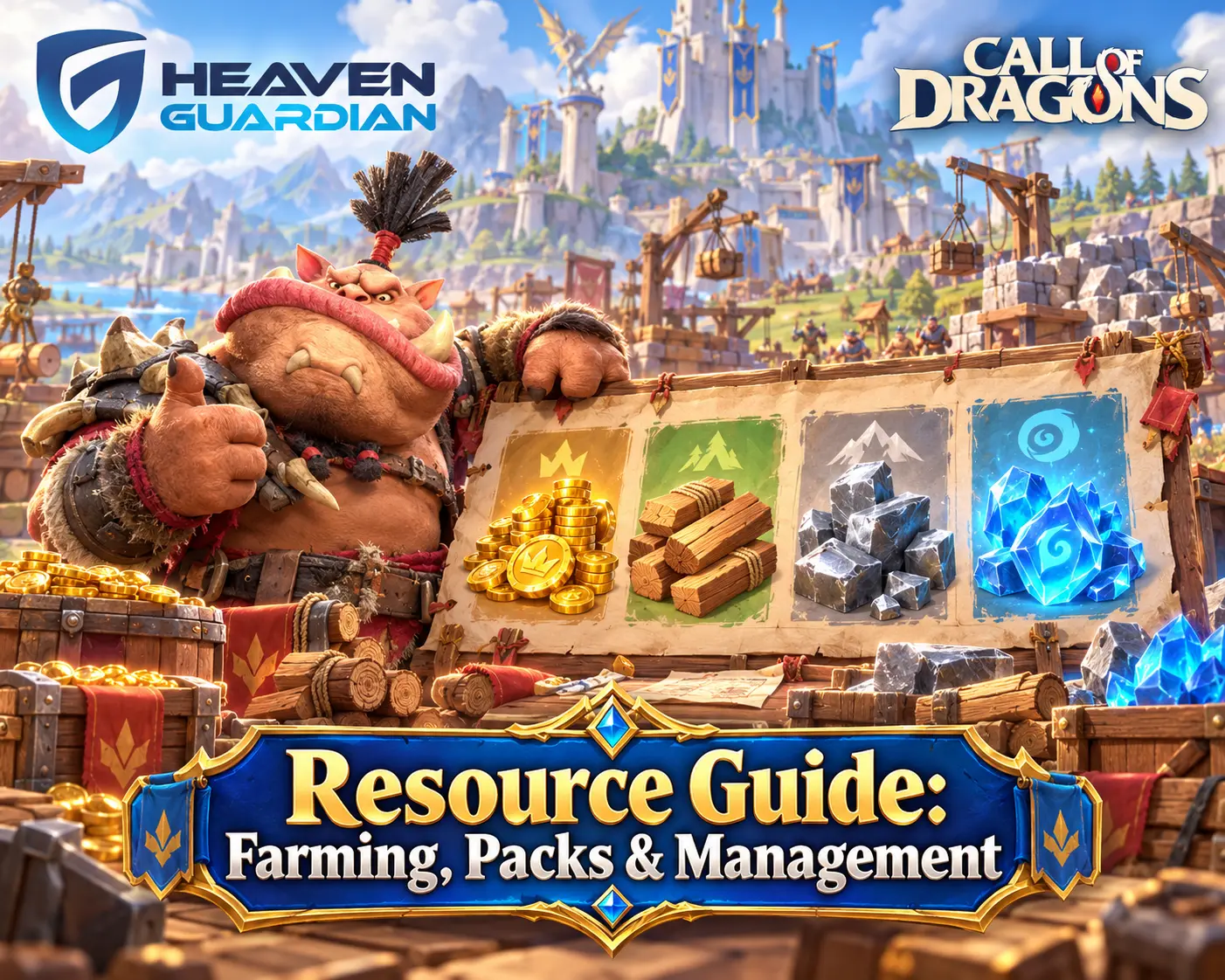
Call of Dragons Resources at a Glance
| Resource | Common Uses | General Priority |
|---|---|---|
| Gold | Buildings, research, training, healing, and progression costs | High throughout the game |
| Wood | Buildings, technology, troops, and general development | Very high during growth |
| Ore | Higher-level construction, research, military progression, and healing | Increasingly important later |
| Mana | Advanced progression and increasingly expensive troop recovery | Critical from mid-to-late game |
How Resources Work in Call of Dragons
Your account can obtain resources from several different systems:- Resource Points on the world map.
- City resource buildings.
- Main and Side Quests.
- Daily and seasonal activities.
- Alliance rewards and territory.
- Resource items and choice chests.
- Events and Exchange systems.
- Farm accounts.
- Other seasonal or progression rewards.
What Are Resource Packs and Resource Items?
Players often use the term resource packs broadly for inventory items that grant a fixed amount of Gold, Wood, Ore, or Mana when consumed. These can include:- Fixed Gold resource items.
- Fixed Wood resource items.
- Fixed Ore resource items.
- Fixed Mana resource items.
- Choice resource chests that let you select the resource you need.
Terminology note: “Opening” or “using” resource items is clearer than “unlocking resource packs.” These items do not normally require a separate unlock mechanic before they can be consumed.
Should You Open Resource Packs Immediately?
Usually, no. Keeping resource items unused gives you greater control over how many exposed resources are sitting in your City. A better process is:- Choose the upgrade, training queue, research, or healing action you want to complete.
- Check the exact resource shortage.
- Gather or collect free sources first when practical.
- Consume only enough resource items to cover the remaining gap.
- Spend those resources immediately.
Why You Should Avoid Opening Everything
Opening every resource item at once can create several problems:- You may expose more resources than your Storehouse protects.
- You lose the flexibility of choice-resource items.
- You may convert resources you will not need for several days.
- You may discover that the real bottleneck is speedups rather than resources.
- You have less emergency reserve after a large battle.
Best Times to Use Resource Packs
1. Immediately Before an Important Building Upgrade
High-level buildings consume increasingly large amounts of resources. If gathering and City production do not cover the requirement, use resource items to fill the exact shortage shortly before starting the upgrade. This is especially useful for progression-blocking buildings such as City Hall prerequisites and military or technology buildings.2. Immediately Before Major Research
Technology becomes increasingly expensive. Use stored items when an important research project is ready but your available balance is short. Avoid consuming a large reserve several hours or days before the research queue becomes available.3. Before Large Troop Training or Promotion
Large military queues can consume substantial resources. Resource items are useful when you already have the training capacity, speedups, or event objective needed to justify the spending. Do not confuse Training Speed with resource efficiency. A Training Speed bonus shortens the timer; it does not multiply the resources obtained from inventory items.4. After Heavy PvP When Healing Becomes Expensive
Large battles can produce major resource requirements for troop recovery. Keep a meaningful inventory reserve before important wars so you can recover without exhausting every exposed resource in your City. Mana becomes particularly important as accounts mature and recovery costs rise.5. During Resource-Spending Events
Sometimes an event or seasonal activity rewards actions that already require resources, such as training or progression. The efficient approach is to combine objectives:- Complete an upgrade you already needed.
- Spend resources you would eventually spend anyway.
- Use speedups only when the reward is worthwhile.
- Collect event rewards without creating unnecessary resource consumption.
6. When You Need an Emergency Reserve
Stored resource items are extremely useful after an unexpected battle, urgent technology requirement, or last-minute Alliance objective. Keeping some unopened gives your account liquidity without forcing you to gather the entire shortage from scratch.Call of Dragons Resource Farming
Resource items should supplement your economy—not replace ordinary gathering. Your main sustainable resource income comes from:- World-map Resource Points.
- Alliance territory gathering.
- Alliance Resource Centers.
- City production.
- Quests and challenges.
- Events.
- Daily rewards.
- Farm-account transfers when your account setup supports them.
Gather Every Day
Unused Legions represent lost economic opportunity. When you are not fighting, send available gathering marches to Resource Points rather than leaving every Legion inside the City. Long gathering sessions are particularly useful overnight or during periods when you cannot actively play.Best Gathering Heroes
Dedicated gathering heroes can improve resource efficiency through their skills and Gathering talent trees. Examples of gathering-oriented heroes include Indis and Pan, along with other heroes whose current talents or skills support gathering. The most important rule is:Only the primary hero’s talent tree is active. If your main gathering bonuses come from talents, place the developed Gathering hero in the primary slot.
- Gathering Speed.
- Load Capacity.
- March Speed while gathering or traveling.
- Extra resource rewards.
- Reduced downtime between gathering marches.
Gather Inside Alliance Territory
Alliance territory can improve gathering efficiency through Alliance technology and territorial bonuses. When possible, prioritize Resource Points located inside safe Alliance territory because you may benefit from:- Alliance gathering bonuses.
- Faster response from allied players.
- Shorter travel routes near your City.
- Access to Alliance Resource Centers.
How Gathering Boosts Actually Work
A Gathering Boost increases the speed at which your Legion collects resources from Resource Points. Use a Gathering Boost:- Before sending several gathering marches.
- Before a long overnight farming session.
- During gathering-focused events.
- When your Alliance controls high-level Resource Points or Resource Centers.
Resource Production Boosts
Production boosts affect resources generated by your City’s production buildings. They are different from Gathering Boosts and from inventory resource items.| Boost | What It Improves | Does It Increase Resource Pack Value? |
|---|---|---|
| Gathering Boost | Gathering speed from Resource Points | No |
| Resource Production Boost | City resource production | No |
| Construction Speed | Building completion time | No |
| Training Speed | Troop training time | No |
How to Protect Resources From Raids
The Storehouse protects a portion of your City resources from enemy looting. Resources above the protected amount can become much more vulnerable when your City is attacked successfully. That makes inventory resource items valuable because you can keep a substantial reserve outside your active City balance until it is required. A practical protection strategy is:- Keep most inventory items unopened.
- Know approximately how much your Storehouse protects.
- Avoid exposing huge balances before logging off during wartime.
- Consume resources shortly before spending them.
- Use Peace Shields when appropriate.
- Relocate away from vulnerable frontline territory if necessary.
Important: Not every resource entering your account follows identical Storehouse rules. For example, some resources obtained through looting or Resource Assistance have separate restrictions, so review the current Storehouse information in your client.
Which Resource Should You Farm?
There is no permanent answer because your bottleneck changes over time. Use this priority:- Check your next major upgrade or research project.
- Compare your available balances.
- Check healing requirements before major wars.
- Send gathering marches to the resource with the largest upcoming shortage.
- Reassess every few days instead of farming one resource indefinitely.
Gold
Gold remains important throughout progression. Farm it aggressively when research, buildings, military development, or recovery begins consuming your reserves faster than they regenerate.Wood
Wood is heavily used during City development and technology progression. Growing accounts can burn through large Wood reserves rapidly.Ore
Ore becomes an increasingly important bottleneck during advanced development. Do not allow your Ore reserve to fall far behind simply because Wood and Gold are easier to accumulate.Mana
Mana becomes increasingly important as the account matures, especially for players who participate heavily in PvP and face expensive troop recovery. Starting a dedicated Mana reserve before the shortage becomes severe is usually easier than trying to solve it after a major war.Call of Dragons Mana Farming
Mana deserves its own plan because many early accounts underestimate how important it becomes later. A practical Mana strategy is:- Begin gathering Mana consistently before late-game demand peaks.
- Keep Mana choice-resource items unopened until needed.
- Use farm accounts to support Mana shortages when permitted by your account setup.
- Avoid wasting Mana on actions that are not currently progression-critical.
- Build a war reserve before major PvP periods.
Are Farm Accounts Worth Using?
A farm account is a secondary account or character focused heavily on resource production and gathering rather than competitive combat. Farm accounts can be valuable for active players who repeatedly run short of resources, particularly once the main account reaches expensive research, troop, and healing stages.What a Farm Account Should Prioritize
- Gathering heroes.
- Gathering talents.
- Load Capacity.
- Resource production.
- Gathering Speed.
- Alliance resource bonuses.
- Only enough military development to gather safely and function efficiently.
Alliance Resource Centers
Alliance Resource Centers are shared gathering locations that contain large reserves of a selected resource. When available, they can be valuable because:- Many members can gather from the shared location.
- The reserves can be much larger than ordinary Resource Points.
- They reduce the need to search constantly for individual nodes.
- They support the Alliance’s overall resource economy.
Best Ways to Get More Resources
| Method | Best For | Cost |
|---|---|---|
| World Gathering | Sustainable daily income | Time and Legion availability |
| Quests & Challenges | Early progression and daily rewards | Gameplay activity |
| Alliance Resource Centers | Large gathering sessions | Alliance access |
| Events | Resource items and bonus rewards | Varies by event |
| City Production | Passive income | Building investment |
| Farm Account | Long-term high resource demand | Additional playtime |
| Store / Exchange Options | Urgent shortages | Gems, event currency, or purchases depending on source |
Should You Buy Resources With Gems?
Usually, direct resource purchases should not be your first use of valuable Gems. Before spending Gems on resources, check whether the shortage can be solved through:- Inventory resource items.
- Gathering.
- Alliance Resource Centers.
- Events.
- Daily rewards.
- Farm-account resources.
Planning Resources for Major Upgrades
Before starting an expensive progression push, calculate the entire sequence rather than only the next building. For example:- Identify the target City Hall or research milestone.
- List prerequisite buildings or technologies.
- Estimate the Gold, Wood, Ore, and Mana needed.
- Compare the requirement with your active and inventory reserves.
- Farm the largest expected shortages first.
- Confirm you also have enough speedups.
- Open resource items only as each step becomes available.
Resource Management Before War
Resource strategy changes before a major Alliance war. Before heavy PvP:- Build a healing reserve.
- Keep inventory items unopened.
- Gather Mana and other expected bottlenecks.
- Finish unnecessary exposed-resource spending beforehand.
- Avoid holding massive unprotected City balances.
- Confirm whether your Alliance has Resource Centers or resupply plans.
Resource Packs vs Speedups
Resources and speedups solve different bottlenecks. A resource item gives you the Gold, Wood, Ore, or Mana needed to begin an action. A speedup reduces or removes the time required for that action. You need both for rapid progression.| Situation | Real Bottleneck |
|---|---|
| Upgrade available but resource balance is too low | Resources |
| Resources available but construction takes several days | Speedups |
| Resources and speedups available but prerequisite missing | Progression requirement |
| Large PvP recovery after war | Resources and healing capacity |
Common Resource Management Mistakes
- Opening every resource item immediately: Keep inventory reserves until the resources are actually needed.
- Calling the resources Food and Stone: Call of Dragons uses Gold, Wood, Ore, and Mana.
- Using Gathering Boosts before opening packs: Gathering boosts affect Resource Point collection, not inventory-item value.
- Assuming Construction Speed makes resources more efficient: It changes time, not resource cost or pack value.
- Ignoring Mana until late game: Build reserves before healing and advanced progression become expensive.
- Gathering one resource forever: Farm according to your next bottleneck.
- Ignoring Alliance territory: Alliance bonuses and Resource Centers can significantly improve farming efficiency.
- Leaving gathering Legions idle: Send them out when you are not actively fighting.
- Using the wrong primary gathering hero: Only the primary hero’s talents apply.
- Holding huge exposed balances before logging off: Spend or protect resources before dangerous periods.
- Buying resources with Gems too quickly: Exhaust cheaper or free resource sources first.
- Ignoring speedup shortages: More resources do not create faster progress when time is the actual bottleneck.
Players comparing established accounts with developed resource reserves, gathering heroes, troop tiers, and progression can review a call of dragons account for sale that clearly lists City progression, resources, heroes, troop tiers, current Season, and migration details. Verify every listing detail before deciding.