
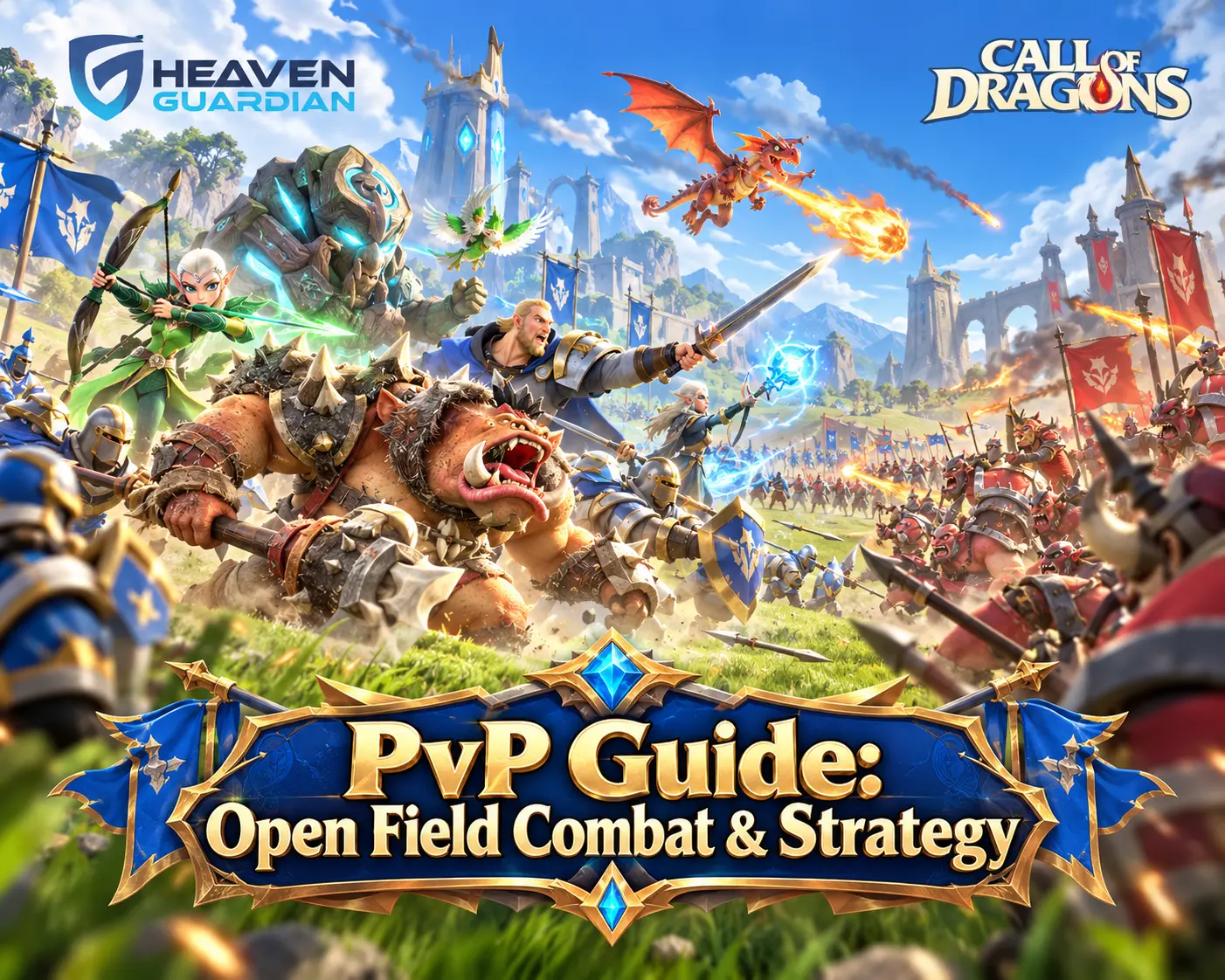
The biggest mistake new players make is treating every Legion as an independent damage dealer. Strong PvP formations have specific jobs. Infantry absorbs pressure, Cavalry threatens exposed backlines, Marksmen apply Physical ranged damage, Magic Legions pressure enemies from range, and specialized heroes add shields, healing, debuffs, control, counterattacks, or burst damage.
The goal is therefore not to create one supposedly unbeatable Legion. A strong PvP setup creates several compatible formations that support one another and can be repositioned according to the battlefield.
PvP Fundamentals at a Glance
| PvP Element | Why It Matters |
|---|---|
| Hero Pairing | Determines your Legion’s damage, sustain, control, and special mechanics. |
| Troop Type | Must match hero skills, talents, Artifacts, and formation role. |
| Positioning | Determines which Legions are exposed, protected, surrounded, or able to attack safely. |
| Attack Range | Controls how close your Legion must move before attacking or casting certain skills. |
| Rage Skills | Often provide the largest burst, control, shield, healing, or debuff effects. |
| Artifact | Adds stats and an active combat effect to the primary hero’s Legion. |
| War Pet | Adds another combat mechanic that should match your formation. |
| Focus Fire | Turns several average attacks into enough concentrated pressure to remove one target quickly. |
How PvP Works in Call of Dragons
Most large-scale PvP occurs through open-field Legion combat, rallies, garrisons, structure fights, Pass battles, territory wars, and seasonal objectives.
Open-field PvP gives you the most direct control over individual Legions. You can move, retarget, disengage, flank, chase, protect allies, or concentrate several Legions on one enemy.
Rallies and garrisons are different. They rely more heavily on specialized heroes, Rally or Garrison talents, reinforcement management, target selection, and the complete composition of the attacking or defending force.
Do not copy an open-field build automatically into a rally or garrison. A hero can be excellent in one role while losing an entire passive skill or talent category in another.
Build Full Single-Troop Legions
One of the most important Call of Dragons PvP rules is to match the troop type to your heroes.
Most combat heroes contain skills or talents that specifically strengthen:
- Infantry.
- Cavalry.
- Marksmen.
- Magic units.
If a hero provides 20% Infantry HP, for example, replacing part of that Legion with Magic or Cavalry units means those troops do not receive the same benefit.
The same issue can affect troop-specific talents, Artifact attributes, deputy skills, and War Pet synergy.
Avoid generic mixed formations: “Infantry + Archers” and “Cavalry + Spells” are not useful Call of Dragons build categories. Build around one compatible troop class unless a specific hero mechanic explicitly gives you a reason not to.
Call of Dragons Troop Roles in PvP
Infantry: Frontline and Counterattack Pressure
Infantry formations are generally the safest units to place closest to enemy pressure.
Depending on the heroes involved, Infantry can specialize in:
- High HP and DEF.
- Shields.
- Healing or sustain.
- Counterattack damage.
- Damage reduction.
- Protecting nearby ranged formations by occupying the frontline.
A durable Infantry Legion buys time for your Magic and Marksman formations to deal damage.
Cavalry: Mobility and Backline Pressure
Cavalry excels when movement determines the fight.
Use Cavalry to:
- Pressure exposed ranged Legions.
- Finish low-HP targets.
- Intercept enemies moving toward your backline.
- Punish isolated players.
- Flank groups instead of attacking directly through their frontline.
- Disengage before slower enemy formations surround you.
Fast movement does not mean Cavalry should charge every visible target. Running too far ahead of allied support is one of the fastest ways to lose a valuable Legion.
Marksmen: Physical Ranged Damage
Marksmen can produce extremely high sustained Physical damage, but they need protection.
Keep them:
- Behind the frontline.
- Near allied Infantry.
- Away from exposed flanks.
- Within range of the target caller’s priority enemy.
- Ready to move immediately when enemy Cavalry begins closing the distance.
Do not remain stationary just because the Legion is ranged. PvP positioning changes constantly.
Magic: Range, Hero Skills, and Area Pressure
Magic formations often combine long attack range with strong Hero Skill damage, debuffs, control, or area effects.
They are particularly useful when:
- Several enemies are grouped together.
- Your formation can attack safely behind allied Infantry.
- A Hero Skill can affect multiple targets.
- Your Alliance is fighting around a choke point or structure.
- You need to pressure enemies without placing every Legion in melee range.
Their value falls quickly when enemy mobility reaches them and they cannot reposition.
Understand the Primary and Deputy Hero Rule
Each combat Legion uses a primary hero and a deputy hero.
The choice matters because the primary hero determines several important parts of the formation, including the talent tree used by the Legion and the active Artifact slot.
The deputy still contributes eligible skills, which makes pair synergy extremely important.
When deciding who should be primary, ask:
- Which hero has the better talent tree for this battle?
- Which Artifact needs to be active?
- Does skill order matter for the pairing?
- Is one hero specialized for Mobility, PvP, Skills, Tank, Rally, or another required category?
- Which hero is sufficiently leveled to function as primary?
Do not automatically put your rarest or highest-Power hero in the primary position.
Hero Pairing Matters More Than Hero Rarity
Two individually strong Legendary heroes can create a weak formation when their troop requirements or mechanics conflict.
Good pairings usually share at least one of these characteristics:
- The same troop class.
- Compatible damage type.
- A shared debuff or buff mechanic.
- Matching Rage Skill timing.
- One hero compensating for the other’s weakness.
- Artifact or War Pet synergy.
- Compatible field, Rally, or Garrison roles.
Common Pairing Archetypes
| Pairing Style | Purpose |
|---|---|
| Damage + Damage | Maximum burst or sustained pressure when survivability is already sufficient. |
| Damage + Tank | Keeps a powerful attacker alive through additional Rage cycles. |
| Damage + Support | Adds shields, healing, buffs, Rage, or other utility. |
| Debuffer + Damage | Weakens an enemy before the main damage effects land. |
| Control + AoE | Keeps multiple enemies vulnerable to area damage and Alliance focus fire. |
Attack Range Is a PvP Resource
Range determines how close a Legion must be before it can apply pressure.
That means range can indirectly determine:
- How exposed your Legion becomes.
- Whether you can attack across allied frontlines.
- How easily enemy Cavalry can reach you.
- Whether an Artifact or Hero Skill can hit its intended target.
- How many enemies can retaliate against your position.
Do not look only at Damage Factor or ATK when evaluating PvP formations. A slightly weaker Legion that deals damage safely for a longer period can outperform a theoretically stronger formation that spends the fight running or dying.
Rage Skills and PvP Timing
Heroes do not use conventional MMO spell cooldown rotations. Their major combat abilities are generally tied to Rage and other in-game activation conditions.
Rage management matters because the next cast can provide:
- Large burst damage.
- Area damage.
- Healing.
- Shields.
- Slow.
- DEF Break or other debuffs.
- Damage reduction.
- Buffs that enable the next part of the pairing.
Instead of thinking “wait until the enemy’s cooldown is down,” think about Rage cycles, visible buffs/debuffs, Artifact readiness, positioning, and whether the target is about to disengage.
Artifacts in PvP
Artifacts replace the generic “gear” model used by many other games.
A strong PvP Artifact should match:
- The primary hero.
- The troop type.
- The formation’s damage or defensive mechanic.
- The actual battlefield role.
- Any required debuff, Rage, Passion, shield, range, or target condition.
Do not equip a Legendary Artifact only because it has higher rarity.
A developed Epic Artifact with the correct troop attributes and activation conditions can provide more useful value than an undeveloped Legendary Artifact whose skill rarely activates in your formation.
Only the Primary Artifact Matters
Do not design a formation assuming both heroes contribute active Artifacts. Build the Legion around the Artifact used by the primary hero.
War Pets in PvP
War Pets add another layer of formation specialization.
Different pets support different troop classes and mechanics, including:
- Infantry.
- Cavalry.
- Marksmen.
- Magic.
- Support formations.
- Debuffs.
- Rage generation.
- Hero Skill damage.
- Counterattack or other specialized mechanics.
Do not evaluate the species name alone.
A useful War Pet needs:
- A relevant talent.
- Compatible attributes.
- Useful learned skills.
- Enough stars or development.
- An activation condition your Legion can trigger consistently.
A highly developed compatible pet can outperform the theoretical best pet when the latter has poor attributes or incomplete skills.
Positioning Wins Open-Field Battles
The battlefield should usually have a rough structure:
Infantry → frontline
Magic and Marksmen → protected damage line
Cavalry → flanks, interception, pursuit, and backline pressure
That formation is not rigid, but it gives every troop type a useful starting role.
Do Not Stand Directly on Top of Allies
Area Hero Skills, War Pets, and Artifacts can punish tightly grouped Legions.
Stay close enough to receive support and focus the same targets, but leave enough spacing that one enemy area effect does not hit every Legion simultaneously.
Protect Your Flanks
A ranged formation can look safe while attacking forward but become extremely vulnerable when enemy Cavalry approaches from the side.
Watch the minimap and surrounding field instead of staring only at your current target.
Use Terrain
Terrain, narrow approaches, Alliance structures, Roads, rivers, cliffs, and other map features can affect movement and engagement angles.
Flying Legions can also use terrain differently from ground formations, which creates opportunities for flanking and repositioning.
Focus Fire: The Most Important Alliance PvP Habit
Five players attacking five different enemies usually create less pressure than five players attacking one appropriate target.
Focus fire lets your group:
- Remove enemy damage faster.
- Force an enemy to retreat.
- Convert debuffs into team-wide damage value.
- Reduce the number of enemy Rage Skills being generated against you.
- Create numerical advantages one target at a time.
Good Focus Targets
Priority targets can include:
- Overextended ranged Legions.
- Low-HP formations.
- Enemies separated from their group.
- High-impact damage or support formations.
- Targets already carrying valuable debuffs.
Do not waste time attacking the nearest durable Infantry Legion simply because it is easiest to click.
Know When to Retreat
Good PvP players disengage before a bad trade becomes catastrophic.
Retreat when:
- Your Legion is being focused by several enemies.
- Your frontline has collapsed.
- Enemy Cavalry has reached your ranged backline.
- You are too far from Alliance support.
- The objective is already lost.
- Your formation has taken enough damage that staying produces a poor hospital trade.
- You are chasing an enemy into a larger hostile group.
Retreating is not losing. Preserving a Legion allows you to recover, reposition, reinforce, and re-enter under better conditions.
Avoid Overextending
One of the easiest PvP mistakes to recognize is a fast Cavalry or Flying Legion that follows a low-HP target far beyond allied support.
The enemy may deliberately retreat toward:
- More allied Legions.
- A defensive structure.
- A choke point.
- A rally.
- A location where your escape route becomes blocked.
Ask one question before chasing:
“Will killing this target improve the actual battle?”
If the answer is no, return to formation.
Use Debuffs as Team Tools
Effects such as DEF Break, Slow, Feeble, HP Reduction, ATK reduction, Rage interference, and other control mechanics become more valuable when several allies attack the same target.
For example, lowering one enemy’s DEF is more valuable when five Physical Legions immediately attack that enemy than when the debuffer fights alone.
This is why support and control heroes can remain important even when their personal Damage Factor is lower than that of pure damage heroes.
Area Damage vs Single-Target Damage
Neither is universally better.
Area Damage Is Best When:
- Enemies are clustered.
- You are fighting around a Pass or structure.
- Several enemy Legions are already engaged.
- Your Artifact or War Pet can also affect multiple targets.
Single-Target Damage Is Best When:
- Your Alliance is focus firing.
- One high-value formation must die quickly.
- The enemy is isolated.
- You need to remove a rally, support, or damage threat before it can continue cycling skills.
Open-Field PvP Checklist
- Use compatible full troop classes.
- Check primary/deputy order.
- Equip an Artifact that actually matches the formation.
- Use a compatible War Pet.
- Keep Infantry near the frontline.
- Protect ranged formations.
- Keep Cavalry available for flanks and exposed targets.
- Attack the Alliance target caller’s target.
- Watch for enemy area damage.
- Maintain enough spacing between Legions.
- Do not chase too far.
- Retreat damaged formations before trades become inefficient.
- Watch your flanks.
- Use range instead of walking ranged units into melee pressure.
- Fight for the objective, not just kills.
PvP Around Alliance Objectives
Large fights usually happen for a reason.
The objective may be:
- A Pass.
- Alliance territory.
- An Alliance Tower.
- A Siege Bastion.
- A City.
- A Behemoth.
- A rally.
- A seasonal objective.
Winning the kill count while losing the actual objective can still mean losing the battle.
Before engaging, understand what your Alliance is trying to accomplish.
Rally PvP vs Open-Field PvP
Rally builds should not be treated as larger open-field Legions.
A rally may require:
- A dedicated Rally primary hero.
- Rally talents.
- An Artifact selected specifically for the rally.
- Compatible reinforcement troops.
- Continuous reinforcement.
- Alliance debuffs and surrounding pressure.
- Target-specific planning.
Do not launch a rally simply because you own strong heroes. The rally captain, deputy, Artifact, target, troop type, reinforcement quality, and surrounding field all matter.
Do Not Feed a Losing Rally
Damage reduction and healing can make a bad rally last longer without making it efficient.
Leadership should review battle performance and stop reinforcement when the trade is clearly unfavorable.
Garrison PvP
Garrison commanders need a different set of strengths from mobile open-field heroes.
Useful garrison mechanics can include:
- Garrison-specific damage reduction.
- Counterattack pressure.
- Healing or shields.
- Rally debuffs.
- Troop HP or DEF.
- Effects that activate specifically while garrisoned.
A powerful open-field hero may lose significant value inside a garrison if one or more field-only passives become inactive.
PvP Resource Management
PvP has an economic cost.
Heavy fighting can consume:
- Gold.
- Wood.
- Ore.
- Mana.
- Healing capacity.
- Speedups.
- Time spent rebuilding your usable fighting strength.
That means the best PvP decision is not always the one that produces the largest number of enemy wounded units.
Efficient players ask:
- Was this trade necessary?
- Did it help the Alliance objective?
- How much healing will it cost?
- Can I afford another fight after this one?
- Am I exchanging an expensive formation into an enemy who can recover more easily?
Players comparing developed PvP rosters can review a call of dragons account for sale that clearly lists hero skills, troop tiers, Artifacts, War Pets, City progression, current Season, and migration details. Verify every listing detail before deciding.
How to Improve at PvP Without Spending More
Better mechanics can improve PvP performance even when your account Power does not change.
Focus on:
- Stop mixing troop classes unnecessarily.
- Fix primary and deputy order.
- Use the correct Artifact.
- Improve War Pet synergy instead of chasing rarity alone.
- Learn your attack range.
- Move ranged Legions before Cavalry reaches them.
- Focus Alliance targets.
- Stop chasing low-HP enemies into bad positions.
- Retreat before your formation becomes critically damaged.
- Understand which debuffs your formation provides.
- Use terrain and structures.
- Practice controlling several Legions without letting them stack on top of each other.
Common Call of Dragons PvP Mistakes
- Using mixed troop formations: Most heroes and talents are designed around a specific troop class.
- Using incompatible hero pairs: Two strong heroes are not automatically a strong Legion.
- Ignoring primary/deputy order: Your talent tree and Artifact strategy depend on the primary.
- Searching for conventional gear: Call of Dragons heroes use Artifacts rather than MMO-style armor sets.
- Treating Rage Skills like ordinary cooldown abilities: Learn the actual Rage and activation mechanics of your pairing.
- Putting ranged Legions on the frontline: Preserve their range advantage.
- Charging Cavalry directly through enemy Infantry: Look for exposed flanks and ranged targets instead.
- Clumping every Legion together: Area damage can punish the whole group.
- Spreading damage across too many targets: Focus fire removes enemies faster.
- Ignoring debuffs: DEF Break, Slow, Feeble, HP effects, and other impairments can change the correct target.
- Chasing too far: Low-HP targets can pull you away from support.
- Fighting until every Legion is nearly dead: Healing efficiency matters.
- Using field builds in rallies or garrisons: Role-specific skills and talents matter.
- Ignoring War Pets: They are part of modern PvP formation building.
- Choosing Artifacts only by rarity: Activation conditions and synergy matter more.
- Fighting for kills instead of objectives: Alliance wars are decided by map control and strategic goals.
FAQ
What is the best troop type for PvP in Call of Dragons?
There is no universal best troop type. Infantry provides frontline durability, Cavalry provides mobility and backline pressure, Marksmen provide strong Physical ranged damage, and Magic formations provide ranged Hero Skill and area pressure.
Should I mix troop types in PvP?
Usually no. Most hero skills, talents, Artifacts, and pairings work best when the Legion uses the intended troop class.
What is the best PvP hero in Call of Dragons?
There is no permanent single best hero. Hero value changes with generation, troop type, pairing, investment, Artifact, War Pet, and whether the formation is intended for open field, rally, or garrison.
What is the best PvP hero pairing?
The best pairing depends on your troop class and season. Prioritize compatible troop requirements, complementary skills, a useful primary talent tree, and Artifact or War Pet synergy rather than combining heroes only because they are individually powerful.
Should my strongest hero always be primary?
No. Use the hero whose talent tree, level, Artifact, and battlefield role make the most sense as primary.
What is the most important open-field PvP skill?
Positioning and target selection are among the most important player skills. A powerful formation can still trade poorly when it is isolated, surrounded, out of range, or attacking the wrong target.
How do I protect Marksmen and Magic Legions?
Keep them behind durable allied formations, watch your flanks, maintain spacing, and begin repositioning before enemy Cavalry reaches melee distance.
What should Cavalry attack in PvP?
Cavalry is particularly useful for threatening exposed ranged formations, isolated enemies, damaged Legions, and vulnerable flanks. Avoid blindly charging through a concentrated enemy frontline.
Are Artifacts important for PvP?
Yes. A compatible Artifact contributes important attributes and an active combat effect. Choose according to the primary hero, troop type, formation mechanic, and activation conditions.
Are War Pets important for PvP?
Yes. Modern PvP formations should consider War Pet talents, attributes, learned skills, and activation conditions alongside the hero pairing and Artifact.
When should I retreat from a PvP fight?
Retreat when you are being heavily focused, your frontline collapses, ranged Legions become exposed, the objective is lost, or continuing the battle would create an inefficient healing trade.
Is open-field PvP the same as rally PvP?
No. Rally formations can require dedicated Rally heroes, talents, reinforcement plans, and target-specific Artifacts. Do not automatically use an open-field build for a rally.
How can a lower-power player contribute in PvP?
Stay with the group, follow target calls, protect ranged allies, focus debuffed enemies, avoid unnecessary losses, help with construction or reinforcement, and use formations that perform a clear role rather than fighting alone.
Conclusion
Winning Call of Dragons PvP requires more than high account Power. The strongest players understand how troop classes, hero pairings, Rage Skills, Artifacts, War Pets, range, positioning, focus fire, and Alliance objectives work together.
Build full compatible troop Legions instead of generic mixed armies. Use Infantry to absorb pressure, Cavalry for mobility and backline threats, Marksmen for Physical ranged damage, and Magic formations for ranged Hero Skill and area pressure.
Choose primary and deputy heroes according to actual synergy, not rarity alone. Equip an Artifact and War Pet that your formation can trigger consistently, and learn when your most important Rage Skills and debuffs create a favorable attack window.
In the open field, protect ranged units, avoid clumping, watch your flanks, focus the same target as your Alliance, and disengage before a poor fight creates unnecessary healing costs.
Most importantly, remember that PvP is usually attached to a strategic objective. Winning the map, protecting your Alliance, controlling territory, and completing seasonal objectives matter more than chasing individual kills.