
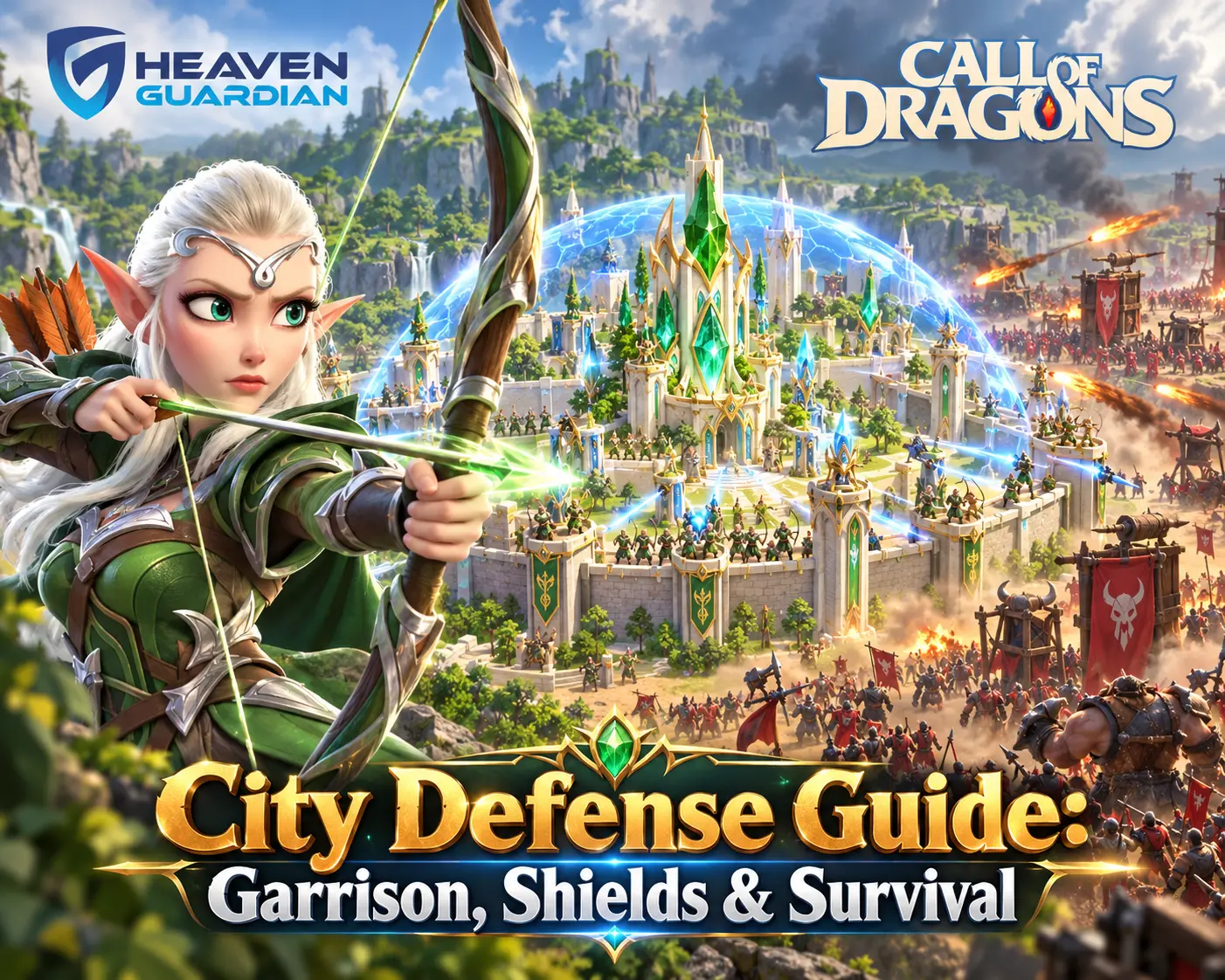
A strong Call of Dragons city defense is not simply about upgrading one building or keeping as many troops as possible at home. Your survival depends on where your city is located, your garrison setup, available troops, Alliance support, resources, defensive items, and whether defending the attack is even worth the losses.
That last point is particularly important. A well-developed garrison can make an attacker pay heavily, but most players should not try to absorb a powerful rally simply because their city can technically fight back.
This guide explains how to prepare your city, improve your garrison, protect resources, react to an incoming attack, and decide when shielding or repositioning is better than fighting.
How City Defense Works in Call of Dragons
When another player targets your city, your defense depends on your overall account and garrison setup rather than a manually arranged battlefield formation.
Several systems contribute to the result:
- Your selected garrison Heroes.
- The Skills and Talents supporting the garrison role.
- Your available troops.
- Hero and troop-type synergy.
- Artifacts and War Pets used with the defensive setup.
- Military Technology and general account progression.
- Alliance reinforcements and nearby allied players.
- Your ability to shield, relocate, or receive support before the attack arrives.
Therefore, upgrading the City Wall alone does not create an unbeatable defense.
Call of Dragons City Defense Priorities
| Priority | What to Check | Why It Matters |
| 1 | Alliance position | Nearby allies can react, reinforce, and pressure attackers |
| 2 | Garrison setup | Determines how effectively your city fights |
| 3 | Shield / relocation options | Can prevent an unnecessary defensive battle |
| 4 | Troops available | A city with its military elsewhere may be easier to pressure |
| 5 | Military Technology | Improves the combat strength behind your defense |
| 6 | Wall condition | Should be maintained after city attacks |
| 7 | Exposed resources | Reduces the economic value attackers can gain |
Build a Proper City Garrison
Your Call of Dragons garrison should be built around synergy rather than simply placing your two highest-Power Heroes together.
Look for Heroes whose current Skills and Talent Trees support defending cities or structures. Then consider whether their bonuses work with the troops available in your city.
Use Garrison-Focused Heroes
Some Heroes have Skills or Talent options specifically designed for Garrison combat.
These effects can provide defensive stats, damage bonuses, Skill improvements, damage reduction, or other advantages that matter far more while defending than in normal open-field combat.
However, Hero generations and balance change over time. Therefore, avoid investing purely because an old guide labels one pair the permanent best city defense.
Match Your Troops to the Garrison
Do not force an equal mix of Infantry, Cavalry, Marksmen, and Magic units simply because it sounds balanced.
If your garrison Heroes strongly improve a particular troop type, you want your available defense to benefit from those bonuses whenever possible.
By contrast, mismatched Hero and troop bonuses can leave much of your defensive investment unused.
Artifacts and War Pets Matter for City Defense
Modern Call of Dragons Hero development extends beyond Hero levels and Skills.
Your garrison can also benefit from the right Artifact and War Pet.
The ideal choices depend on the defensive Hero pair and troop type. For example, one garrison may gain more from survivability and defensive effects, while another performs better by increasing Skill damage or punishing attackers.
Therefore, avoid copying an Artifact simply because it performs well in open-field PvP. The best open-field equipment is not automatically the best defensive equipment.
Stay Close to Your Alliance
Your Alliance is one of your strongest forms of city defense.
An isolated city gives enemies more time to attack without interference. Meanwhile, a city surrounded by active Alliance members is much harder to pressure safely.
Good defensive positioning provides several benefits:
- Faster allied response.
- Easier reinforcement.
- More friendly Legions available to attack an enemy rally.
- Better warning when hostile players approach.
- Less opportunity for enemies to surround your city uncontested.
As a result, simply relocating closer to your active Alliance can improve survival more than a minor individual upgrade.
Use Alliance Reinforcements Early
If a serious enemy rally is forming, communicate before it reaches your city.
Your Alliance may be able to reinforce the city, pressure the rally, block enemy movement, or tell you that defending is a bad trade and you should shield instead.
Waiting until the attacker is already on top of your city reduces your options.
Follow Your Alliance’s War Calls
In organized wars, individual decisions affect other players.
If your leadership asks you to shield, relocate, reinforce another city, or bring your Legions into the field, follow the wider strategy rather than turning your city into an unnecessary personal last stand.
Use Peace Shields When Defending Makes No Sense
One of the most valuable defensive decisions is recognizing when not to fight.
If your current game state allows you to activate a Peace Shield, shielding can be far more efficient than absorbing a rally from an opponent your garrison cannot realistically handle.
This is especially useful when:
- You are about to go offline during a war.
- A much stronger enemy is targeting you.
- Your Alliance cannot reinforce in time.
- Your important Legions are away from the city.
- You are carrying more exposed resources than you want to risk.
- Your city is positioned too far from friendly support.
However, always check the current restrictions before planning around a shield because active combat and different scenario rules can affect your options.
When Should You Relocate Your City?
Relocation is another defensive tool.
If your city is sitting in an exposed position that your Alliance no longer controls, repeatedly defending it may accomplish very little.
Moving back toward the main Alliance group can protect you while also making your troops more useful in future battles.
Consider repositioning when:
- Your Alliance front line has moved.
- Your city has become isolated.
- Enemy players can surround you easily.
- Your Alliance cannot reinforce your location quickly.
- You are unlikely to stay online for the upcoming fight.
Protect Your Resources Before a City Attack
City defense is also an economic problem.
If you are holding more open resources than you need, an enemy has more reason to attack you.
A practical resource-defense routine includes:
- Upgrade your Storehouse as your city develops.
- Spend excess resources on useful buildings, Technology, and troop progression.
- Avoid opening large resource items before you actually need them.
- Do not maintain huge exposed stockpiles during an active war without a reason.
- Coordinate major upgrades around periods when you can protect the city.
Do Not Use “Ghost Storage” Myths
Sending a Legion on a long march does not magically move your city’s resource stockpile into that Legion.
Your troops and your stored resources are separate systems.
Therefore, protect resources through actual resource management, Storehouse protection, spending, inventory items, shielding, and safe positioning instead of relying on fake storage tricks.
Upgrade the City Wall, but Do Not Depend on It Alone
Your City Wall remains part of your overall city development and should not be neglected.
Keep it upgraded as required by your normal city progression and repair damage after attacks when necessary.
However, the Wall should be viewed as one layer of defense rather than the entire defensive strategy.
A player with a developed Wall but poor Heroes, weak Technology, no Alliance support, and a bad city position can still be an easy target.
Military Technology Is Part of Your Defense
City defense uses the same broader account strength you build for warfare.
As a result, troop development and relevant military Technology are long-term defensive investments.
Instead of chasing Power for its own sake, prioritize upgrades that strengthen the Legions and troop types you genuinely use.
A coherent military account usually defends better than an account whose resources have been spread across every possible unit type without a clear plan.
Keep Enough Troops Available During War
Your city is more vulnerable when your usable military strength is scattered across distant activities.
During a peaceful period, that may be fine. During active PvP, however, long gathering marches or distant PvE activity can leave you with fewer immediate options when enemies approach.
Before going offline during a conflict:
- Check your city location.
- Recall important Legions if they may be needed.
- Confirm your garrison configuration.
- Reduce unnecessary resource exposure.
- Check whether your Alliance expects fighting nearby.
- Use an appropriate shield if you cannot respond.
What to Do When an Enemy Rally Targets Your City
Do not panic and immediately start changing everything.
Use a simple decision process.
Step 1: Identify the Attacker
Check the rally leader and compare their apparent strength with your own defensive capabilities.
Step 2: Alert Your Alliance
Leadership may already have a plan for defending, reinforcing, countering, or avoiding the rally.
Step 3: Decide Whether the City Should Tank It
If the attacker dramatically outclasses your garrison, taking the hit simply to prove that you can defend is usually inefficient.
Step 4: Reinforce or Shield
If the fight is worthwhile, prepare the garrison and coordinate reinforcements. Otherwise, use your available defensive escape option before it is too late.
Step 5: Review the Battle Report
After a real defense, study what happened. Check which damage types hurt you, whether the garrison’s troop synergy worked, and whether the defensive trade was actually favorable.
City Defense vs Open-Field Defense
A strong city garrison does not necessarily mean the same Heroes should lead your open-field Legions.
Garrison Heroes can have bonuses that activate specifically while defending. Meanwhile, open-field commanders may prioritize mobility, range, control, AoE damage, or pursuit.
Therefore, treat city defense as its own role.
| Role | Main Priorities |
| City Garrison | Defense, survivability, garrison bonuses, troop synergy |
| Open Field | Mobility, range, damage, control, target selection |
| Rally Leader | Offensive rally bonuses, damage, durability, coordination |
| Reinforcement | Supporting the designated defender with appropriate troops |
Common Call of Dragons City Defense Mistakes
- Using the highest-Power Heroes automatically: Garrison synergy matters more than the Power number alone.
- Forcing a balanced troop mixture: Build around the bonuses of your actual garrison.
- Following an old permanent garrison tier list: New Hero generations, Artifacts, Pets, and balance changes can shift defensive options.
- Relying only on the City Wall: Defense also depends on troops, Heroes, Technology, positioning, and Alliance support.
- Trying to place traps manually: Call of Dragons city defense is not a trap-placement base-defense minigame.
- Using a front/middle/back troop formation: That is not how city garrison composition should be planned.
- Sitting outside Alliance support range: An isolated city is easier to pressure.
- Waiting too long to ask for reinforcements: Communicate as soon as a serious rally begins forming.
- Defending every rally: Sometimes shielding or moving is the better strategic choice.
- Holding unnecessary exposed resources: Spend or protect resources before major wars.
- Using an open-field build as your garrison without checking Skills: Defensive and field roles can require different setups.
- Ignoring War Pets and Artifacts: They are part of modern Hero optimization.
- Going offline during war without checking your city: Position, resources, troops, and shield status should be reviewed first.
FAQs
What is the best way to defend your city in Call of Dragons?
Use a properly synergized garrison, remain close to active Alliance support, maintain relevant Technology and troops, protect unnecessary resources, and shield or relocate when taking the fight would be inefficient.
What are the best garrison Heroes in Call of Dragons?
The answer changes as new Hero generations and balance updates arrive. Prioritize Heroes with strong current Garrison Skills or Talents and match them with the appropriate troop type, Artifact, and War Pet.
Should I use mixed troops for city defense?
Not simply for the sake of having every troop type represented. Your garrison should take advantage of the troop bonuses provided by your defensive Heroes and overall account progression.
Should I defend every city rally?
No. If the attacker is substantially stronger and your Alliance cannot support the defense, shielding or repositioning may preserve far more value.
Does upgrading the City Wall protect me from every attack?
No. The Wall is only one part of city progression. Your garrison, Heroes, troops, Technology, resources, Alliance position, and reaction to the attack are also important.
How do I protect resources during war?
Avoid maintaining unnecessary open stockpiles, upgrade your Storehouse, spend resources on useful progression, keep resource items unopened until required, and use shields or safer positioning when appropriate.
Can Alliance members help defend my city?
Yes. Alliance coordination is central to serious warfare, so communicate early when a rally is forming and follow your Alliance’s reinforcement or defensive instructions.
Should I use my open-field Heroes as my garrison?
Only if their Skills and Talents also support the defensive role. A strong open-field Hero is not automatically an effective city garrison commander.
Are traps part of Call of Dragons city defense?
You should not plan city defense around manually positioning traps or creating a trap layout. Focus instead on garrison strength, troops, account progression, Alliance support, and defensive positioning.
Conclusion
Strong Call of Dragons city defense comes from preparation rather than one Wall upgrade or one supposedly unbeatable Hero pair. Build a coherent garrison, stay near your Alliance, manage resources carefully, and respond to enemy rallies before they arrive.
Most importantly, know when not to defend. Preserving your army and repositioning can be more valuable than absorbing an unfavorable rally. For more strategy guides, browse the Heaven Guardian Call of Dragons guide collection.