
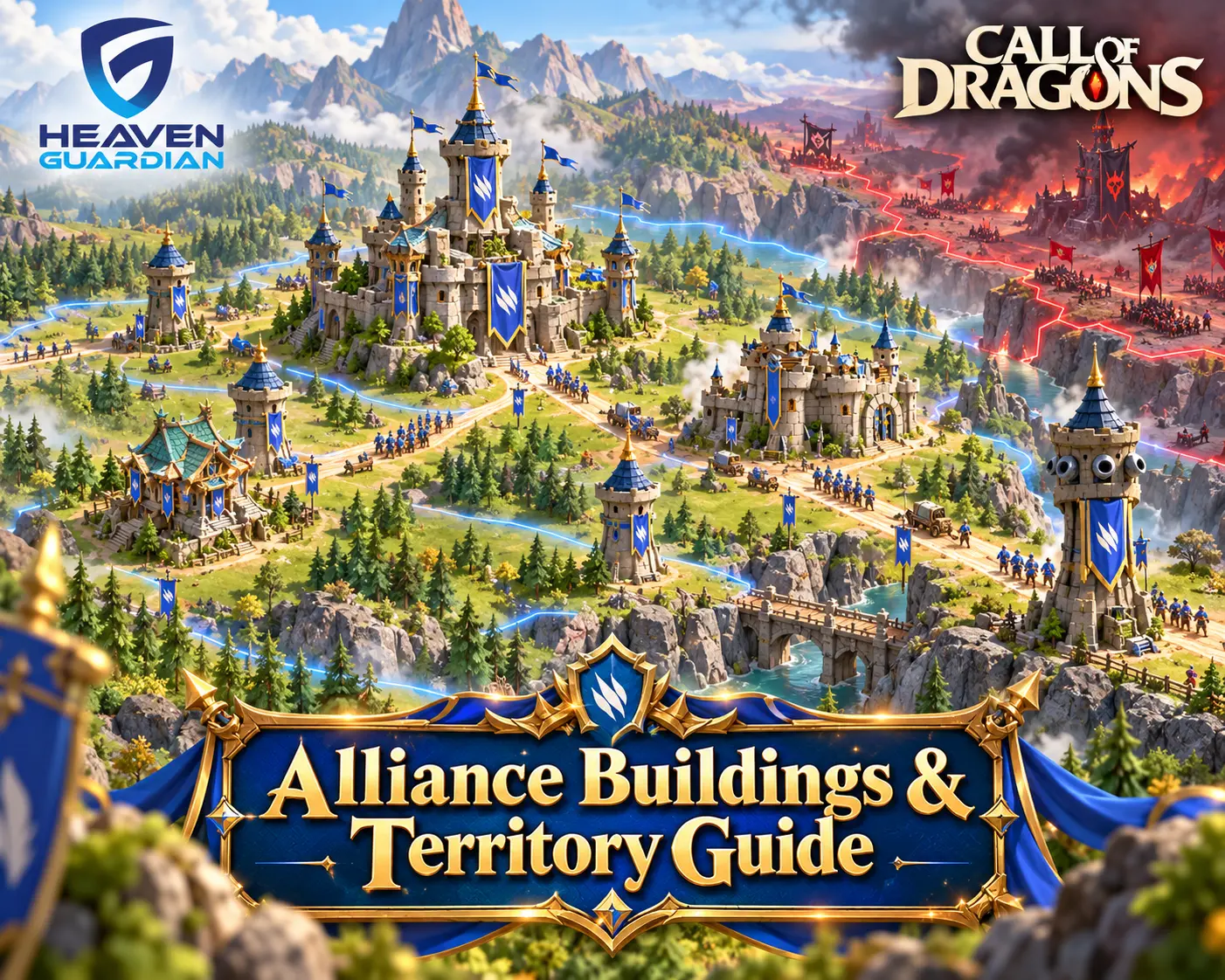
Alliance Territory at a Glance
| Structure | Primary Purpose |
|---|---|
| Alliance Fortress | Creates a major starting point for Alliance territory. |
| Alliance Tower | Expands territory and allows further Road and structure development. |
| Road | Connects Alliance structures and improves Legion movement. |
| Pass | Controls movement between Regions and becomes a major strategic objective. |
| Alliance Resource Center | Provides large shared gathering locations for Alliance members. |
| Alliance Siege Tower | Retains Tower functions while gaining the ability to damage nearby enemy Cities. |
| Alliance Keep | Provides a defensive position for Ranged Legions. |
| Village | Can provide Alliance effects, events, and resource resupply when incorporated into territory. |
| Alliance Siege Bastion | Seasonal structure that can expand territory, attack Alliance Buildings, and hold a garrison. |
How Alliance Territory Works in Call of Dragons
Alliance territory is created and expanded through connected Alliance structures. Your Alliance cannot simply place important buildings anywhere on the map without considering territory rules, structure ranges, Roads, Passes, and the current Season. A well-designed territory network gives members several strategic advantages:- Safer City placement inside valid Alliance territory.
- Faster gathering while gathering eligible resources within Alliance territory.
- Faster movement through connected and upgraded Roads.
- Access to strategic Passes and Regions.
- Alliance resource generation.
- Access to Villages and their Alliance benefits.
- Better defensive and offensive positioning during large wars.
Important: Building rules can differ between Home Realm, Pre-Strife, Season of Strife, and newer seasonal maps. Always check the current placement interface before committing Alliance resources.
Alliance Fortresses
Alliance Fortresses are fundamental territory structures. An Alliance Core Fortress establishes an important territorial anchor, while additional Fortresses can create new strategic starting points for expansion. Fortress placement should be planned carefully because surrounding territory can determine:- Where members can safely relocate.
- Which objectives can be reached with Towers and Roads.
- How quickly the Alliance can reinforce a contested front.
- Whether future territory expansion remains efficient.
- How vulnerable the Alliance becomes if a critical connection is lost.
Fortress Placement Strategy
Before choosing a location, Alliance leadership should ask:- Which Region or objective does this Fortress help us reach?
- Can Towers expand efficiently from this location?
- Can Roads connect it to the existing network?
- Can members relocate nearby without blocking key movement routes?
- How difficult would it be to defend if an enemy reaches the area?
Alliance Towers and Territory Expansion
Alliance Towers are one of the most important tools for expanding territory. Their placement determines how quickly your Alliance can reach strategic objectives and how efficiently members can move and gather. Alliance Towers can:- Extend Alliance territory.
- Create new positions from which Roads can be connected.
- Help reach Fortresses, Passes, Villages, and other Towers.
- Expand the protected and economically useful area available to members.
- Become part of the Alliance’s frontline during territorial wars.
Build Forward, Not Randomly
The strongest territory layouts use Towers to create a deliberate path toward the next objective. A common expansion sequence is:- Identify the target Pass, Village, choke point, or strategic location.
- Place the next Tower toward that objective.
- Assign enough builders to complete it efficiently.
- Connect the new area through Roads where appropriate.
- Move the frontline forward with another Tower.
- Repeat while maintaining a defensible territory network.
Alliance Roads and Why They Matter
Roads are a major part of Alliance logistics. Once completed, they connect important Alliance locations and increase the March Speed of Alliance Legions traveling along them. Roads can become extremely valuable during:- Pass captures.
- Territory expansion.
- Emergency reinforcements.
- Large open-field battles.
- Behemoth operations.
- Rapid movement between important Alliance structures.
Protect Important Road Connections
Roads depend on their connected structures. If an important endpoint becomes inactive or is lost, the connected Road can also become unusable or vulnerable. For this reason, the best Alliance layouts avoid depending on one fragile forward structure for all movement into a contested area.Call of Dragons Passes and Region Control
Passes control movement between Regions and are among the most important strategic objectives on the map. Normally, your Legions and City relocation are restricted by Pass ownership. Securing a Pass can therefore determine which Alliance enters a new Region first and how quickly it can establish territory on the other side. This is why Pass openings often become major Alliance operations rather than ordinary PvE fights.Before a Pass Opens
Good Alliances prepare before the Pass becomes available:- Position the rally host close to the objective.
- Select the strongest appropriate rally leader.
- Confirm which players will fill the rally.
- Keep builders ready for immediate expansion.
- Prepare Roads and construction routes.
- Keep Alliance resources available.
- Coordinate City relocation after new territory becomes valid.
What to Do Immediately After Capturing a Pass
Capturing the Pass is only the beginning. After gaining access:- Begin the first forward Tower immediately.
- Assign builders instead of letting everyone join random construction.
- Start the necessary Roads.
- Expand enough territory for member relocation.
- Secure useful terrain and choke points.
- Prepare for competing Alliances entering from other Passes.
- Continue building toward the next strategic objective.
How to Capture New Zones Efficiently
When a new Region becomes accessible, construction speed and organization can be just as important as combat power. Avoid having every member perform the same job. A strong expansion operation divides responsibilities.| Group | Primary Responsibility |
|---|---|
| Rally Team | Capture the Pass or objective as quickly as possible. |
| Builders | Immediately construct forward Towers and Roads. |
| Open-Field Team | Protect builders and stop enemy interference. |
| Relocation Group | Move Cities into useful positions once territory becomes available. |
| Leadership | Set markers, coordinate priorities, watch enemy expansion, and redirect members as conditions change. |
Alliance Siege Towers
An Alliance Siege Tower is an upgraded Alliance Tower that retains the normal Tower’s territorial functions while gaining the ability to attack nearby enemy Cities. Its attacks reduce the target City’s Durability. It does not directly defeat the City’s Garrison through its normal barrage. When a City’s Durability reaches zero, the City can be forced to relocate. This makes Siege Towers useful for:- Removing enemy Cities positioned near a frontline.
- Opening space around an important territorial objective.
- Applying pressure without relying exclusively on direct City attacks.
- Supporting a broader territorial push.
Siege Towers Are Not Siege Units
This distinction is important. Call of Dragons does not require you to train a separate troop class called “Siege Units” to destroy walls. The siege mechanic described here belongs to the Alliance building system. Your normal Legions still fight, reinforce, rally, and defend while the Alliance Siege Tower performs its structure-specific role.Alliance Siege Bastions
Alliance Siege Bastions are a newer seasonal Alliance structure designed specifically for territorial warfare. Unlike Alliance Siege Towers, which primarily pressure enemy Cities, Siege Bastions can:- Attack enemy Alliance Buildings.
- Expand Alliance territory.
- Hold garrisoned Legions.
- Operate as a fortified frontline position.
Best Siege Bastion Placement
Look for positions that:- Threaten a high-value enemy Alliance Building.
- Remain within reach of allied reinforcement.
- Extend useful territory rather than dead space.
- Create pressure around a choke point.
- Can be defended by nearby allied Legions.
- Force the enemy to respond instead of freely expanding elsewhere.
Alliance Keeps
Alliance Keeps are defensive structures built on valid Alliance territory. They are particularly useful at narrow terrain features where ranged fire can control an approach. Alliance members can place Ranged Legions in Keeps, allowing the structure to act as a defensive firing position. Good Keep locations include:- Narrow approaches.
- Steep terrain.
- Important forward Towers.
- Road intersections.
- Pass approaches.
- Areas where enemy melee Legions cannot easily surround the position.
Villages and Alliance Territory
Villages are more than decorative map locations. Extending your territory to a Village can bring it under Alliance control. Once integrated into the Alliance network, Villages can provide:- Special events.
- Alliance effects or buffs.
- Resource resupply.
- Additional strategic reasons to expand in a particular direction.
Alliance Resource Centers
Alliance Resource Centers provide large gathering locations for Alliance members and support Alliance economic development. Their main advantages include:- Large resource reserves.
- Convenient gathering for Alliance members.
- Less need to search constantly for individual resource nodes.
- Contribution to the Alliance’s wider resource economy.
How to Defend Alliance Territory
Territory defense is not simply a matter of stationing the strongest Legion at one Tower. The most effective defensive system combines:- Early information. Watch enemy movement and identify the actual target.
- Fast Roads. Reinforcements need to reach the threatened area quickly.
- Strong positioning. Fight around terrain, Keeps, and choke points rather than on open ground when possible.
- Ranged support. Use appropriate Ranged Legions from safe positions.
- Frontline protection. Keep durable Infantry between ranged damage dealers and enemy melee Legions.
- Reinforcement rotation. Replace weakened Legions rather than leaving them exposed until defeated.
- Alliance communication. Mark targets and avoid splitting damage across too many enemy Legions.
- Protection of critical connections. Losing one important Tower can affect more than the territory immediately around it.
How to Attack Enemy Alliance Territory
An organized territorial attack should have a strategic objective. Fighting purely for kills can consume Stamina, healing capacity, and time without changing the map. Before attacking, determine whether the objective is to:- Destroy or disable an important Alliance structure.
- Secure a Pass.
- Break a Road or territorial connection.
- Force enemy Cities away from a frontline.
- Reach a Village or Behemoth objective.
- Create territory for a Siege Bastion.
- Prevent an enemy Alliance from expanding into the next Region.
Focus the Objective
A common mistake is allowing the main force to chase low-HP enemy Legions away from the structure you are trying to capture or defend. Kills are useful only when they help accomplish the larger objective. Keep enough pressure on the building, rally, Pass, or construction point to prevent the enemy from recovering.Use Area Damage Carefully
Large territorial wars usually create dense formations. Area Hero Skill and Artifact damage can punish grouped enemies, but the same is true for your opponent. Avoid stacking every Legion directly on one point. Spread enough to reduce unnecessary multi-target damage while remaining close enough to focus the same priority targets.Best Troops for Alliance Territory Battles
There is no special “siege troop” category that should replace your normal battlefield formations. Territory wars use the same Infantry, Cavalry, Marksman, and Magic unit classes as other combat.| Unit Type | Typical Territory-War Role |
|---|---|
| Infantry | Frontline pressure, protection, garrisons, and durable objective fighting. |
| Cavalry | Flanking, interception, chasing, reinforcement disruption, and rapid repositioning. |
| Marksmen | Physical ranged pressure from behind the frontline or defensive positions. |
| Magic | Ranged Magic damage, area pressure, control, and focus-fire support depending on hero pairing. |
Best Alliance Territory Strategy for Members
Not every player needs to be an Alliance leader to contribute effectively. Regular members can help by:- Joining priority construction immediately.
- Following Alliance markers instead of selecting random targets.
- Keeping one strong formation available for emergency defense.
- Relocating only where leadership requests.
- Avoiding City placement that blocks useful Road or movement space.
- Joining designated rallies with compatible units.
- Reinforcing structures when requested.
- Reporting enemy movement before engaging alone.
Players evaluating established accounts for Alliance warfare can review a call of dragons account for sale that clearly lists troop tiers, developed heroes, Artifacts, War Pets, current Season, Alliance eligibility, and migration details. Verify every listing detail before deciding.
Common Alliance Territory Mistakes
- Building Towers without a destination: Every expansion should move toward a strategic objective.
- Ignoring Roads: Large territory is less useful when reinforcements take too long to cross it.
- Stopping after capturing a Pass: The real advantage comes from expanding quickly into the new Region.
- Sending every player into combat: Builders and logistical players are essential during expansion.
- Blocking Roads with poor City placement: Unplanned relocation can make Alliance movement less efficient.
- Using fictional siege units: Call of Dragons territory warfare uses normal troop classes plus Alliance structures such as Siege Towers and Siege Bastions.
- Ignoring structural connections: Losing a key territorial link can affect Roads and forward positions.
- Chasing kills away from an objective: Territory wars are won by accomplishing strategic objectives, not merely accumulating kills.
- Clumping every Legion together: Dense formations are vulnerable to area Hero Skill and Artifact damage.
- Using mixed troop Legions: Most combat builds perform better with one compatible troop class.
- Confusing Siege Towers with Siege Bastions: They are different Alliance structures with different purposes.
- Following outdated placement rules: Alliance building restrictions can change with updates and Seasons.