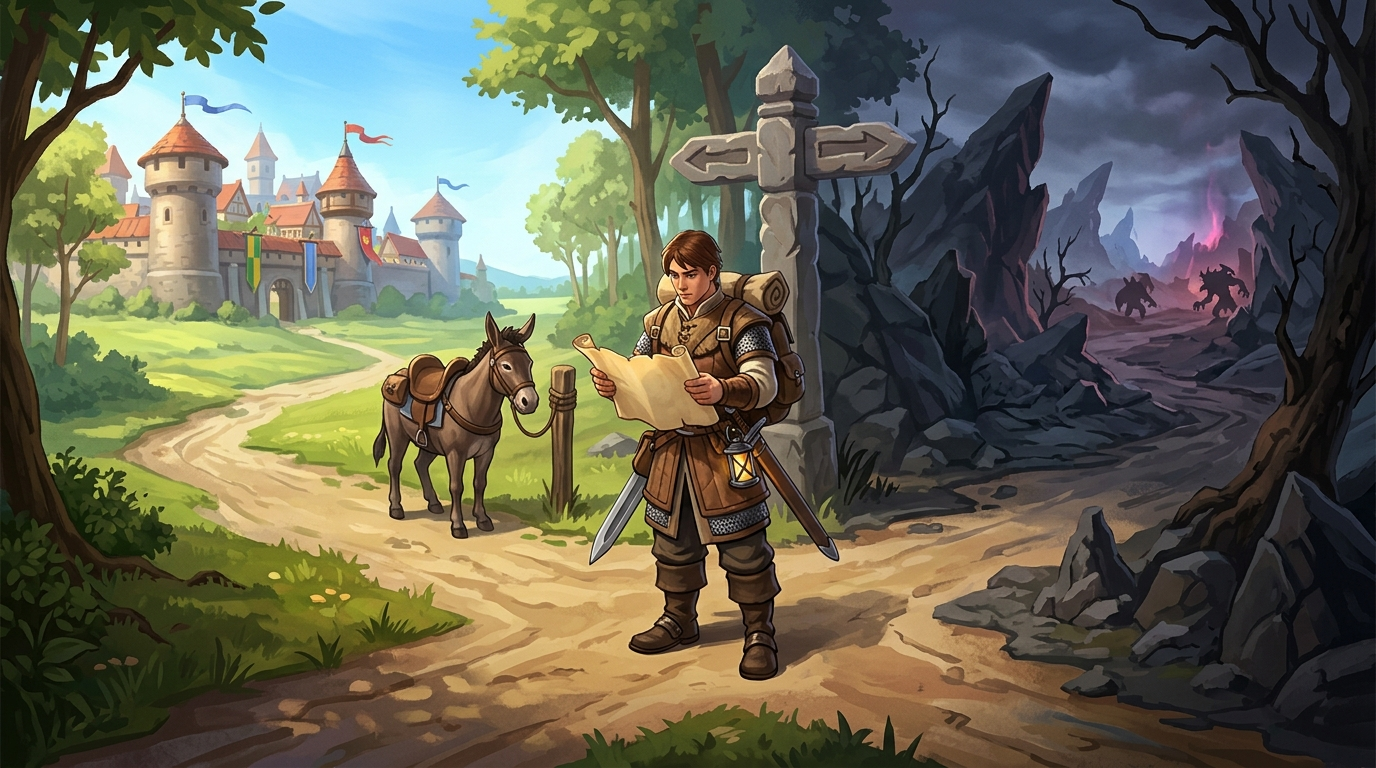
This Albion Online beginner guide 2026 explains what to do after the tutorial, how to choose a starting city, which equipment to use, how progression works, and when to enter dangerous zones.
Albion Online can feel confusing because it does not have traditional classes or a long main quest that carries you through the game. After completing the tutorial, you are free to gather, fight, trade, craft, join a faction, explore the Mists, or enter full-loot PvP areas.
That freedom is the main appeal of Albion, but it also causes many beginners to spend silver on the wrong equipment or spread their progression across too many activities.
The best early strategy is simple: choose one affordable combat build, establish one reliable silver method, learn the zone rules, and keep several replacement sets available before risking valuable equipment.
Finish the tutorial and Journal objectives, select the Royal City closest to your friends or preferred gathering resource, unlock Tier 4 equipment, choose one beginner build, and farm Fame and silver in Blue or Yellow Zones. Move into Red or Black Zones only when you can replace your complete set several times.
What Is Albion Online?
Albion Online is a sandbox MMORPG with classless combat, a player-driven economy, and open-world PvP.
Your character does not permanently become a warrior, mage, healer, archer, or tank. Your equipped weapon and armor determine your role.
Changing equipment changes:
- Your active abilities
- Your damage type
- Your defenses
- Your mobility
- Your healing and support options
- Your role in solo and group content
This system is commonly described as “you are what you wear.” One character can eventually learn every equipment, gathering, refining, and crafting line on the Destiny Board.
Albion Online Core Systems
| System | What It Means for Beginners |
|---|---|
| Classless combat | Your equipment determines your abilities and role. |
| Destiny Board | Tracks combat, gathering, crafting, refining, and farming progression. |
| Fame | Experience earned by completing the activity connected to a Destiny Board node. |
| Item Power | Represents the numerical strength of equipped gear. |
| Player economy | Equipment and resources are traded through local city markets. |
| Full-loot PvP | Equipment and inventory can be lost after death in lethal zones. |
| Local banks and markets | Items stored or sold in one city do not automatically appear in another. |
| Albion Journal | Provides objectives that introduce activities and progression systems. |
The Most Important Beginner Mindset
Albion Online should not be approached like a traditional MMORPG where the only goal is reaching maximum level.
There is no single character level. Every weapon, armor type, gathering profession, and crafting line has its own progression.
Your real progress includes:
- Weapon and armor specialization
- Reliable silver income
- Knowledge of equipment abilities
- Map and zone awareness
- Market knowledge
- Escape and survival skills
- Friends, guilds, and group experience
Better Beginner Decisions
| Common Mistake | Better Approach |
|---|---|
| Rush the highest gear tier possible | Use affordable equipment that can be replaced repeatedly. |
| Level every weapon equally | Test several weapons, then focus on one main family. |
| Avoid PvP forever | Practise in non-lethal Arena and Yellow Zone content. |
| Treat every death as a failure | Use cheap sets and treat deaths as controlled learning costs. |
| Spend all available silver on one set | Keep several complete replacement sets in storage. |
The strongest early habit is asking one question before leaving a city:
Can I afford to lose this complete set?
What to Do After the Albion Online Tutorial
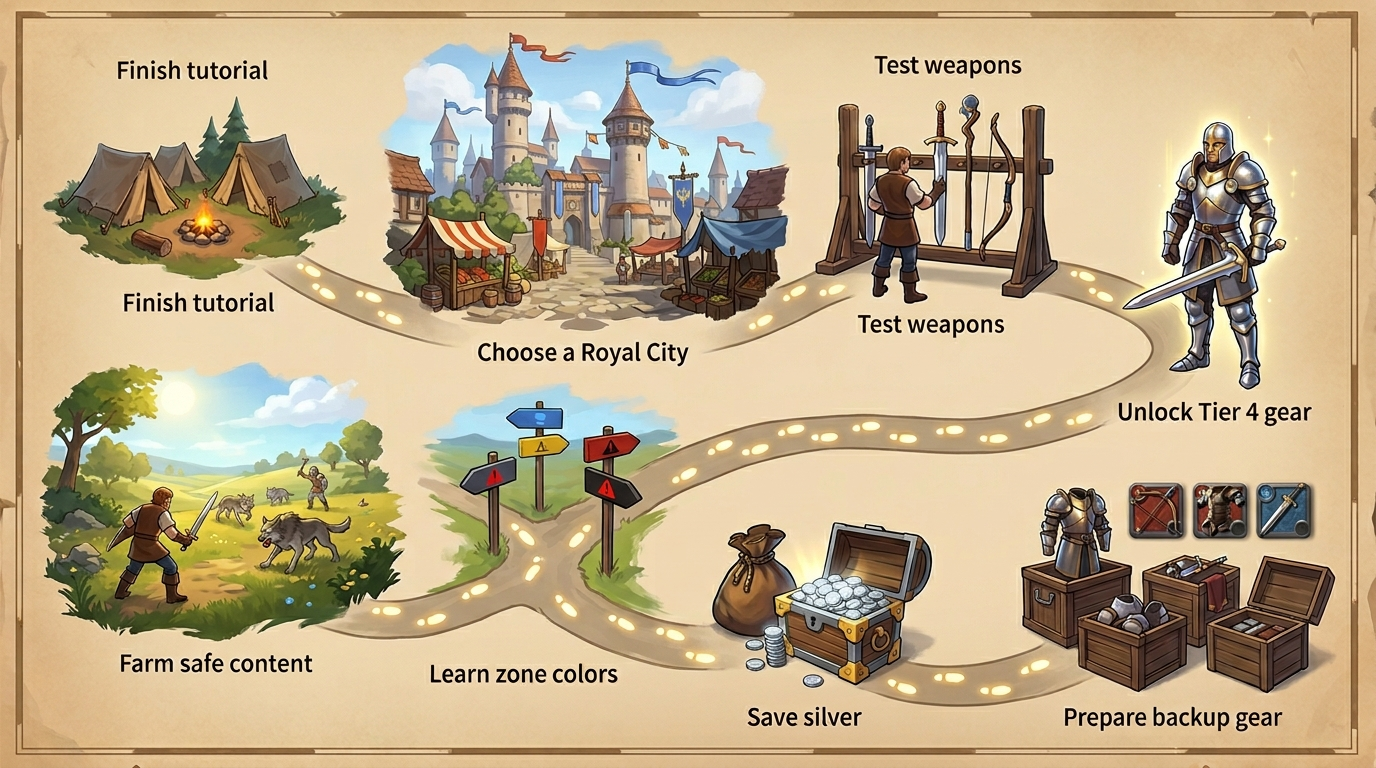
After completing the tutorial, follow the early objectives shown through the Albion Journal and HUD tracker.
These objectives introduce:
- Gathering and tools
- Crafting stations
- Equipment and abilities
- The Destiny Board
- Markets and banks
- Combat and open-world activities
Beginner Starting Roadmap
- Finish the tutorial.
- Select a starter town and nearby Royal City.
- Complete the early Journal objectives.
- Try several basic weapon families.
- Unlock Tier 4 equipment.
- Choose one affordable beginner build.
- Farm Combat Fame and silver in safe content.
- Learn the zone-color rules.
- Store several replacement sets in your home city.
- Practise non-lethal PvP before entering full-loot zones.
Do Not Stay in the Starter Town Too Long
Starter towns are useful for early quests, gathering, and basic crafting. The nearby Royal City provides a larger market, more equipment options, banks, islands, faction activities, and better access to the wider world.
Move to the Royal City after understanding the initial systems and unlocking your first practical build.
Best Starting City in Albion Online for Beginners
There is no permanent best starting city for every beginner.
Your first choice determines which starter town and biome you enter, but it does not permanently lock your character to that region. You can relocate later.
The five starter-town paths are:
| Starter Town | Nearby Royal City | Biome | Primary Resource |
|---|---|---|---|
| Forest Cross | Lymhurst | Forest | Wood |
| Highland Cross | Martlock | Highland | Stone |
| Mountain Cross | Fort Sterling | Mountain | Ore |
| Steppe Cross | Bridgewatch | Steppe | Hide |
| Swamp Cross | Thetford | Swamp | Fiber |
How to Choose Your Starting City
Use the following priority:
- Friends or guild: Start near people who can help you.
- Preferred gathering resource: Choose the biome containing the resource you want to level.
- Faction preference: Choose a city whose Faction Warfare community interests you.
- Market and activity: Choose a city where you plan to buy and sell regularly.
Do not choose Caerleon as a fresh beginner base. It is surrounded by Red Zones and is better approached after learning full-loot transport and PvP risk.
Your Starting City Is Not Permanent
You can travel to another city later, but banks and markets are local.
Before relocating:
- Sell equipment you do not need.
- Transport only what is worth moving.
- Buy replacement equipment in the destination city when cheaper.
- Remember that personal-island location and market prices may affect the decision.
Albion Online Progression Explained
Progression is based on performing activities while using the related equipment or tool.
Examples:
- Defeating PvE enemies with a sword progresses combat nodes related to that sword and your equipped armor.
- Gathering ore progresses mining nodes.
- Crafting bows progresses the related crafting line.
- Refining hide progresses leather-refining nodes.
You can eventually progress every line on one character, but beginners should not attempt to level everything simultaneously.
Main Progression Paths
| Progression Type | How It Progresses | Beginner Recommendation |
|---|---|---|
| Combat | Defeat PvE enemies and use applicable Tomes or Fame Credits. | Focus on one weapon family and one armor setup. |
| Gathering | Collect resources with the matching tool. | Choose one primary resource. |
| Refining | Convert raw resources into refined materials. | Learn city bonuses before investing focus. |
| Crafting | Produce equipment, consumables, and other items. | Delay large batches until you understand market margins. |
| Farming | Use a personal or guild island for crops, herbs, and animals. | Treat it as an optional economic activity. |
| PvP knowledge | Practise matchups, positioning, and cooldown timing. | Begin in non-lethal content with inexpensive gear. |
Best Early Progression Strategy
Combine one combat build with one silver-making method.
For example:
- Combat plus gathering
- Combat plus Faction Warfare
- Combat plus open-world mob farming
- Combat plus basic market trading
Add crafting, refining, islands, and additional weapon families after your first build and income source become reliable.
Destiny Board, Fame, and Specialization
The Destiny Board is Albion Online’s progression tree.
It contains nodes for:
- Combat equipment
- Gathering tools
- Gathering specialization
- Refining
- Crafting
- Farming
- Adventurer progression
Important Progression Terms
| Term | Meaning |
|---|---|
| Fame | Experience applied to the relevant Destiny Board nodes. |
| Mastery | Broad progression that unlocks equipment tiers and related bonuses. |
| Specialization | Focused progression for a specific weapon or equipment item. |
| Learning Points | Accelerate eligible nodes after part of the Fame requirement is completed. |
| Combat Fame Credits | Progress other combat nodes after earning Fame through sufficiently developed equipment. |
How Beginners Should Use Learning Points
Learning Points are limited and should not be spent automatically on every available node.
Strong uses include:
- Unlocking higher gathering tiers
- Accelerating a slow profession you are committed to
- Progressing a combat line you are confident you will continue using
Combat Fame can be farmed repeatedly, so many players reserve a large portion of Learning Points for gathering progression.
Disable automatic Learning Point use until you understand which nodes matter to your plan.
Item Power, Gear Tiers, and Enchantments
Item Power represents the strength of equipped gear.
It is influenced by:
- Equipment tier
- Enchantment level
- Item quality
- Mastery
- Specialization
- Related equipment-family progression
Gear Enchantment Levels
- .0: Flat equipment
- .1: Uncommon enchantment
- .2: Rare enchantment
- .3: Exceptional enchantment
- .4: Pristine enchantment
Lower-tier enchanted equipment can have similar base power to higher-tier flat equipment.
This makes Tier 4.1 and Tier 5 equipment practical starting points for many beginners.
Why Tier 4.1 Is Popular
Tier 4.1 equipment is often:
- Affordable
- Widely available
- Strong enough for early PvE
- Useful for learning lethal zones
- Easy to replace after a death
It is not automatically the cheapest option on every market. Compare Tier 4.1, Tier 5, and similar effective-tier combinations before buying.
For a full explanation of weapons, armor classes, boots, capes, mounts, and Item Power, read the Albion Online gear guide.
Best Beginner Builds in Albion Online 2026
There is no universal best beginner build. The strongest choice is a weapon you enjoy that also provides reasonable PvE clearing, survival, and affordable equipment.
Beginner Build Priorities
A practical starter build should have:
- Simple abilities
- Reliable damage
- Some healing or defense
- Manageable energy use
- At least one mobility option
- Low replacement cost
Beginner-Friendly Weapon Families
| Weapon | Main Strength | Recommended For |
|---|---|---|
| Battleaxe | Damage and self-sustain | Solo PvE and melee beginners |
| Nature Staff | Strong healing and safe PvE | Players who value sustain |
| Light Crossbow | Ranged burst and area damage | Ranged PvE players |
| Spear | Range, flexibility, and mobility | Solo players learning spacing |
| Bow | Ranged sustained pressure | Players who prefer kiting |
| Fire Staff | Direct magical damage | Damage-focused ranged players |
| Holy Staff | Group healing | Players planning to join group content |
Default Beginner Battleaxe Build
| Slot | Example Item | Purpose |
|---|---|---|
| Weapon | Battleaxe | Damage and self-healing |
| Off-Hand | Torch | Accessible offensive support |
| Helmet | Scholar Cowl or Hunter Hood | Energy management or defensive reflection |
| Armor | Mercenary Jacket | Healing through repeated damage |
| Boots | Soldier Boots | Movement and recovery |
| Cape | Regular Cape | Keeps the first set inexpensive |
| Food | Affordable damage or sustain food | Improves clearing or recovery |
| Potion | Healing Potion | Emergency health recovery |
This is a learning setup, not a permanent meta recommendation. Use the Armory to compare current activity-specific builds and adjust the equipment according to your budget.
How to Use the Armory in 2026
The Armory provides build recommendations generated from current player data for supported activities.
Beginners can use it to:
- Find commonly used builds for an activity
- See which equipment pieces are normally paired together
- Compare alternative abilities
- Understand the expected cost of a complete setup
- Save a build as a loadout
Do Not Copy Builds Blindly
A recommended build may assume:
- Higher specialization
- Experienced ability timing
- A coordinated group
- A larger replacement budget
- A specific matchup or activity
Use the Armory as a starting point. Replace expensive artifact items with affordable alternatives while learning.
Optional progression consideration: Players comparing established equipment specialization, unlocked gathering tiers, available silver, and existing character progression can review the included details of an Albion Online account for sale. Existing progression can reduce early setup time, but understanding zone risk and equipment abilities remains essential.
Albion Online Zone Colors and PvP Risk
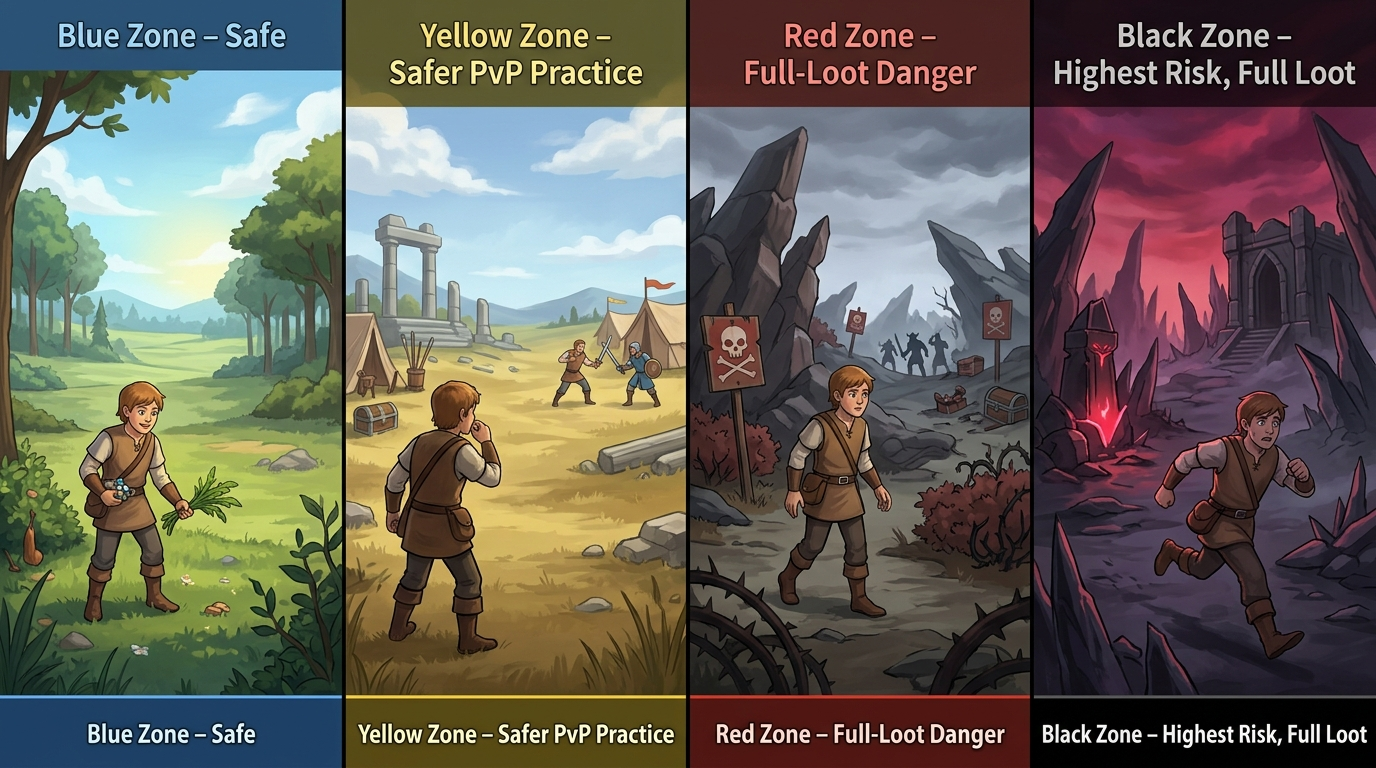
Understanding zone colors is one of the most important beginner skills.
| Zone Type | PvP Rules | Equipment Loss | Beginner Use |
|---|---|---|---|
| Blue Zone | No hostile open-world PvP | No full-loot loss | Learning controls and basic systems |
| Yellow Zone | Optional hostile PvP with knockdowns | Equipped gear is retained | Faction play and non-lethal open-world practice |
| Red Zone | Full-loot PvP with reputation rules | Equipment and inventory can be lost | First lethal-zone experience with visible hostile count |
| Black Zone | Unrestricted full-loot PvP | Equipment and inventory can be lost | Higher-risk progression after learning survival |
| Orange Ruleset | Used in the Depths | Equipped gear is retained, carried inventory can be lost | Extraction-style PvPvE after learning a build |
Beginner Zone Progression
- Learn abilities and movement in Blue Zones.
- Practise Faction Warfare and PvP awareness in Yellow Zones.
- Buy several inexpensive replacement sets.
- Try a Red Zone route while monitoring the hostile-player count.
- Use cheap equipment for your first Black Zone sessions.
Never enter a lethal area because a guide describes it as profitable. Enter only when the possible reward justifies losing the complete set.
Best Fame Farming Method for Beginners in 2026
Beginners should start with open-world PvE mobs because they provide Combat Fame, silver drops, and build practice without requiring a group.
Safe Beginner Fame Farming
Blue and Yellow Zone mobs are useful for:
- Learning ability rotations
- Unlocking Tier 4 equipment
- Testing sustain and energy use
- Building a small silver reserve
Faster Solo Progression
Once you understand the build, inexpensive open-world Black Zone farming can provide stronger progression.
The S.A.F.E. Portal can send solo players to a random Outlands destination and provide a temporary return route. The destination remains full-loot, so use inexpensive equipment and return before your inventory becomes too valuable.
Other Beginner Fame Options
- Solo dungeons for predictable PvE practice
- Non-lethal Mists for mixed solo content
- Knightfall Abbey after learning PvP awareness
- The Depths for equipment-safe extraction-style PvPvE
- Group dungeons with a guild or organized party
For builds, Combat Fame Credits, Satchels, Auto-Respec, and detailed solo and group methods, read the Albion Online fame farming guide.
How Beginners Make Silver
Silver allows you to replace equipment, purchase consumables, experiment with builds, and recover after a death.
The best beginner silver method is one you can repeat without investing your complete balance.
| Method | Starting Risk | Main Benefit |
|---|---|---|
| Open-world mobs | Low to high | Combat Fame and silver together |
| Gathering | Low to high | Steady materials with low starting capital |
| Faction Warfare | Low in Yellow Zones | Faction Points and PvP practice |
| Solo dungeons | Low to high by zone | Predictable PvE and occasional loot |
| Mists | Non-lethal or lethal | Mixed solo objectives, mobs, and resources |
| Market trading | Financial risk | No combat required |
| Crafting and refining | Market-dependent | Long-term specialization potential |
Beginner Silver Rules
- Keep several replacement sets in your bank.
- Sell unused loot instead of storing everything.
- Do not buy an expensive mount on the first day.
- Check market prices before crafting or refining.
- Do not invest all silver in one trade.
- Include food, potion, cape, bag, and mount in the set cost.
Gathering for Beginners
Gathering is accessible because it requires little initial capital and teaches map awareness.
The five primary open-world resources are:
- Wood, gathered with an Axe
- Ore, gathered with a Pickaxe
- Hide, gathered with a Skinning Knife
- Fiber, gathered with a Sickle
- Stone, gathered with a Stone Hammer
Beginner Gathering Strategy
- Choose the primary resource near your Royal City.
- Use the highest tool you can afford to replace.
- Focus on one profession rather than carrying every tool.
- Unlock the matching gathering set from Tier 4.
- Bank before becoming overloaded.
- Move into lethal zones only after learning escape mechanics.
For profession comparisons, biomes, equipment, food, mounts, Black Zone routes, and profitability, read the Albion Online gathering guide.
Crafting and Refining for Beginners
Crafting and refining can be profitable, but they are not guaranteed silver methods.
Profit depends on:
- Material prices
- City production bonuses
- Station fees
- Focus
- Specialization
- Returned materials
- Market taxes
- Sales volume
Beginner Crafting Advice
- Do not craft random equipment only to sell it.
- Calculate material and station costs first.
- Test a small batch before scaling.
- Choose one crafting or refining line.
- Learn the correct production city.
- Do not assume gathered materials are free.
For crafting stations, city bonuses, focus, journals, quality, and profit calculations, read the Albion Online crafting guide.
Best Content for New Players
| Content | What It Teaches | When to Try It |
|---|---|---|
| Open-world mobs | Build rotation, Fame farming, and movement | Immediately after unlocking a build |
| Solo dungeons | Predictable PvE and boss mechanics | First several sessions |
| 1v1 Arena | Solo matchups and cooldown timing | After learning the weapon abilities |
| 5v5 Arena | Group roles, positioning, and objectives | After completing a basic group build |
| Yellow Zone Faction Warfare | Open-world group movement and PvP awareness | Early progression |
| Non-Lethal Mists | Solo objectives, exploration, and player awareness | After learning zone and equipment basics |
| The Depths | Extraction decisions and PvPvE | After developing a balanced build |
| Red and Black Zones | Full-loot survival and higher-risk progression | After preparing replacement sets |
How Beginners Should Practise PvP
PvP knowledge is valuable even when your main activity is gathering or PvE. Many high-value areas allow other players to attack you.
Start With Non-Lethal PvP
Use:
- 1v1 Arena
- 5v5 Arena
- Crystal Arena
- Yellow Zone Faction Warfare
- Duels with inexpensive equipment
- Non-lethal Mists
Basic PvP Survival Skills
- Inspect enemy equipment when safe.
- Learn which armor ability the enemy is using.
- Keep one defensive or movement ability available.
- Do not activate every cooldown simultaneously.
- Watch the edge of the screen for additional players.
- Move away after being repeatedly inspected or followed.
- Do not chase an enemy into unknown terrain.
When to Try Lethal PvP
Enter lethal PvP when:
- You understand your abilities.
- You know the zone rules.
- You have several replacement sets.
- Losing the set will not remove your complete silver balance.
- You are prepared to leave an unfavorable fight.
Faction Warfare for Beginners
Faction Warfare provides structured objectives on the Royal Continent.
It can include:
- Capturing and defending objectives
- Following faction groups
- Earning Faction Points
- Participating in province battles
- Attacking or defending fortresses
- Completing faction-related open-world activities
Why Faction Warfare Helps Beginners
- It provides visible objectives.
- You can follow experienced players.
- Yellow Zone participation is non-lethal.
- It teaches group movement and positioning.
- Faction Points provide additional reward value.
Begin in Blue and Yellow Zones. Red Zone faction fighting is full-loot and should be attempted with replaceable equipment.
Should Beginners Join a Guild?
A good guild can accelerate progression by providing:
- Build advice
- Group dungeons
- Faction groups
- Roads of Avalon content
- Gathering and transport support
- Access to guild infrastructure
- Players who can explain mistakes
Choose a Beginner-Friendly Guild
Before joining, ask:
- Which server and time zone is most active?
- Does the guild accept new players?
- What content does it run?
- Are there mandatory activities?
- Does it require expensive equipment?
- How does it handle guild taxes?
- Does it provide approved builds?
Avoid guilds that pressure beginners to donate expensive items, transport unknown cargo, or wear equipment they cannot replace.
First Week Progression Plan
| Day | Main Goal |
|---|---|
| Day 1 | Finish the tutorial, follow Journal objectives, and choose a Royal City. |
| Day 2 | Try several weapon families and select one main build. |
| Day 3 | Farm open-world mobs and unlock the required Tier 4 equipment. |
| Day 4 | Choose gathering, faction activities, or another repeatable silver method. |
| Day 5 | Practise combat in Arena or Yellow Zone faction content. |
| Day 6 | Prepare several affordable Tier 4.1 or Tier 5 replacement sets. |
| Day 7 | Try a Red Zone, S.A.F.E. Portal route, lethal Mist, or beginner guild activity with cheap gear. |
This schedule is flexible. A player who enjoys gathering may spend more time developing tools, while a PvP-focused player may spend more time in Arena and Faction Warfare.
Daily Beginner Checklist
- Check the Albion Journal for useful objectives.
- Repair damaged equipment.
- Confirm the correct abilities before leaving town.
- Farm Fame on the main build.
- Complete one repeatable silver activity.
- Sell or organize unused loot.
- Check Destiny Board progress.
- Replace consumables.
- Keep backup equipment ready.
A focused 30-minute session can produce more useful progress than several hours of switching randomly between activities.
Albion Online Returning Player Guide 2026
Returning players should not immediately equip an old expensive build and enter lethal content.
Returning Player Checklist
- Open the Albion Journal and review new progression categories.
- Check the Armory for current activity-specific builds.
- Inspect each ability on your old equipment.
- Check current market prices before replacing a set.
- Practise the build in 1v1 Arena or other non-lethal content.
- Review the current Faction Warfare province and fortress systems.
- Prepare an inexpensive version of the old build.
- Enter lethal content only after rebuilding mechanical confidence.
Do Not Assume the Old Meta Is Current
Balance patches can change:
- Weapon damage
- Cooldowns
- Armor abilities
- Consumables
- Popular counters
- Group compositions
Use the Armory and recent activity data as references, then test the build before making an expensive purchase.
Common Albion Online Beginner Mistakes
- Buying high-tier equipment immediately: Expensive gear does not replace game knowledge.
- Ignoring the Albion Journal: You miss structured objectives and useful rewards.
- Spreading Fame across every weapon: No equipment line develops useful specialization.
- Spending Learning Points randomly: Important progression becomes slower later.
- Entering lethal zones accidentally: Equipment and inventory may be lost.
- Keeping no replacement sets: One death stops further progression.
- Crafting without calculations: Material and station costs can exceed the selling price.
- Using the same equipment for every activity: PvE, PvP, gathering, and transport require different tools.
- Ignoring food and potions: The build is incomplete without consumables.
- Following players into unknown routes: The path may lead toward allies or a gank group.
- Carrying too much loot: Greed turns a profitable session into a complete loss.
- Joining the wrong guild: Mandatory costs may exceed the support provided.
Albion Online Beginner FAQ
Is Albion Online beginner-friendly in 2026?
Yes. The Albion Journal, improved early-game objectives, Armory, and non-lethal Arena options make the main systems easier to learn. The game still requires players to understand full-loot risk and local markets.
What should I do first in Albion Online?
Finish the tutorial, follow the Journal objectives, choose a Royal City, unlock Tier 4 equipment, select one beginner build, and begin earning Combat Fame and silver.
What is the best starting city for beginners?
The best city is normally the one closest to your friends, guild, or preferred gathering resource. Lymhurst connects to wood, Martlock to stone, Fort Sterling to ore, Bridgewatch to hide, and Thetford to fiber.
What is the best beginner build?
A Battleaxe, Torch, Mercenary Jacket, suitable defensive helmet, and Soldier Boots provide an accessible combination of damage, healing, and mobility. Nature Staff, Light Crossbow, Spear, Bow, and Fire Staff are also practical choices.
How should beginners make silver?
Begin with open-world mobs, gathering, Yellow Zone Faction Warfare, solo dungeons, or another repeatable activity. Avoid investing all available silver in crafting or market speculation.
Should beginners enter the Black Zone?
Yes, after learning zone rules and preparing several inexpensive replacement sets. Start with cheap equipment and treat every item taken into the Black Zone as potentially lost.
What is the fastest beginner Fame farm?
Open-world mobs provide accessible Combat Fame. Yellow Zones are safer for learning, while inexpensive Black Zone farming through a S.A.F.E. Portal can provide faster progression after you understand survival.
What should a returning player do first in 2026?
Review the Journal, inspect current abilities, check the Armory, practise in non-lethal Arena, verify market prices, and rebuild confidence with an inexpensive set before entering full-loot content.
Conclusion
This Albion Online beginner guide 2026 provides a foundation for starting without wasting silver or progression.
Follow the Journal, choose a Royal City that supports your goals, unlock Tier 4 equipment, and focus on one affordable build. Combine Combat Fame with one reliable silver method and keep replacement sets available before entering lethal zones.
Use the Armory to research current builds and 1v1 Arena to practise matchups without losing equipment. Develop gathering, crafting, refining, and additional weapon lines after your first progression path becomes stable.
The goal is not to reach the highest gear tier immediately. Build specialization, understand equipment abilities, learn when to leave dangerous situations, and use equipment you can afford to replace.
For more beginner advice, weapon builds, gathering strategies, Fame farming methods, and economy guides, explore the Albion Online guides on Heaven Guardian.